
Lieferung heute & morgen

Qualitätsgarantie

Willkommens-Angebote freischalten: KOSTENLOSE Lieferung | Bis zu 80 % RABATT | Kostenlose 30-Tage-JoyPlus-Testphase
App herunterladen
Whether you are slicing bread, vegetables, fruit, cheese, eggs or cured meats, mandoline slicers and food slicers can make food preparation much easier. However, these appliances differ considerably in terms of the foods they can process, operation, materials and cleaning. An electric food slicer is not automatically suitable for every type of vegetable, while a mandoline cannot replace a bread slicer.
For home cooks, families, meal-prep enthusiasts and hosts, the focus should therefore not be on having as many functions as possible. What matters is whether the kitchen slicer fits your actual routine and can be cleaned safely and thoroughly.
Names such as multifunction slicer, vegetable slicer or vegetable chopper sound versatile. In practice, however, a device may be limited to certain foods. An egg slicer, for example, is designed for soft, cooked foods, while a cheese slicer produces thin slices of cheese. Hard or frozen foods and bones are expressly unsuitable for many manual slicers.
Before buying, you should therefore check:
Sharp blades and cutting wires make food preparation easier, but they also increase the risk of injury if the device is used carelessly. A hand guard, non-slip base or sturdy locking mechanism are therefore important features.
When using a mandoline, vegetables should ideally be guided with the holder supplied. The last pieces of onions, potatoes or cucumbers should not be pushed towards the blade by hand. With a manual charcuterie slicer, you should also ensure that the blade is cleaned carefully after use and stored safely.
Small gaps, permanently attached blades and difficult-to-reach collection containers can make everyday use more difficult. You should therefore check whether the parts are removable, whether the product is dishwasher-safe and how much space it requires in your kitchen cupboard.
The specifications are not consistent: the 5five mandoline is described as dishwasher-safe, while the two Leifheit egg slicers should only be cleaned by hand according to the product details. These differences are more relevant to your buying decision than a long list of advertised functions.
With an electric food slicer, adjustable slice thickness is a key parameter. According to the product description, the Ritter Sono¹ model has a serrated blade and can make cuts ranging from wafer-thin to approximately 20 mm. The carriage has an 18 cm cutting length. This is useful for bread, fruit and vegetables, but does not by itself indicate whether particularly large or hard foods can be processed.
With a vegetable slicer, on the other hand, the available cutting styles and the way the food is guided are important. Even slices or julienne strips are useful for meal preparation. If you mainly prepare onions, potatoes and cucumbers, you may not need a separate vegetable chopper.
Stainless steel kitchen tools are widely used for blades and cutting wires because the material is corrosion-resistant and suitable for food preparation. However, the product description “stainless steel” does not necessarily refer to the entire housing. On the 5five mandoline, the blade is made from stainless steel, while the holder is made from ABS plastic.
Wood can also be a practical choice, for example in an integrated chopping board. The charcuterie slicer combines stainless steel and wood. Wooden surfaces should be dried thoroughly after washing so that they do not remain damp for long periods.
A good kitchen slicer should remain stable during use. Look for:
Electric appliances also require a safe on/off switch. The Ritter Sono¹ is described as having a safety push-button switch and a continuous-operation switch. A removable food carriage can make cleaning easier.
The following selection categorises products according to specific usage situations. The information is based on the respective product descriptions and does not replace checking the individual user manual.
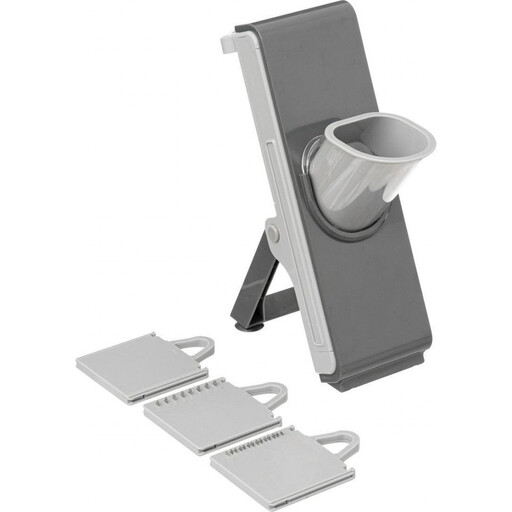
Why this product suits this profile: This manual mandoline can slice, grate and chop, without requiring a power socket or an additional motor. It is therefore suitable for smaller kitchens and occasional food preparation.
The product description lists specific functions and includes a finger guard. The model is also described as dishwasher-safe.
Stainless steel blades, three listed functions, included pushers and compact dimensions of 26.5 x 15 x 9.5 cm.

Why this product suits this profile: If you regularly slice bread, fruit or vegetables and want the convenience of electric operation, this food slicer offers adjustable slice thickness and a removable carriage.
The description specifies a cutting range of up to approximately 20 mm, an 18 cm cutting length, plus safety and continuous-operation switches instead of making only general claims about its functions.
Electric ECO motor, serrated blade, safety glass base and manufacturing described as taking place in Germany.
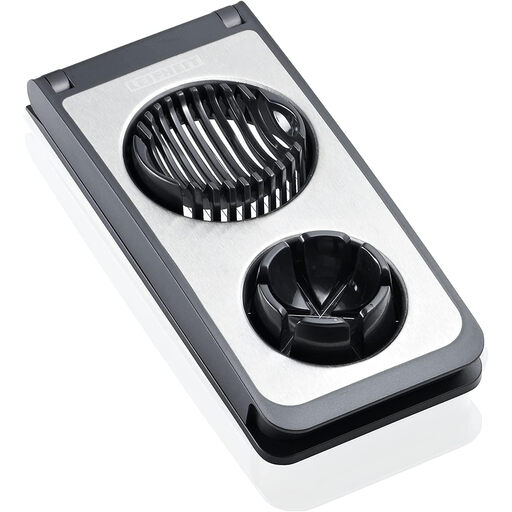
Why this product suits this profile: For breakfasts, buffets and hosts who regularly want to cut eggs, kiwis or boiled potatoes into uniform shapes, a specialised egg slicer is more practical than a large multifunction slicer.
The three functions are clearly specified: round slices, oval slices and wedges. According to the description, the wires are made from rust-resistant stainless steel.
Sturdy stainless steel housing, foldable mechanism and dimensions of 14 x 4 x 24.5 cm. According to the product details, it should be cleaned by hand.
We have put together a complete, regularly updated list of products that fully meet these strict selection criteria and the safety regulations applicable in the EU.
A vegetable slicer or mandoline is usually operated manually and is designed for vegetables, fruit and, in some cases, cheese or boiled potatoes. An electric food slicer is powered by a motor and, depending on the blade and design, may also be suitable for bread, cured meats or larger foods. Before buying, compare the blade type, slice thickness and permitted foods.
Its lifespan depends on the quality of the blades, frequency of use, cleaning and storage. Stainless steel blades should be stored dry after cleaning. Blunt or damaged blades must not be used any further. For electric appliances, repair-friendly designs and available replacement parts may be important for long-term use.
A manual vegetable slicer does not incur any electricity costs. An electric food slicer uses energy while operating; the actual cost depends on its power rating, usage time and electricity tariff. For occasional slicing, energy consumption is usually less important than safe operation, ease of cleaning and the space available on your worktop.