
Lieferung heute & morgen

Qualitätsgarantie

Willkommens-Angebote freischalten: KOSTENLOSE Lieferung | Bis zu 80 % RABATT | Kostenlose 30-Tage-JoyPlus-Testphase
App herunterladen
A manual coffee grinder is ideal if you want to grind coffee beans without electricity – at home, in the office, while camping or when travelling. However, hand coffee grinders can vary considerably in their burrs, adjustment mechanism and build quality. An appealing product description alone won’t tell you whether a model suits the way you like to make coffee.
Claims such as “30, 40 or 60 settings” may sound impressive at first. What matters, though, is how those settings are designed and whether you can reliably select the same grind size each time. An unclear adjustment dial or play in the central shaft can mean that the same setting produces a different result with every grind.
A metal body may feel sturdy, but that doesn’t tell you anything about the quality of the burrs. For a durable coffee grinder, the burrs, the shaft bearings and how precisely the parts fit together are especially important. A stainless steel conical burr set isn’t automatically equally suitable for every use. Its size, how it is made and how securely the shaft is guided also matter.
A portable coffee grinder should fit in a rucksack or kitchen drawer while still feeling secure in your hand. A grip that’s too small, a slippery body or a handle that won’t lock in place can make grinding harder – particularly when you need a fine setting for espresso. A folding handle can make the grinder easier to carry, but it should feel secure when in use.
If you plan to grind coffee beans regularly, look for conical burrs made from stainless steel or a similarly wear-resistant material. Conical burrs generally take up less space than flat burrs, making them a good choice for compact hand grinders.
A double-bearing support for the central shaft can help guide the burr cone more evenly. This matters when you need to set a coffee grinder particularly finely for espresso. For coarser grinds for a French press, an adequately sized and consistent particle distribution is more important.
A coffee grinder with adjustable grind settings should offer clear, fine increments between settings. Espresso needs a fine grind, while a coffee grinder for French press should be set much coarser. Filter coffee and moka pot coffee require other grind sizes.
Check the following:
The number of clicks is only a technical guide. The right setting also depends on the beans, roast, dose and brewing method.
A bean hopper holding around 20 to 25 grams is suitable for one or several cups, depending on your dose. Grinding larger quantities by hand generally takes longer than using an electric model.
For routine care, clean the burrs and grounds container regularly with a dry brush. Water can damage metal parts and bearings or affect residue inside the grinder. Also check whether the burrs can be taken apart as described in the instructions.
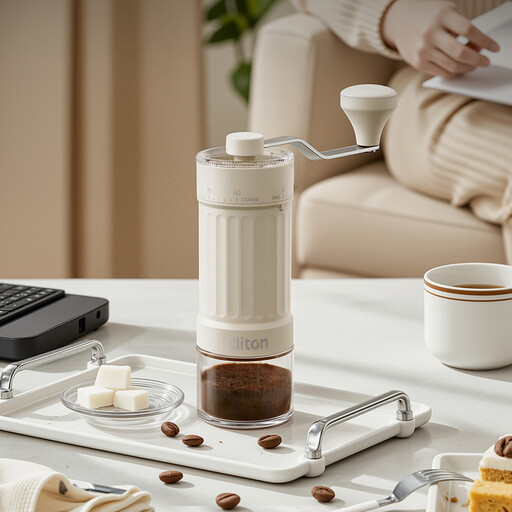
Why this product suits this profile: This model is aimed at people looking for a manual coffee grinder to get started with and try out different brewing methods.
Before buying, check the grind range, container capacity and cleaning instructions rather than relying on the exterior design alone.
Manual operation without electricity and a compact design for everyday use.
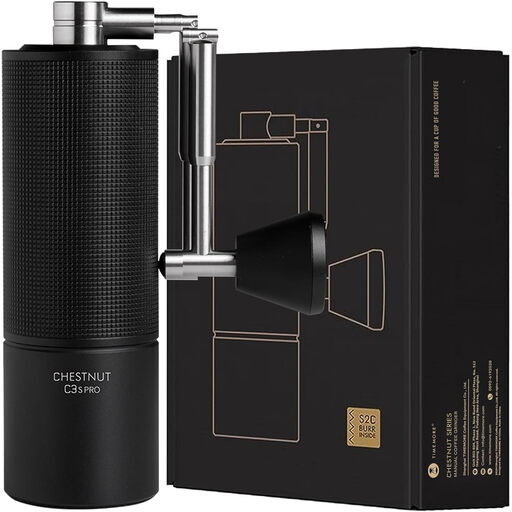
Why this product suits this profile: This grinder combines an aluminium body with 38 mm conical burrs made from hardened stainless steel and around 36 adjustable grind settings.
The specifications clearly set out the burr size, material, adjustment range and double-bearing shaft support.
A folding handle, a 52 mm body diameter and grind settings ranging from fine espresso to coarse French press.
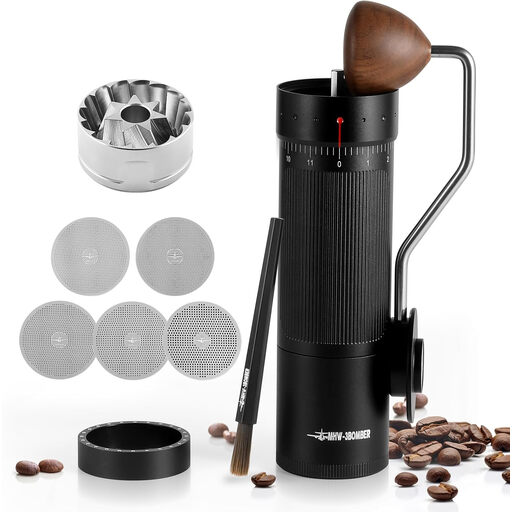
Why this product suits this profile: This model is designed for people who switch between espresso, moka pot, filter coffee and French press, and adjust the grind setting frequently.
The external adjustment mechanism, with 60 clicks per rotation, means you don’t have to keep opening the grinder when switching brewing methods.
CNC-machined stainless steel conical burrs, a magnetic grounds cup with a capacity of around 20 g, and five included sieves.
We’ve put together a complete, regularly updated list of products that meet these strict selection criteria and fully comply with the safety regulations in force in the EU.
For espresso, choose a grinder with finely stepped adjustments, a securely supported central shaft and sufficiently precise conical burrs. The handle should also remain easy to operate when there is more resistance. You don’t necessarily need a dedicated espresso grinder, provided its grind range and design are suitable.
Its lifespan depends on the burrs, bearings, frequency of use and care. Dry cleaning, careful disassembly and avoiding excessive force can help reduce wear. If you use it heavily every day, consider whether spare parts are available and whether the care instructions are clear.
A hand coffee grinder doesn’t use electricity, so it won’t add to your energy bills while you use it. However, grinding each portion takes physical effort. It can be a practical choice for individual cups, travel and places without a power supply; for several portions in a row, an electric grinder is usually quicker.