
Lieferung heute & morgen

Qualitätsgarantie

Willkommens-Angebote freischalten: KOSTENLOSE Lieferung | Bis zu 80 % RABATT | Kostenlose 30-Tage-JoyPlus-Testphase
App herunterladen
A manual coffee grinder is ideal if you want to grind coffee beans without electricity – at home, in the office, while camping or when travelling. But not every hand grinder is suited to every brewing method. If you focus only on a metal body or the number of grind settings, you could overlook some important details.
A long scale may sound impressive, but it tells you little about how precise the adjustments actually are. What matters is whether the grind setting clicks securely into place and can be adjusted consistently. A coffee grinder for espresso and French press should offer both fine and coarse settings without the adjustment shifting as you turn the handle.
A sturdy-looking body can’t make up for a basic or poorly supported grinding mechanism. Check what the grinding unit is made of and how the shaft is supported. With a conical burr coffee grinder, stable bearings and an even feed of beans are important factors.
Electric models need a socket, can be noisy depending on their design and are often less convenient for camping or travelling. On the other hand, grinding larger quantities with a manual coffee grinder can take more effort. The right choice depends on the amount you’re grinding, your brewing method and where you plan to use it.
A stainless steel burr set is corrosion-resistant, and many models can be cleaned with a dry brush. Conical burrs usually guide the beans between two cone-shaped grinding elements. The name alone isn’t what matters: the grinding unit must also be held securely in place.
Ceramic burrs can also be suitable for certain uses. Before buying, check that the model is specifically designed for coffee beans. Spice grinders aren’t automatically suitable for coffee.
Espresso usually calls for a fine grind, while French press requires a much coarser result. In between are methods such as the moka pot and pour-over. A coffee grinder with an adjustable grind setting should therefore offer at least the following:
The right setting depends on the beans, roast, brewing method and desired brew time. A general number of clicks won’t work for every type of bean.
For a single portion, 15 to 25 grams is often enough. A model with a 20-gram capacity is practical for many households and for use on the go. Also consider the handle’s diameter, how it attaches and how stable the grinder is. A non-slip handle can make it easier to use, but it doesn’t replace a securely supported grinding mechanism.
For travelling, weight, dimensions and ease of cleaning also matter. A portable coffee grinder should come apart as much as possible without small parts being easily lost.

Why this product suits this type of user: According to STARESSO product information, this manual coffee grinder has stainless steel conical burrs, an internal stepped grind adjustment and a double ball-bearing system. With a 20 g capacity, it’s designed for single portions.
The product information gives an adjustable range from espresso-fine to French-press-coarse, and says the grinder can be fully dismantled for cleaning.
Metal body, stainless steel burrs, 20 g capacity and dimensions of approximately 150 mm high and 190 mm long with the handle attached.
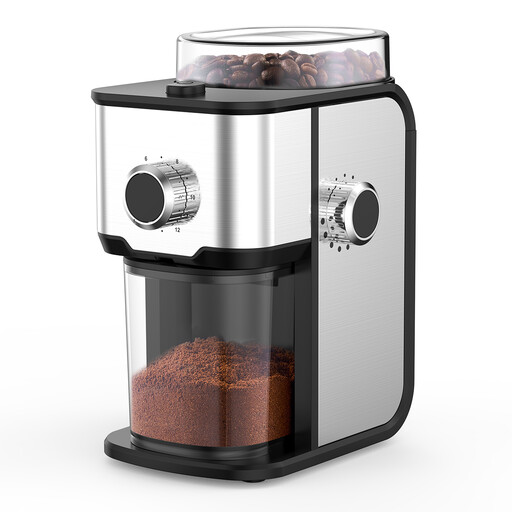
Why this product suits this type of user: If you mainly grind at home or in the office and would rather not do it by hand, this compact model offers an electric alternative.
The product description lists 14 grind settings, making its range clearer than that of machines that only grind for a set amount of time.
Flat burrs, 14 settings and a container for 2 to 12 cups, according to the product description.
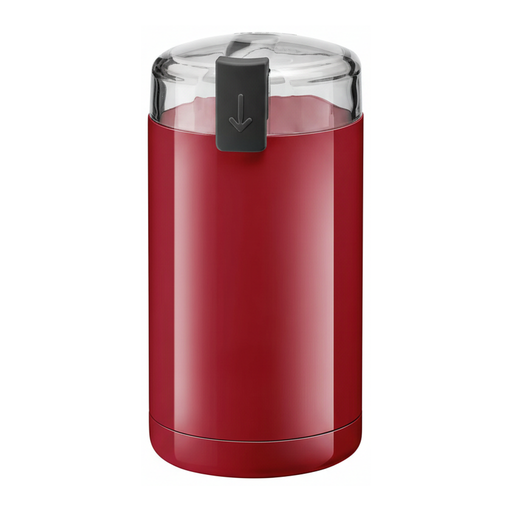
Why this product suits this type of user: An electric grinder can be more convenient than a portable coffee grinder when you need to grind larger quantities in the kitchen. This model is designed for mains operation and household use.
The technical specifications clearly state that it uses a blade, has a 75 g capacity and includes a safety feature that only allows it to operate when the lid is correctly in place.
180 W motor, 75 g capacity and compact dimensions of 90 × 90 × 170 mm, according to the product information.
After each use, remove loose coffee grounds from your manual coffee grinder with a dry brush. Only use water on parts that the instructions say are suitable for washing. Make sure the burrs are completely dry before adding fresh beans.
Don’t put too much pressure on the handle. If the grinder is unusually hard to turn, there may be too many beans in it, a foreign object inside or an incorrect setting. If your portable coffee grinder is designed to allow it, it’s also a good idea to remove the handle for transport.
We’ve put together a comprehensive, regularly updated list of products that meet these strict selection criteria and fully comply with the safety regulations in force in the EU.
Look for an adjustable grind setting with both fine and coarse click-stops. According to the product information, the stainless steel conical burrs on the STARESSO D6 PLUS cover both settings. You’ll then need to adjust the grind to suit your beans and brewing method.
Its lifespan depends on the burrs, bearings, cleaning and how heavily you use it each day. A metal body, a securely supported shaft and proper cleaning can all help keep it in good working order. It wouldn’t be possible to give a reliable general estimate without specific warranty or manufacturer information.
A manual coffee grinder doesn’t need electricity to work, but you’ll need to put in some effort for every portion. If you regularly grind larger quantities, an electric grinder may save you time. For single portions, travelling and camping, a manual model gives you more freedom from power sockets.