
Lieferung heute & morgen

Qualitätsgarantie

Willkommens-Angebote freischalten: KOSTENLOSE Lieferung | Bis zu 80 % RABATT | Kostenlose 30-Tage-JoyPlus-Testphase
App herunterladen
Freshly ground beans do not require a power connection – provided your manual coffee grinder is suited to your preferred brewing method. Whether you enjoy espresso, moka, filter coffee or French press, the key factors are not eye-catching marketing terms, but the burrs, adjustment system, capacity and ease of use.
The Joybuy Product Recommendation Officer's selection therefore focuses on clear product specifications and common purchasing pitfalls. This helps you avoid a poor buy before your new hand coffee grinder becomes impractical after only a short time.
A high number of clicks may sound convincing at first. What matters, however, is whether the grind size can be changed evenly and consistently. An external adjustment is usually easier to access when frequently switching between espresso and French press than an internal mechanism. For a coffee grinder with an adjustable grind size, there should also be information on the direction of rotation and the number of clicks.
A conical burr grinder generally guides the beans through the grinding mechanism in a space-efficient way. For practical use, the material, axle bearings and grip of the housing are also important. A stainless-steel conical burr grinder may be designed for durability, but an unstable shaft or slippery housing makes grinding more difficult – particularly at fine settings.
A capacity of 20 to 30 grams is sufficient for many single servings, but it is not automatically enough for several people. If you regularly prepare filter coffee for several cups, compare the desired amount of beans with the grinder's capacity. For camping and travel, compact dimensions and a securely sealable collection container are often more important than a large capacity.
A coffee grinder for espresso and French press requires as wide an adjustment range as possible. Espresso needs finely ground coffee, while French press calls for considerably coarser particles. Models with CNC-made stainless-steel cones and a bearing-supported central shaft are easier to assess based on their construction than products that merely claim to offer “precise grinding”.
Look for the following information:
Absolute consistency cannot be determined from product specifications alone. However, these construction features provide an objective basis for choosing between models.
An external grind adjustment is practical if you want to fine-tune the setting quickly when changing brewing methods. According to the product specifications, the MHW-3BOMBER R3 offers 60 clicks per revolution. This makes it easier to adjust gradually between a fine espresso grind and a coarser French press grind.
An internal adjustment can also be useful if you change the grind size less often or prefer a simple-looking housing. Before buying, check whether the mechanism can be accessed without tools and whether adjustment instructions are included.
Aluminium housings are generally lightweight and easy to transport. Stainless-steel components can support a robust construction for the burrs and axle. The following features are also important for everyday use:
Coffee residue should be removed regularly. Water should be avoided with several of the models listed, particularly around the burrs.
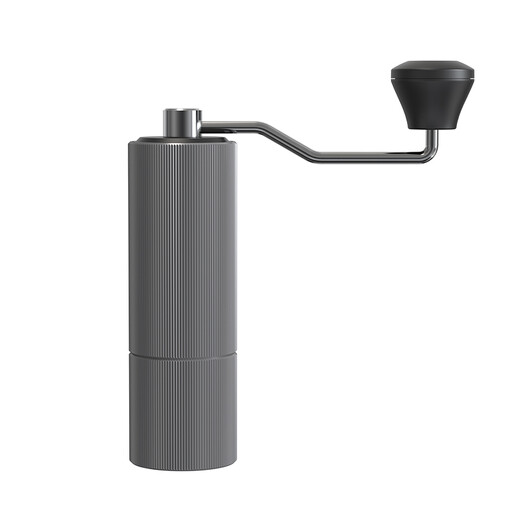
Why this product suits this profile: With a capacity of 20–30 g, internal click adjustment and an aluminium housing, this grinder supports several brewing methods without relying on an electrical power source.
The product data specifies the burrs, adjustment direction, capacity and cleaning method, rather than relying on vague performance claims.
420 stainless-steel conical burrs, dual bearings and a grippy surface; suitable for espresso, pour-over, moka and French press.
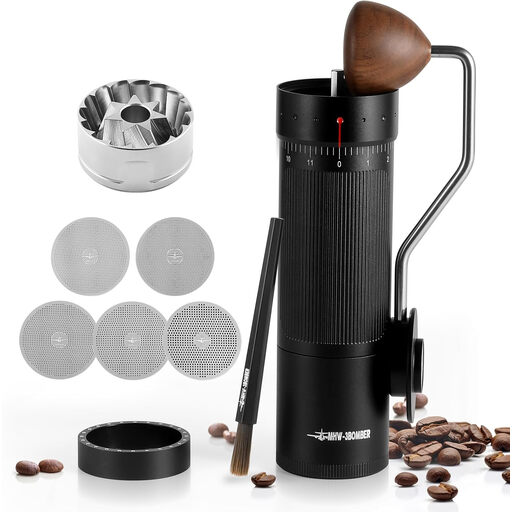
Why this product suits this profile: The external adjustment with 60 clicks per revolution is ideal for users who want to change the grind size regularly and consistently.
The grind size is adjusted externally on the housing. According to the product description, five sieves measuring 300, 400, 500, 600 and 850 µm are included.
CNC-made 420 stainless-steel cones, a magnetic collection cup with a capacity of around 20 g, and a range spanning espresso to French press.
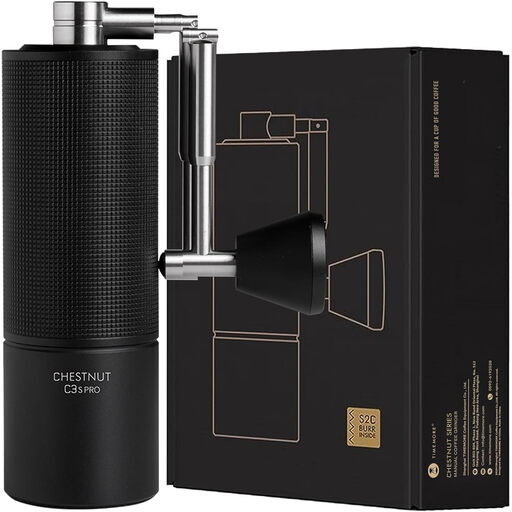
Why this product suits this profile: Its compact design and foldable handle make it suitable as a portable coffee grinder for a rucksack, campervan or camping trip.
The design takes transport and grip into account: according to the specifications, the body measures 52 mm in diameter and the handle folds away.
38 mm conical burrs made from hardened stainless steel, around 36 grind settings and a stated capacity of 25 g.
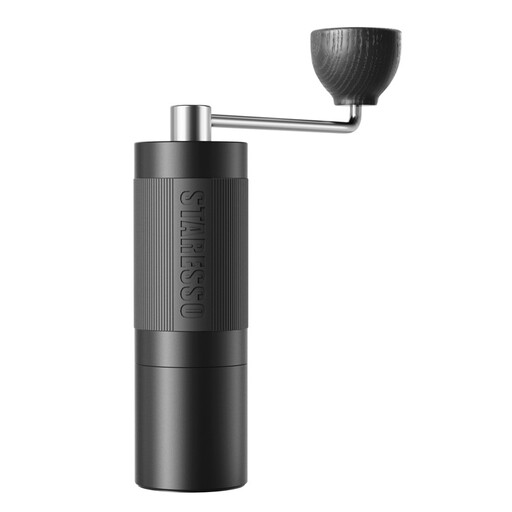
Why this product suits this profile: The metal housing, silicone grip and compact design are well suited to the office, travel and camping without access to mains power.
The product description specifies that it can be fully dismantled for cleaning, as well as providing the handle dimensions and a precise capacity of 20 g.
Dual ball-bearing system, stepped grind adjustment and suitability for espresso, moka, pour-over and French press.
We've put together a complete, regularly updated list of products that fully meet these strict selection criteria and the safety regulations applicable in the EU.
Look for a sufficiently wide range of fine and coarse settings. Models with around 36 to 60 clicks, or an adjustment system explicitly described as offering the full range, provide a clear basis for comparison. A sturdy handle is also important for espresso, as fine grinding can require more force.
Its lifespan depends on the burrs, bearings, workload and maintenance. Dry coffee beans, regular brushing and dry storage help reduce residue and corrosion. If you encounter unusual resistance, do not continue turning with excessive force. Instead, check the grind setting, beans and instructions.
The grinder uses no electricity, so there are no ongoing energy costs. Coffee beans are the only consumable. Over time, you may need to replace brushes or individual wearing parts, provided the manufacturer offers these as spare parts.