
Lieferung heute & morgen

Qualitätsgarantie

Willkommens-Angebote freischalten: KOSTENLOSE Lieferung | Bis zu 80 % RABATT | Kostenlose 30-Tage-JoyPlus-Testphase
App herunterladen
A marker pen set can be used for painting, drawing, writing, colouring or highlighting. The choice ranges from simple felt-tip pens for children to watercolour markers, brush pens and dual-tip markers for illustrations or calligraphy. However, the product name alone reveals little about how suitable a set really is.
Poor purchases often result from three common pitfalls:
That is why it is worth checking the technical specifications and intended user group before you buy.
The tip determines which techniques you can use with the marker:
Rounded, pressure-resistant tips are practical for children. For illustrations and design work, however, a combination of fine and brush tips is often more versatile.
Water-based ink is widely used at school, in the office and for many creative applications. Depending on the formulation, it can be removed from textiles, blended with water and usually has less odour than alcohol-based ink. However, the description “washable markers” should always be understood as “washable from most textiles”. The decisive factors are the type of fabric, how long the ink has been left to set and the washing temperature.
Alcohol-based ink usually dries quickly and can be layered or blended on suitable marker paper. However, it is not automatically washable and may soak through thin paper more easily. Special marker pads or thicker paper are therefore advisable for these markers.
For watercolour techniques, you should use watercolour paper or mixed-media paper. According to the product specifications, the Faber-Castell Albrecht-Dürer markers are water-soluble and designed to create watercolour effects on watercolour paper. With any set, it is advisable to carry out a quick test at the edge of the paper before starting a finished drawing.
A round or triangular barrel can affect how you hold the pen. Triangular models such as the STAEDTLER triplus colour are designed to encourage a controlled grip position. During long writing or drawing sessions, also consider the weight, barrel diameter and non-slip surface.
For a long service life, tightly closing caps and suitable storage are important. Some models feature DRY SAFE, which, according to the manufacturer’s specifications, is intended to prevent the ink from drying out for several days when the cap is removed, under the stated test conditions. Nevertheless, caps should be replaced after use.
For children’s sets, ventilated safety caps and the stated age range are important. Small caps or replacement tips could be swallowed. Markers are therefore not suitable for children under three unless the product information states otherwise in a legally permissible manner. Adult supervision remains advisable for younger children.
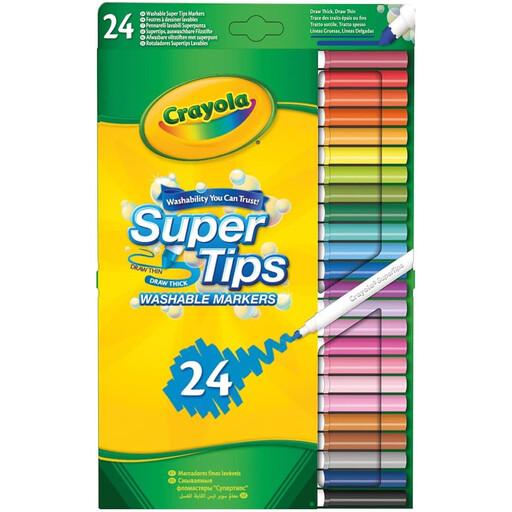
Why this product suits this profile: The 24-piece set covers painting, writing and drawing in a range of colours and, according to the product specifications, is suitable for children aged three or four and over.
The product description specifies washable ink and a tip that can create narrow or broader lines depending on the angle. This means it is not limited to a single line width.
24 shades, a pressure-resistant tip and, according to the supplier, ink that washes out of skin and clothing.
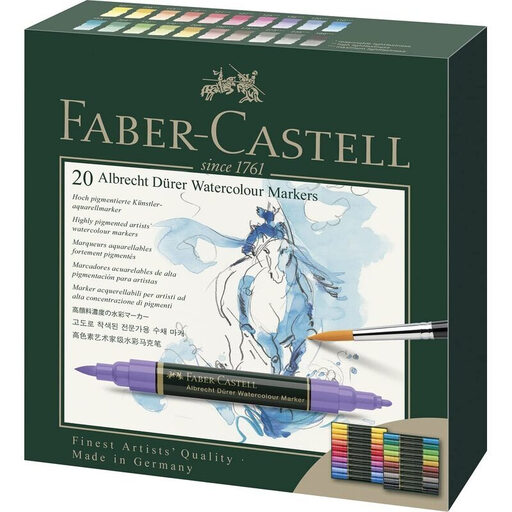
Why this product suits this profile: The 20 watercolour markers combine a soft brush tip with a sturdy fibre tip and are aimed at illustrators, ambitious hobby artists and people who work on the go.
The ink base, two tips and recommended use on watercolour paper are clearly specified. This makes it easier to choose the set for a particular technique than a marker with no clear technical details.
Water-based, water-soluble ink, two tips per pen and a practical 20-pen storage wallet.
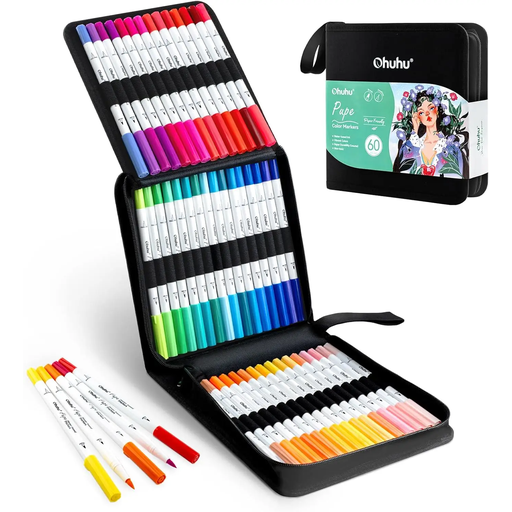
Why this product suits this profile: This set is aimed at people who use lettering, calligraphy, journalling and illustration and need a wide choice of colours plus two tips per marker.
The tips are clearly specified as 0.4 mm and 1 to 5 mm. The set also includes a colourless blender, adding useful functionality to the range of colours.
60 pens with fine and brush tips, water-based ink, a colour chart option and a storage case.
If your main aim is highlighting documents, highlighters with chisel tips are more suitable than classic brush pens. According to the product description, the STAEDTLER Textsurfer Classic has a soft chisel tip of approximately 1 to 5 mm, a larger ink reservoir and water-based ink. For colour-coded notes and study materials, a compact 4-colour set such as the Deli Highlighter can also be a practical choice.
For a focused comparison of different colour combinations, you can also browse our selection of multicoloured highlighters.
We have put together a complete, regularly updated list of products that fully meet these strict selection criteria and the safety regulations applicable in the EU.
For children, water-based markers described as washable and fitted with pressure-resistant tips are practical. Also check the recommended age range, ventilated safety caps and any warning about small parts that could be swallowed. For example, the Noris Junior fibre-tip pens are described as having a broad, rounded fibre tip and a ventilated cap.
Longevity depends on how the markers are used, the amount of ink, wear on the tips and storage conditions. Caps should be closed fully after use. Storing many water-based markers horizontally can help maintain an even distribution of ink. Sets with replacement tips or a large ink reservoir are practical for intensive use.
For simple lines and notes, normal paper is usually sufficient. With brush pens and watercolour markers, however, thin paper may become rough or allow the ink to show through. Thicker watercolour or mixed-media paper is more suitable for washes and mixed techniques. Test new markers on a separate sheet first.