
Lieferung heute & morgen

Qualitätsgarantie

Willkommens-Angebote freischalten: KOSTENLOSE Lieferung | Bis zu 80 % RABATT | Kostenlose 30-Tage-JoyPlus-Testphase
App herunterladen
By Joybuy Product Recommendation Officer, August 28, 2026
A new marker set can open the door to countless creative projects, from detailed illustrations to relaxing colouring. However, that joy can be short-lived if the pens you buy don't live up to their promise. Dried-out tips, bleeding ink, or colours that don't adhere to your chosen surface are common frustrations. Before you make a decision, it's important to understand the typical pitfalls that often lead to a bad purchase.
Many users invest in large sets only to find that the tips fray after a short time or the ink flow is uneven. Another problem is the misleading labelling of the ink type. A pen advertised as "waterproof" whose ink smudges when it comes into contact with another medium can ruin an entire piece of art. It's equally disappointing when the opacity is insufficient on dark paper or unconventional materials like rocks or glass.
To avoid these problems, you should focus on three core technical features. These will determine whether a marker set is suitable for your specific needs or not.
The ink composition is the most important factor and defines a pen's range of applications.
The marker's tip determines the kind of strokes you can create. Many modern sets offer dual-tip pens to maximise versatility.
A large set isn't always better. Look for a thoughtful colour palette that suits your projects. For portraits, for example, special skin tone pens are more useful than a set with many neon shades. Features like lightfastness are crucial if you want your artwork to remain colourfast for a long time. For children, pens labelled as washable are also a practical feature.
Based on these objective criteria, we have identified some products that are suitable for different user profiles and their specific requirements.
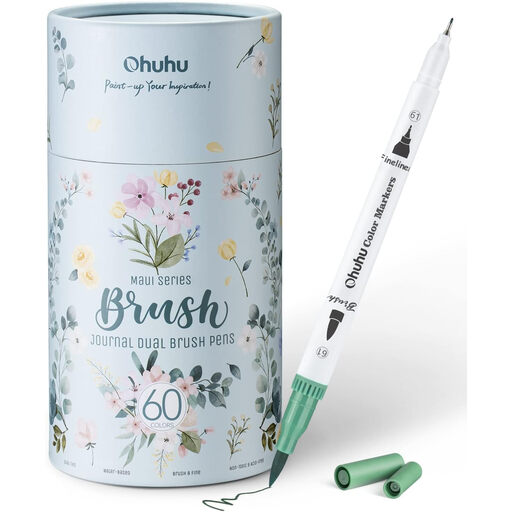
Why This Fits Their Persona: This set offers a wide variety of colours and the popular combination of a fineliner and brush tip. The water-based ink is low-odour and easier for beginners to handle than alcohol markers, making it ideal for bullet journaling, sketching, and colouring.
The water-based ink minimises bleed-through on most types of paper. The dual tip eliminates the need for a separate fineliner set, offering high flexibility right from the start.
Dual tips (0.4 mm fineliner & 1-6 mm brush) for maximum versatility. 60 colours provide a broad palette for diverse projects. Includes replacement nibs.
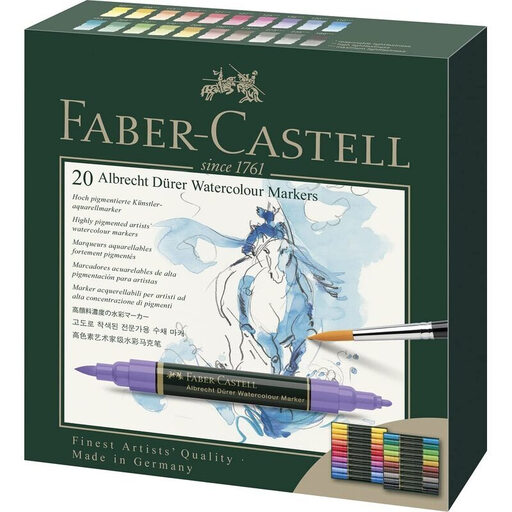
Why This Fits Their Persona: For artists who value pigment quality and lightfastness. These markers combine the handling of a pen with the properties of classic watercolour paints. The "Made in Germany" label stands for reliable material quality.
The highly pigmented ink and high lightfastness prevent artwork from fading quickly. The tips are robust, and the manufacturer states the ink does not bleed through on suitable watercolour paper.
Fully water-soluble ink for professional watercolour effects. Dual tip with a soft brush tip and a stable fibre tip for maximum control.
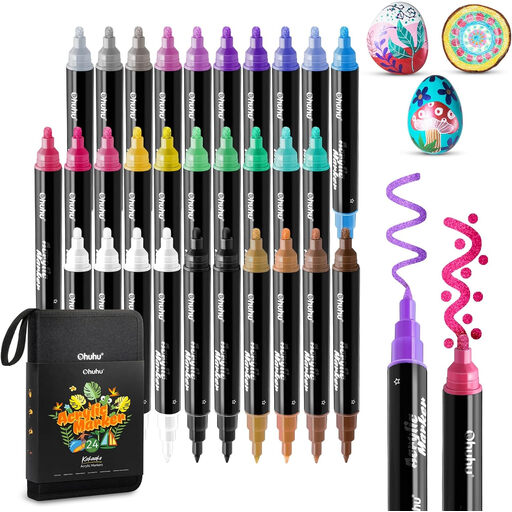
Why This Fits Their Persona: This set is designed for creatives who work on more than just paper. The acrylic ink adheres to a variety of surfaces like rocks, wood, ceramic, glass, and fabric, making it a versatile tool for craft projects and decorations.
Conventional markers fail on smooth or porous surfaces. These acrylic pens offer high opacity and a waterproof, lightfast finish after drying, ensuring the longevity of DIY projects.
Adheres to almost any surface, making it a universal tool for crafters. The dual tip (fine and round) allows for both detailed work and broad coverage.
We have compiled a complete, up-to-date list of products that fully meet these strict selection criteria and German safety regulations.
1. How do I store marker sets correctly to prevent them from drying out? Most manufacturers recommend storing markers horizontally. This ensures that the ink flows evenly to both tips (in dual-tip markers) and prevents one tip from drying out. Be sure to close the caps tightly after each use.
2. What is the main difference between alcohol markers and watercolour pens? The main difference lies in the ink base and its behaviour. Alcohol markers use a fast-drying, permanent ink that is ideal for seamless blending on special paper. Watercolour pens contain water-soluble ink that can be reactivated and blended with water after application to create watercolour effects.
3. Can I mix different types of markers? Mixing different ink types should be done with caution. Layering water-based pens over alcohol-based markers can work, but the reverse can lead to smudging. Acrylic pens are opaque and can generally be painted over dried layers of other markers. It is always advisable to test combinations on a separate piece of paper first.