
Lieferung heute & morgen

Qualitätsgarantie

Willkommens-Angebote freischalten: KOSTENLOSE Lieferung | Bis zu 80 % RABATT | Kostenlose 30-Tage-JoyPlus-Testphase
App herunterladen
Marker pens differ in more than just colour and price. The ink, nib, paper compatibility and intended use are all important considerations. If you simply look for the largest number of colours, you may end up buying a set whose nibs do not suit your technique or whose ink bleeds through the paper you use.
A marker set with 60 or 120 colours may seem versatile at first glance. However, for detailed illustrations, technical work or lettering, a precise nib is more important than the number of colours alone. Fineliner nibs ranging from around 0.05 to 1.0 mm are suitable for outlines and small areas. Brush pens, on the other hand, allow you to vary line widths for hand lettering, shading and loose sketches.
Water-based markers can be blended with water, but that does not mean they can be completely removed from every surface. When choosing pens for children, it is therefore important to check the specific washability information. Even water-soluble colours can leave marks on textiles and absorbent paper. For glass, plastic or overhead projector film, special non-permanent markers with water-soluble ink are more suitable.
Lightfastness describes how much a colour fades after prolonged exposure to light. Water resistance refers to whether dried ink smudges when it comes into contact with moisture. A marker can therefore be water-resistant without having a specified level of lightfastness. For sketches, bullet journals and presentations, one property may often be more important than the other, whereas illustrations intended for long-term storage require both to be considered.
Look out for specific measurements such as 0.4 mm, 1–2 mm or 1–6 mm. These values make it easier to assess whether a set is suitable for fine drawing, larger areas or both.
Water-based markers are suitable for many drawing and lettering techniques and can be blended with water on suitable watercolour or mixed-media paper. For watercolour markers, paper with a sufficient weight is recommended, as thin copier paper may buckle or absorb the colour unevenly.
Permanent markers generally contain ink that is more resistant to water and smudging once dry. They can adhere to paper, plastic, metal or wood, but cannot necessarily be removed from every surface without leaving residue. Test the marker on an inconspicuous area before use.
A tightly closing cap helps prevent the nib from drying out. Many markers should be stored horizontally so that the ink remains evenly distributed. For children’s sets, pay attention to the recommended age and any small parts. Pen caps may pose a choking hazard, so markers should not be given to children under three.
For drawings intended for archival storage, information such as acid-free, pH-neutral and lightfast can provide useful guidance. These claims do not replace an assessment of the complete paper and storage system, but they can help you make an informed initial choice.
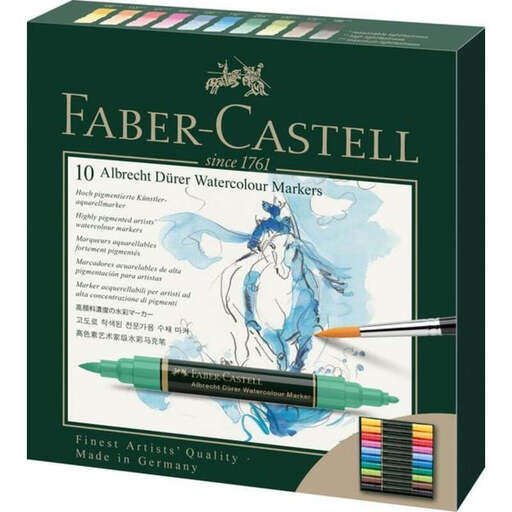
Why this product suits this profile: This compact set of 10 offers an accessible introduction to watercolour markers and is suitable for sketches, colour gradients and creative work on the go.
The two nibs per marker make the set more functional than one marketed solely on the number of colours: a brush tip for areas and a fibre tip for outlines.
Water-based, water-soluble ink, 10 colours and stated high lightfastness; case for transport and storage.
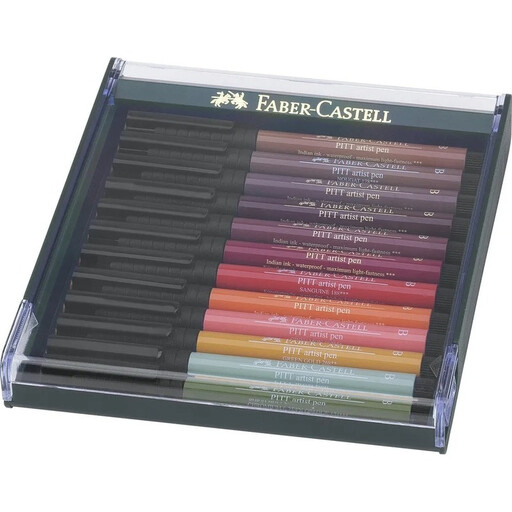
Why this product suits this profile: The flexible brush tip and earthy colour palette are ideal for illustrations, hand lettering, bullet journalling and drawings designed to last.
The product details specify waterproof, permanent pigment ink and lightfastness. This means the set is designed for durability rather than simply offering a large selection of colours.
12 flexible brush tips, waterproof pigment ink, and an acid-free, pH-neutral formulation according to the product description.
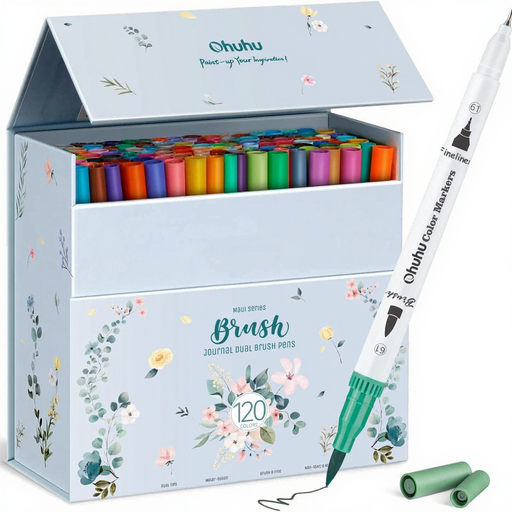
Why this product suits this profile: This extensive set is designed for users who colour, draw or write regularly, or need a range of shades for illustrations.
The combination of a 0.4-mm fineliner and a 1–6-mm brush tip covers both fine details and broad strokes. A colour chart helps you identify the 120 pens.
120 water-based markers, eight replacement nibs, colour chart and storage case; can be blended with water on suitable types of paper.
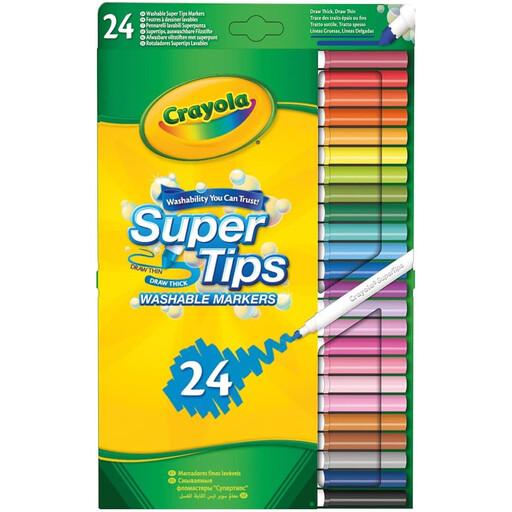
Why this product suits this profile: For drawing, writing and school projects, these markers are designed with children in mind. Their tips create different line widths depending on the angle at which they are held.
The product description mentions washable ink and a recommended age of three or four years and above. Nevertheless, surfaces should be protected and children supervised.
24 multicolour markers, Supertips nib for different line widths and, according to the supplier, washable ink.
We have put together a complete, regularly updated list of products that fully meet these strict selection criteria and the safety regulations applicable in the EU.
Brush pens with a flexible nib are ideal for hand lettering. A dual-tip design with an additional fineliner makes it easier to switch between fine outlines and broad strokes. For permanent lettering, you should also check whether the ink is water-resistant and lightfast.
Use marker paper, watercolour paper or mixed-media paper with a higher weight wherever possible. Place a protective sheet underneath your paper while working and test new markers in an inconspicuous area first. Bleed-through is more likely with highly saturated colours and permanent markers.
Their lifespan depends on how they are used, how they are stored, the amount of ink and the cap. Caps should be put back on firmly immediately after use. Horizontal storage is recommended for many pigment or water-based markers. Replacement nibs can extend their useful life, provided the particular set is designed to accommodate them.