
Lieferung heute & morgen

Qualitätsgarantie

Willkommens-Angebote freischalten: KOSTENLOSE Lieferung | Bis zu 80 % RABATT | Kostenlose 30-Tage-JoyPlus-Testphase
App herunterladen
Markers differ in more than just colour and shape. The key factors are ink, nib shape, surface and desired durability. If you choose based solely on a large number of colours or eye-catching marketing claims, you can quickly end up with a set that is unsuitable for your needs. As a Joybuy Product Recommendation Officer, I therefore categorise the most important features according to specific uses.
Lots of colours may look appealing, but they are of little use if the nib is not suited to the task. For calligraphy, journalling and illustrations, brush pens with flexible brush tips are a sensible choice. For technical labelling or fine outlines, however, fineliner markers with a defined line width are more suitable. Children's colouring pens, meanwhile, need a durable nib that remains stable even when pressed down firmly.
A permanent marker adheres permanently to many surfaces, but can be difficult to remove from textiles, wood or wallpaper. Non-permanent markers generally contain water-soluble ink and can be wiped off smooth surfaces with a damp cloth. Paper, glass, plastic, metal and wood therefore each have different requirements.
Watery inks can bleed through thin paper or roughen its surface. With watercolour markers, watercolour pens and water-soluble markers, watercolour or mixed-media paper is often the more suitable choice. Brush pens should also be checked before purchase to ensure that, according to the product description, the ink is suitable for thin paper.
The nib determines how precisely a marker can be used:
With dual-tip markers, you should also check which two nibs are actually included. A brush pen with a 0.4-mm fineliner covers different tasks from a marker with brush and chisel tips.
A small set with ten or 20 colours is easier to transport and is sufficient for many sketches. Larger sets with 60 or 120 colours offer more shades, but require organised storage. For office users and teachers, a refillable marker may be more practical in the long term than a disposable model. With flipchart markers or non-permanent markers, it is therefore important to check compatibility with a specific refill station.
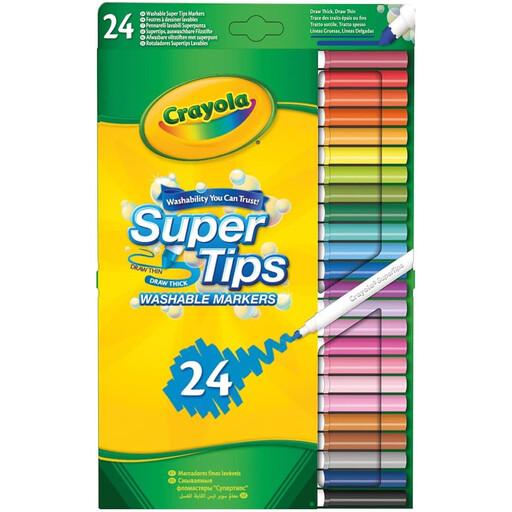
Why this product suits this profile: The 24-colour selection is aimed at children, families and creative beginners looking for markers for school, colouring sheets and their first drawing projects. According to the product description, the nib produces thin and broader lines depending on how it is held.
The product information specifies washable ink as well as an age recommendation and warns about small parts. This makes it easier to assess its suitability for children than with universal markers that are not described in detail.
24 shades, washable ink and a nib for different line widths.
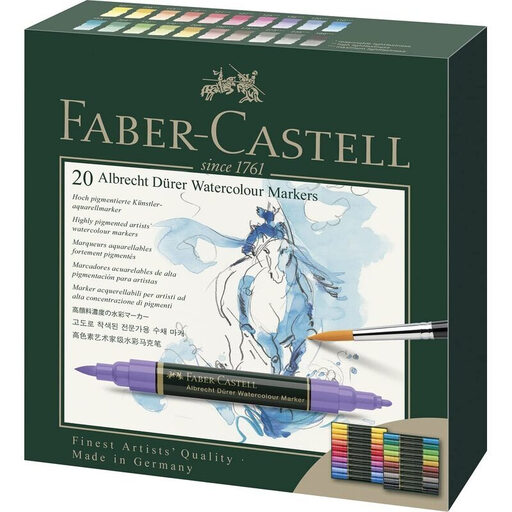
Why this product suits this profile: Artists and illustrators receive 20 watercolour markers with a soft brush tip and stable fibre tip. The water-based, water-soluble ink is intended for sketches and watercolour techniques on suitable paper.
The two clearly specified nibs and the recommended use on watercolour paper reduce the risk of buying a universal marker for an unsuitable colouring technique.
20 colours, dual-tip design and, according to the product information, high lightfastness and water-soluble colour.
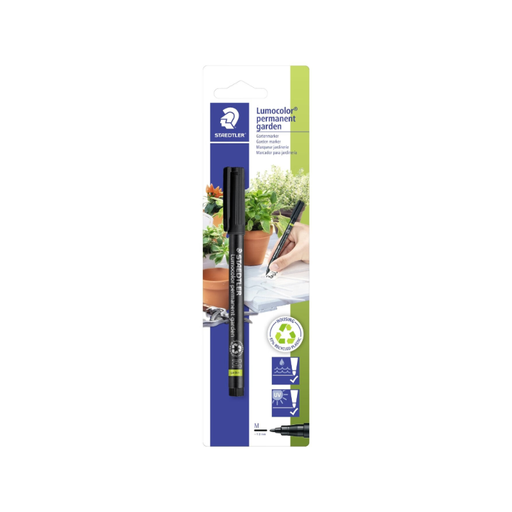
Why this product suits this profile: Gardeners and professional users who want to label plant markers, wooden stakes, ceramics or metal need ink that is explicitly described as suitable for outdoor use.
The product description explicitly states that it is weather- and lightfast. This provides a more specific basis for choosing than simply relying on the designation “permanent marker”.
Black ink, approximately 1.0 mm line width and, according to the product information, water-, weather- and lightfast properties.
We have put together a complete, regularly updated list of products that fully meet these strict selection criteria and the safety regulations applicable in the EU.
Watercolour markers or watercolour pens with water-soluble, water-based ink are suitable for this purpose. On watercolour paper, the colour can be blended with water and a brush. Before using them over a large area, it is advisable to test them first, as paper thickness and surface coating can affect the result.
Their lifespan depends on the amount of ink, nib material, use and storage. The cap should be closed fully after every use. Many markers are best stored horizontally. With refillable models, their service life can be extended using a suitable refill station; the nib itself may still wear out.
Non-permanent markers with water-soluble ink can often be removed from smooth, non-absorbent surfaces with a damp cloth. On paper, untreated wood, textiles or rough surfaces, the colour may still soak in. Permanent markers or weatherproof garden markers are intended for lasting marks.