
Lieferung heute & morgen

Qualitätsgarantie

Willkommens-Angebote freischalten: KOSTENLOSE Lieferung | Bis zu 80 % RABATT | Kostenlose 30-Tage-JoyPlus-Testphase
App herunterladen
Whether you’re creating illustrations, practising calligraphy, preparing presentations or making pictures with the children, markers and felt-tip pens can vary considerably in their ink, nib, surface suitability and durability. Colourful packaging tells you little about whether a pen can be wiped off glass, bleeds through paper or is suitable for young children.
This guide explains which features to consider before you buy and which type of product is best for each use.
Water-soluble ink can often be removed from smooth, non-absorbent surfaces with a damp cloth. On paper, card or fabric, however, it can soak in and leave visible marks. If you’re looking for non-permanent markers for glass, films or presentations, always check the specific information about the surfaces they can be used on.
With wipe-off markers, it’s also important to check whether the ink can be removed from glass and plastic as well as films. Before using one for the first time, it’s a good idea to test it on an inconspicuous area.
A broad colour range is useful if you regularly illustrate, colour in or create lettering. For fine outlines, though, a 0.4-mm or 0.6-mm nib matters more than the number of shades. Broader nibs are ideal for filling areas and writing headings, while fineliners and fine fibre tips create precise lines.
Dual-tip markers give you two ways to use the same pen. This saves space, but it can also mean that one nib gets used more quickly than the other.
For children’s markers, check the age guidance, the risk of swallowing caps and whether the ink is washable. Water-based, low-odour inks are handy for everyday arts and crafts. However, “washable” doesn’t mean completely stain-proof: fresh marks are usually easier to remove than dried ones.
A brush pen has a flexible brush tip that creates varying line widths, making it ideal for lettering, shading and expressive lines. A fibre tip usually gives you more control over outlines. Depending on the angle, chisel tips can create lines of different widths.
These general guidelines can help you choose for everyday use:
Watercolour markers and watercolour pens usually need sturdier paper for controlled blending. Thin copier paper may let ink bleed through or become rough when you blend with water. For journalling, paper weight, drying time and the level of coverage you want are more important than having a particularly large colour palette.
Make sure the caps are firmly closed after use. Depending on the manufacturer’s instructions, brush pens and fibre-tip pens are often best stored horizontally. Direct sunlight and high temperatures can affect the ink and plastic components.
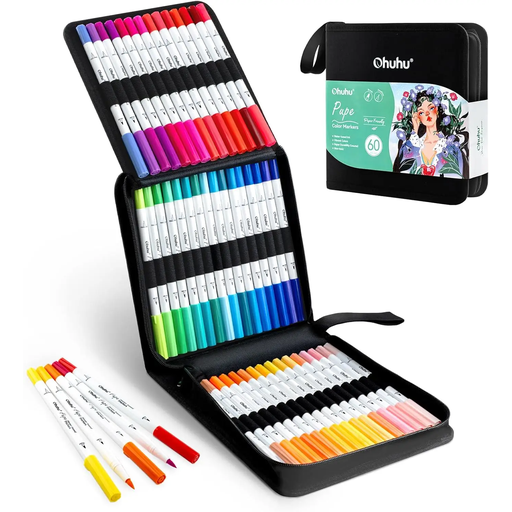
Why it suits this profile: This set combines 59 colours and a colourless blender with a 0.4-mm fineliner tip and a flexible 1- to 5-mm brush tip. It covers drawing, journalling and your first calligraphy exercises in one set.
The dual-tip design means you don’t need two separate sets of pens for fine lines and broad strokes. According to the product information, the water-based ink is designed for use on paper.
60 pens, two tips per pen and a storage case; stated to be ASTM D-4236 certified.
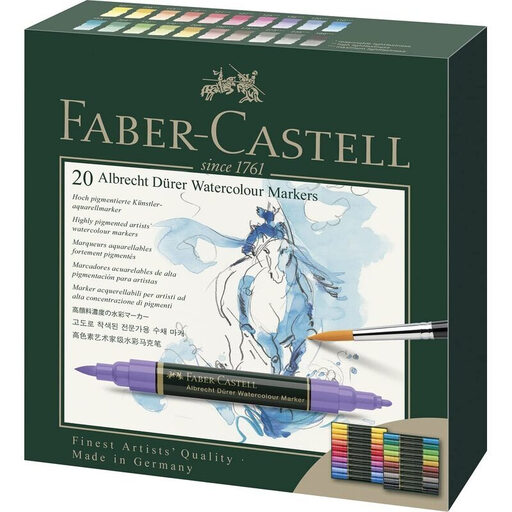
Why it suits this profile: The highly pigmented, water-soluble ink is designed for watercolour techniques on watercolour paper. Two tips on each marker make it easy to work on both colour-filled areas and outlines.
This set offers more than just a wide choice of colours: the brush tip and fibre tip are suited to different stages of your work. However, always consider the stated lightfastness in relation to how you plan to archive your work.
20 colours, two tips per marker and water-soluble ink for blending, washes and wet-on-wet techniques.
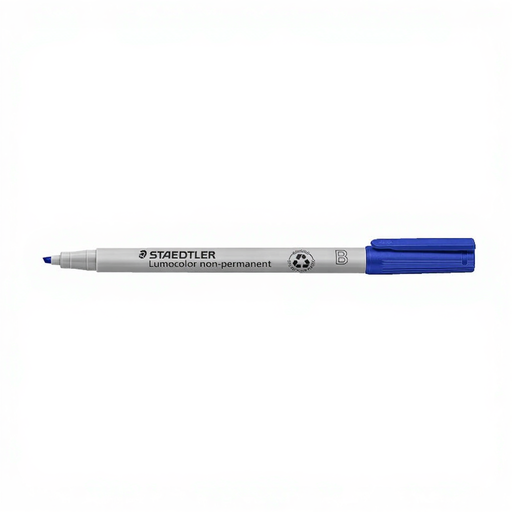
Why it suits this profile: According to the product information, the chisel tip creates lines of around 1.0 to 2.5 mm. This marker is designed for smooth surfaces and overhead projector film, making it suitable for the office, teaching and temporary labelling.
The non-permanent label is backed up by specific information confirming that the ink can be removed from non-absorbent surfaces with a damp cloth. On paper, however, the ink may remain visible permanently.
Variable line width, water-soluble ink and refillable with the STAEDTLER 487 15 refill station.
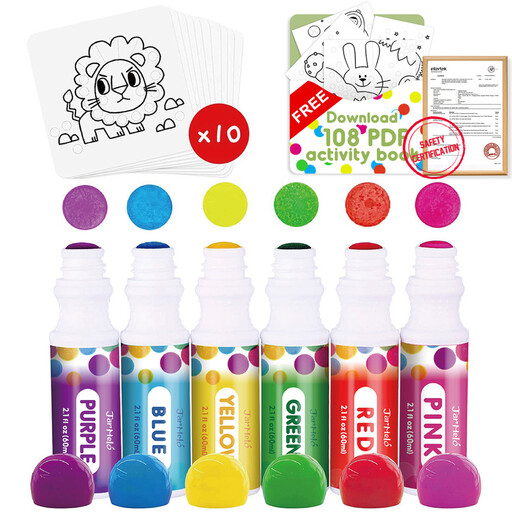
Why it suits this profile: These jumbo dot markers are designed for little hands and are ideal for making dots, lines and large areas of colour. According to the product information, the water-based, alcohol-free, odour-free ink washes off skin and most fabrics by 90 per cent.
The age guidance still matters: this set isn’t intended for children under three. The stated washability is 90 per cent, so it doesn’t mean every material will be completely stain-free.
Six jumbo dot markers, built-in sponge pads and extra activity materials.
We’ve put together a complete, regularly updated list of products that meet these strict selection criteria and the safety regulations in force in the EU.
Dual-tip markers, fineliners and brush pens are handy for journalling. A fine tip is ideal for small labels, while a brush tip works well for headings and areas of colour. If you’re using water-based ink, choose paper that’s sturdy enough to prevent bleed-through.
How long they last depends on how often you use them, how much pressure you apply to the tip, how they’re stored and whether they’re properly capped. Closing the caps firmly helps prevent the ink from drying out. Refillable STAEDTLER Lumocolor markers can be used for longer with the right refill station. Brush pens are best stored horizontally, if the manufacturer recommends it.
Water-soluble ink alone isn’t enough to determine whether a marker is suitable. Check the recommended age, cap size, material information and washability. Toddlers should only use markers under supervision, as small parts can pose a choking hazard.