
Lieferung heute & morgen

Qualitätsgarantie

Willkommens-Angebote freischalten: KOSTENLOSE Lieferung | Bis zu 80 % RABATT | Kostenlose 30-Tage-JoyPlus-Testphase
App herunterladen
A matcha set may seem straightforward at first glance: bowl, bamboo whisk, spoon and perhaps a sieve – that’s it. In practice, however, sets vary considerably in terms of contents, materials, care requirements and intended use. If you only look at the colour, number of pieces or terms such as “tea ceremony”, you can quickly end up buying accessories that do not work well in everyday use.
This guide from the Joybuy Product Recommendation Officer explains what matcha beginners, tea lovers and experienced matcha drinkers should look for before buying.
When choosing a matcha tea set, the number of pieces should not be the only consideration. What matters is which tools are actually included. For example, one six-piece set may include an extra teaspoon and holder, while another seven-piece set may contain a sieve, whisk holder and cloth.
These components are particularly useful for traditional preparation:
Without a sieve, the powder is more likely to form lumps. Without a holder, the bamboo whisk is often stored incorrectly.
Many product descriptions refer to the dishwasher suitability of the ceramic parts only. Bamboo, wood and some porcelain holders should be cleaned by hand and dried thoroughly. Prolonged soaking can damage the bamboo fibres and encourage mould growth.
A matcha whisk set containing delicate natural materials therefore requires a little care. If you are looking for an easy-to-use matcha latte set for everyday use, this is an important point to consider before buying.
Colour gradients, a handmade appearance or a gift box reveal little about practical suitability. Instead, check:
According to the product information, certain TEANAGOO models feature lead-free and mercury-free, or lead-free and cadmium-free, ceramic. Such claims should be verifiable in the relevant product description and packaging information.
A matcha bowl needs to provide enough room for the whisk to move in circles. Models with a capacity of around 400 to 560 ml can be used for whisking and, when required, serving. A lower, wider shape makes it easier to move the bamboo whisk.
A pouring spout is especially useful when matcha needs to be divided between several cups. For a single serving, however, it is not an essential requirement. Also check whether the manufacturer states that the ceramic is microwave-safe. When preparing matcha with bamboo accessories, use hot but not boiling water; several product specifications state around 175 °F, equivalent to approximately 80 °C.
The number of prongs is an objective point of comparison, but it is not the only indication of quality. Depending on the model, the featured sets contain approximately 76, 77 or 100 fine prongs. A dense whisk can make frothing easier, but it remains a natural product with a limited lifespan.
Before use, briefly moisten the prongs. After use, rinse the whisk, leave it to air-dry and store it on a whisk holder. The chasen should be replaced if the prongs break or become misshapen. Its exact lifespan depends on how often it is used, cleaned and stored.
A compact matcha set with bowl and whisk is sufficient for one person. For guests or a Japanese matcha set for several people, additional cups are useful. If you regularly prepare matcha lattes, you do not necessarily need a ceremonial set, but you will benefit from a sieve and a sufficiently large bowl.
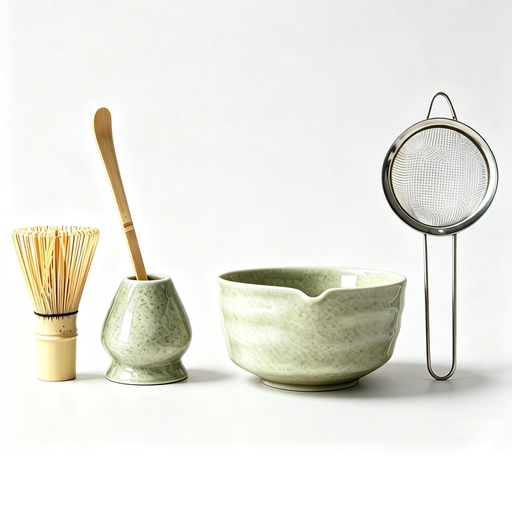
Why this product suits this profile: This compact 5-piece set covers the essential steps from sifting to whisking, making it suitable for getting started at home.
The contents explicitly list a bowl, bamboo whisk, sieve and holder. This makes the functional equipment clearer than with sets that simply advertise a high number of pieces.
Ceramic bowl, bamboo whisk, stainless-steel sieve and holder; no assembly required.

Why this product suits this profile: This set combines a 560 ml bowl with pouring spout, sieve, holders and bamboo tools for regular preparation and serving.
The product information distinguishes between the ceramic parts and bamboo accessories when describing cleaning. This makes it clear that the whisk must be cared for by hand.
560 ml capacity, pouring spout, powder sieve, whisk holder and cloth; the ceramic is stated to be lead-free and mercury-free.

Why this product suits this profile: Two additional cups make this set appealing for shared tea moments, guests and as a matcha gift set.
Alongside the bowl, whisk, spoon, sieve and holders, the contents also list two cups. This makes the actual equipment easy to verify.
510 ml bowl, two 7.2-oz cups, sieve and holder; the ceramic is stated to be lead-free and cadmium-free.

Why this product suits this profile: The 6-piece format combines a whisk, spoon, sieve and two holders, taking up less space than larger sets with several cups.
The product information explicitly states that all parts should be washed by hand. This avoids the common assumption that the entire set is dishwasher-safe.
100-prong bamboo whisk, stainless-steel sieve, porcelain holder and compact weight of 280 g according to the product information.
We have put together a complete, regularly updated list of products that fully meet these strict selection criteria and the safety regulations applicable in the EU.
For ceramic parts, always follow the instructions for the specific product. Small items such as the sieve and spoon should be kept out of the reach of young children.
For basic preparation, you need a matcha chawan, bamboo whisk and measuring spoon. A sieve prevents lumps in the powder, while a whisk holder helps the chasen retain its shape as it dries. Additional cups are useful when preparing matcha for several people.
This depends on how it is used, cleaned and stored. With regular use, a bamboo whisk may show signs of wear after several months. Broken prongs, traces of mould or severe misshaping are reasons to replace it.
Yes, provided it includes a bowl, whisk and sieve. For a matcha latte, the prepared matcha can then be combined with milk or a plant-based alternative. However, suitability as a latte set says nothing about the quality of the matcha powder used.