
Lieferung heute & morgen

Qualitätsgarantie

Willkommens-Angebote freischalten: KOSTENLOSE Lieferung | Bis zu 80 % RABATT | Kostenlose 30-Tage-JoyPlus-Testphase
App herunterladen
A meat knife needs to be suited to the task. A long, narrow model works differently from a boning knife, a carving knife or a heavy cleaver. If you focus only on a shiny blade, bold marketing claims or a low-priced set, you can easily end up buying something that does not meet your needs. This guide explains which technical details matter in everyday use for home cooks, barbecue enthusiasts, butchers and professional kitchens.
The term stainless-steel meat knife initially tells you only about the blade material. Blade thickness, the grind, geometry and care instructions are also important. Corrosion-resistant steel may be less prone to rust, but it still needs to be cleaned and dried. Salt, acids and prolonged exposure to moisture should never be left on the blade for extended periods.
A 20 cm meat knife is often suitable for cutting larger pieces and carving. A narrower, more flexible blade is more practical for separating meat from the bone. A chopping knife or cleaver, on the other hand, is designed for controlled vertical cuts. It should not be used as a universal kitchen knife for meat if the blade is not designed for that purpose.
Some models are described as dishwasher-safe in the product information. Others, including certain forged knives, should be cleaned by hand. Heat, detergents and contact with other cutlery can put greater strain on the edge and handle. The manufacturer’s care recommendation is therefore an important selection criterion, not a minor detail.
For roasts, roast beef and larger pieces of meat, blades measuring 20 to 22 cm are practical because they allow longer strokes. A straight edge supports evenly sized slices, while a serrated edge can provide better grip on certain surfaces. A carving knife may be slightly flexible, but it should still be easy to guide in a controlled manner.
A boning knife usually has a narrower blade. This makes it easier to separate sinews and different parts of the meat with precision. Bones and hard structures, however, require chopping knives or cleavers designed specifically for the job. The product description should clearly state the intended use.
Look for clear information such as corrosion-resistant stainless steel, a forged construction or a specified steel grade. If stated, hardness may be given in HRC. A higher hardness rating does not automatically mean that a blade is more suitable for every purpose: very hard edges can be more sensitive to sideways pressure if used incorrectly.
A full-tang construction, several rivets and a sturdy handle can improve control. However, these features are only meaningful if the knife is well balanced and sits securely in your hand.
A non-slip handle, finger guard and well-balanced weight distribution are important when handling wet or greasy food. The handle should not be too small or too smooth. For safe storage, use a knife block, a magnetic strip with adequate protection, a blade guard or a drawer insert. Loose knives in a cutlery drawer increase the risk of injury and damage.
Use a soft wooden or suitable plastic chopping board. Stone, glass and ceramic boards can damage the edge. Bones, frozen food and hard objects should only be cut if the manufacturer explicitly states that the knife is suitable for them.
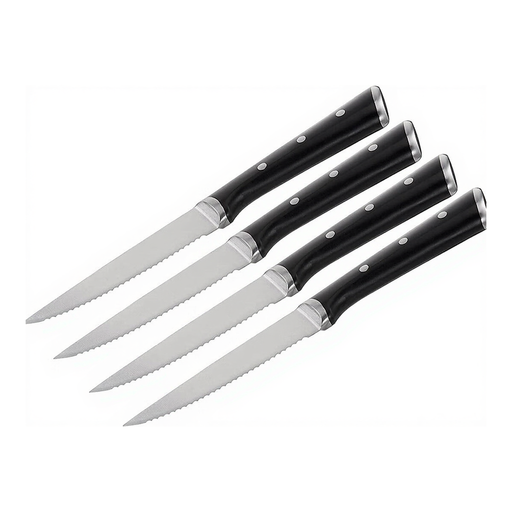
Why this product suits the profile: This four-piece set is designed for cutting small portions of meat and steaks at the table. The 11 cm blades are more compact than typical carving knives.
The stated blade length makes the intended use clear. It is not a substitute for a boning knife or cleaver.
Four steak knives with stainless-steel blades, ABS handles and finger guards; described as dishwasher-safe in the product information.
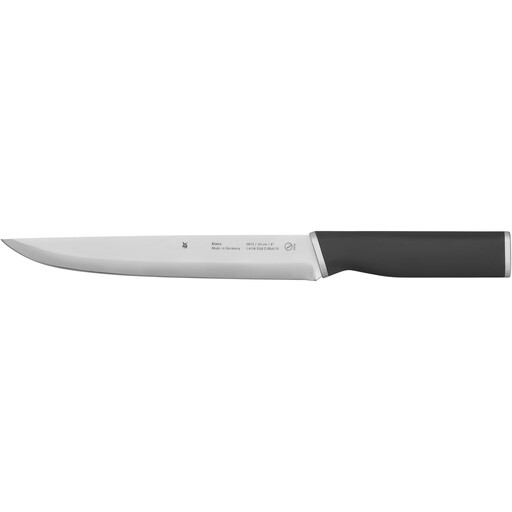
Why this product suits the profile: The 20 cm blade is specified for raw, cooked and roasted meat, making it suitable for typical carving tasks at home.
The product details specify the length, a steel hardness of 55–58 HRC and hand washing as the care requirement. This makes important buying and ongoing-care criteria easier to assess.
Specially hardened steel, a slightly curved 20 cm blade and an ergonomic handle; hand washing is recommended.
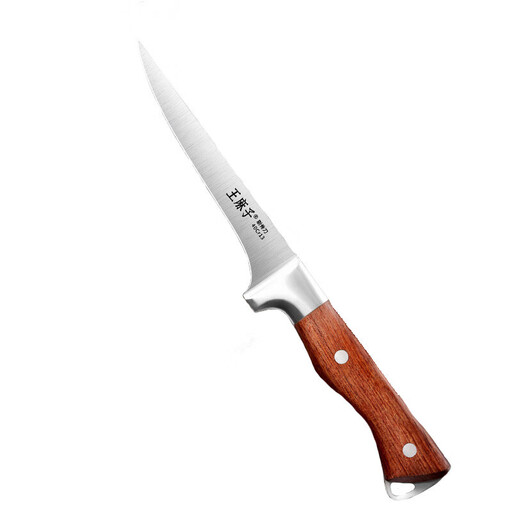
Why this product suits the profile: Its narrow design is intended for boning, skinning and processing beef, lamb or pork in butchery and commercial kitchen environments.
Its clearly defined purpose helps prevent a narrow boning knife from being used accidentally to chop bones.
40Cr13 blade specification, wooden handle and an intended use described as boning and skinning.
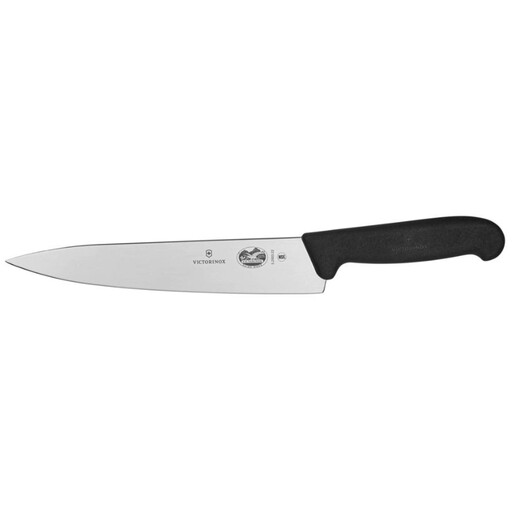
Why this product suits the profile: The long blade with a straight grind is designed to produce precise slices of meat, fish and other foods.
The 22 cm length is clearly stated. For working with bones, a separate chopping knife or boning knife remains the more suitable choice.
Stainless-steel blade, plastic handle with a non-slip design and described as dishwasher-safe in the product information.
We have put together a complete, regularly updated list of products that fully meet these strict selection criteria and the safety regulations applicable in the EU.
For roasts and larger pieces, 20 to 22 cm is often practical. Shorter blades of around 11 to 16 cm are more suitable for steaks, smaller portions or specific cutting tasks. The ideal length depends on the size of the piece, the chopping board and your personal handling style.
It depends on the model. Some product specifications allow dishwasher cleaning, while others require hand washing. Even when machine cleaning is permitted, hand washing can give you better control over the care of the blade and handle. The manufacturer’s instructions are the deciding factor.
A boning knife is useful when meat needs to be separated from the bone, skinned or trimmed of sinews. A carving knife is more suitable for slicing roasts. For bones and hard structures, use only a chopping knife or cleaver designed specifically for that purpose.