
Lieferung heute & morgen

Qualitätsgarantie

Willkommens-Angebote freischalten: KOSTENLOSE Lieferung | Bis zu 80 % RABATT | Kostenlose 30-Tage-JoyPlus-Testphase
App herunterladen
A mechanical gaming keyboard should register keystrokes quickly, feel comfortable to type on and suit your existing desk setup. In practice, unclear layout details, overemphasis on lighting and switches that don’t suit your needs can often lead to the wrong purchase. So before you buy, it’s worth looking beyond the marketing and checking the technical details.
For users in Germany, a QWERTZ keyboard is usually the more straightforward choice. The positions of “Z” and “Y”, along with the special characters, match the German layout. A QWERTY keyboard with a US layout may suit programmers, certain games or international working environments, but you’ll need time to adjust and may have to change your operating system settings.
A keyboard that looks German isn’t necessarily a genuine QWERTZ model, either. Check the product photos, specifications and the labels on the special keys.
A gaming keyboard with RGB can make it easier to find the right keys in low light and complement the look of your setup. But it tells you little about how the keyboard feels to type on, how sturdy it is or how accurately it registers inputs. The key factors include switch type, key rollover, case construction and connectivity.
For a wireless keyboard, you should also check the battery capacity, charging port and whether a 2.4 GHz receiver is included. In everyday use, a missing or awkwardly stored receiver can be more frustrating than less eye-catching lighting.
Some compact keyboards use membrane or scissor-switch technology but are marketed as having a mechanical feel. That may be perfectly adequate for office work, but it isn’t the same as having genuine mechanical switches. If you want to change the switches or customise how the keyboard feels, you’ll need a genuinely mechanical model or a hot-swappable keyboard.
The keyboard’s form factor affects which keys are available and how much room you have to move:
For FPS players, the extra mouse space offered by a 65% or TKL keyboard can be useful. If you type a lot, check whether you regularly use the function keys, Home, End or Print Screen.
Linear switches move without a tactile bump and are often favoured by players who want consistent keystrokes. Tactile switches provide noticeable resistance, while clicky switches also produce a distinct clicking sound.
A quiet mechanical keyboard depends on more than just the switches. Sound-dampening mats, the case, stabilisers and keycap material can all affect how much noise it makes. PBT keycaps are more resistant to developing a shiny appearance through use than ABS keycaps on many models, but that doesn’t automatically make them quieter.
A wired USB-C keyboard doesn’t need battery management and provides a consistent connection. A wireless mechanical keyboard is more practical if it offers several connection options:
A tri-mode keyboard combines all three options. Check whether the model can actually remember multiple Bluetooth devices and whether you can store the receiver inside the case.
A hot-swap PCB lets you replace compatible 3-pin or 5-pin switches without soldering. Make sure the pins are aligned correctly and insert the switches carefully. A gasket-mount keyboard can offer a softer typing feel thanks to its flexible layers, but the actual effect depends on the entire construction.
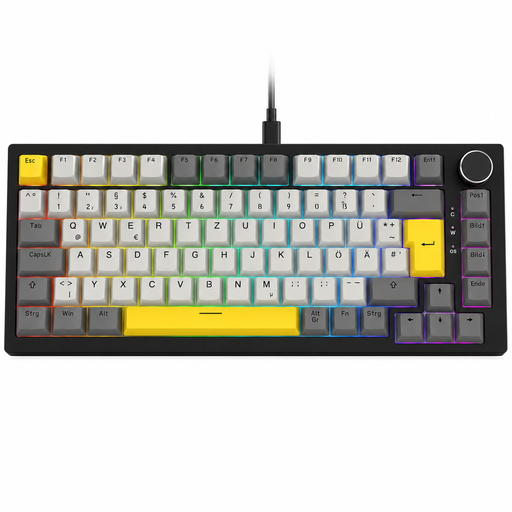
Why this product suits you: This wired 75% model combines a German layout with hot-swap functionality, RGB lighting and a volume control. It’s suitable for gaming and everyday typing, with no battery or pairing to worry about.
The QWERTZ layout is clearly specified. Mechanical switches and a hot-swap PCB also make it clear that this isn’t a membrane-only keyboard.
75% form factor, USB-C wired use, RGB lighting, volume knob and support for replacing compatible switches.

Why this product suits you: This low-profile model is designed for anyone looking to combine a slim design, German key layout and multiple connection options in one device.
The specifications clearly state that it has a German QWERTZ layout, mechanical low-profile switches and 2.4 GHz, Bluetooth and USB-C connectivity.
65% form factor, CHERRY MX Low Profile Speed switches, per-key RGB, N-key rollover and support for up to three Bluetooth devices, according to the product specifications.
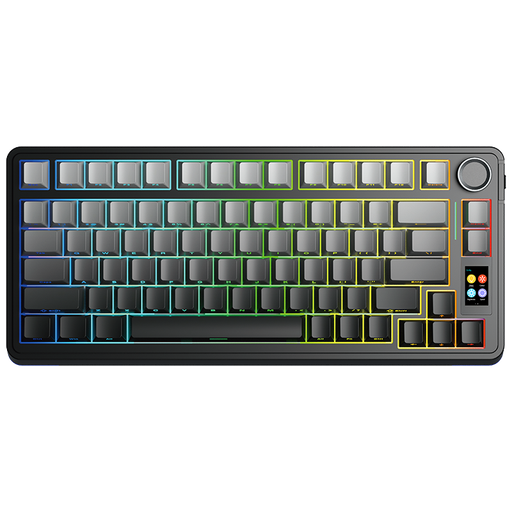
Why this product suits you: If you’re looking for a versatile setup for gaming, working from home and using multiple devices, this compact tri-mode keyboard offers extra controls, too.
This model combines 2.4 GHz wireless, Bluetooth and wired connectivity. Hot-swap support and a documented gasket construction give you ways to customise it rather than locking you into a fixed setup.
75% layout, TFT display, rotary knob, hot-swap functionality and five layers of sound dampening, according to the product description.
We’ve put together a complete, regularly updated list of products that meet these strict selection criteria and fully comply with the safety regulations in force in the EU.
For wireless models, check the position of the USB receiver and look out for possible sources of interference. For fast gaming inputs, 2.4 GHz is often the obvious wireless choice; Bluetooth is particularly useful when switching between devices or working on the go. Don’t assess the advertised polling rate in isolation: the game, computer, monitor and input settings can all affect your experience.
If you’re buying a model with a battery, safety information should form part of your decision. Lithium-ion batteries must not be opened or damaged, or charged with unsuitable power adapters. Spilt liquids can damage the PCB and battery. Only clean the keyboard with a soft, dry cloth when it’s switched off and disconnected.
Yes, as long as the volume, layout and switch type suit your surroundings. Linear or dampened switches are often quieter than clicky options. O-rings, quieter switches or a keyboard with multiple layers of sound dampening can also help reduce noise.
Lifespan depends on the switches, keycaps, stabilisers, cable, battery and how you use the keyboard. Manufacturers often quote high actuation figures for individual switches, but that doesn’t automatically indicate how long the whole keyboard will last. Keeping dust out, cleaning it carefully and avoiding liquids can help keep it working reliably.
Yes. A wireless keyboard for PC with a 2.4 GHz receiver can be suitable for gaming if the receiver, range, battery level and software all work reliably together. If you want the simplest option without having to plan around charging, a wired USB-C keyboard is a sensible alternative.