
Lieferung heute & morgen

Qualitätsgarantie

Willkommens-Angebote freischalten: KOSTENLOSE Lieferung | Bis zu 80 % RABATT | Kostenlose 30-Tage-JoyPlus-Testphase
App herunterladen
A mechanical gaming keyboard should register keystrokes quickly, respond reliably while you type and suit your workspace. Yet product names and technical claims can often lead to the wrong purchase. The most common pitfalls are choosing the wrong layout, unsuitable switches and wireless features whose benefits depend on how you plan to use the keyboard.
This buying guide explains which details really matter when choosing a mechanical keyboard, and which models suit different types of user.
Many budget models use a US layout. A QWERTY keyboard has a different arrangement of important keys from the German layout. If you regularly type in German, this can cause problems with Z, Y, umlauts, special characters and the Enter key.
For Germany, an ISO-DE QWERTZ keyboard is usually the more straightforward choice. You can change the software layout on a US model, but the keycap legends will remain the same.
A gaming keyboard with RGB lighting can improve visibility in low light and let you customise its appearance. However, RGB says nothing about key stability, responsiveness or typing comfort. Be sure to check:
A wireless mechanical keyboard needs a battery, receiver or Bluetooth pairing. A 2,4-GHz connection can be useful for desktop gaming. Bluetooth is better suited to laptops, tablets or switching between multiple devices. If you want to avoid charging breaks and wireless setup, a USB-C keyboard is often the simpler option.
A compact 75% keyboard usually includes function keys, arrow keys and essential navigation keys, while taking up less space than a full-size model. A TKL keyboard does away with the number pad, leaving more room to move your mouse. 65% and 60% models save even more space, but often require Fn key combinations.
A model with a number pad is still more practical for spreadsheets, bookkeeping and lots of number entry. For FPS games, programming and smaller desks, a 75% or TKL keyboard may be a better fit.
Linear switches move smoothly, with no tactile bump. They’re a popular choice for fast gaming inputs and fluid typing. Tactile switches provide noticeable feedback at the actuation point. Clicky switches also make a distinct sound, which can be distracting in shared spaces.
A hot-swap keyboard lets you replace compatible switches without soldering. Check the stated compatibility: some models support both 3-pin and 5-pin switches, while others support only one type. The keycap mounting and switch height should also be compatible.
PBT keycaps are shape-retaining and, according to product information, less prone to developing a shiny finish through wear than many ABS keycaps. However, they don’t automatically make a keyboard quieter. Switches, case, plate and dampening all affect the sound.
A gasket-mount keyboard suspends the plate inside the case using flexible elements. Combined with foam layers, this can change the feel of each keystroke and the keyboard’s resonance. The effect depends on the design, so it isn’t a universal measure of quality.
A volume control is handy if you often adjust or mute audio. Check whether it controls volume only or also supports media and system functions.
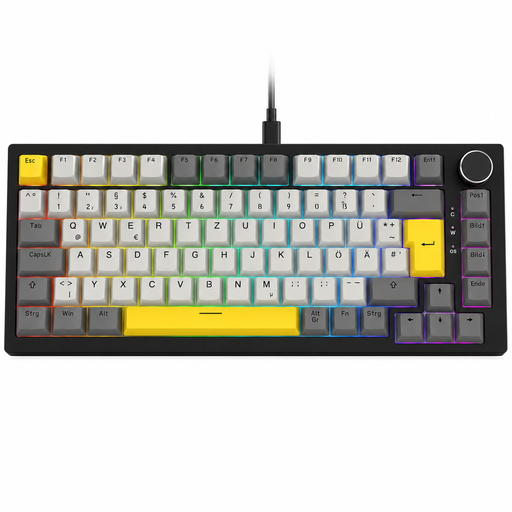
Why this product suits this profile: The German 82-key QWERTZ layout, USB-C connection and integrated volume control offer a straightforward set of features for gaming, office work and everyday typing.
The ISO-DE layout reduces the risk of ending up with unsuitable US key markings. The wired connection needs neither a battery nor a wireless receiver.
75% form factor with 82 keys, hot-swap support for compatible 3-pin switches, RGB lighting and a detachable USB-C cable.

Why this product suits this profile: Its low-profile design, German QWERTZ layout and three connection options make it a good fit for users who switch between gaming, a laptop and multiple devices.
The specifications explicitly list QWERTZ, 2,4 GHz, Bluetooth and USB-C, making it easier to work out which wireless mode suits your needs.
65% format, linear CHERRY MX Low Profile Speed switches, per-key RGB and support for up to three Bluetooth devices, according to the product information.

Why this product suits this profile: The 98% layout with number pad, TFT display, volume control and tri-mode connectivity makes it well suited to frequent typists, programmers and users with multiple devices.
You keep the number pad, while the design is more compact than a traditional full-size model. Hot-swap support also lets you customise it later.
Bluetooth, 2,4 GHz and USB-C, PBT keycaps, gasket-mount construction and a display, according to the product description.
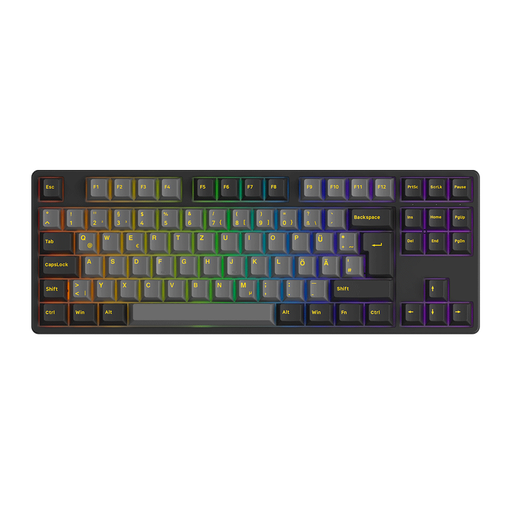
Why this product suits this profile: The TKL format combines a German ISO-DE layout with RGB lighting and wired use for gaming, programming and office work.
The specifications list an ISO-DE layout, 3-pin/5-pin hot-swap support and a 1000-Hz polling rate when used wired.
PBT double-shot keycaps, Akko V3 Cream Yellow Pro switches, RGB and support for Windows and macOS, according to the product details.
Before placing your order, check the following:
We’ve put together a complete, regularly updated list of products that meet these strict selection criteria and fully comply with the safety regulations in force in the EU.
Lifespan depends on the switches, dirt, liquids, usage and build quality. Manufacturers often quote millions of keystrokes as a guide. This figure doesn’t necessarily reflect the lifespan of the keycaps, stabilisers, battery or hot-swap sockets.
Yes, as long as the noise level and layout are right. Linear or dampened switches are usually less noticeable in shared spaces than clicky ones. A desk mat and keyboard dampening can also affect the noise level.
Power consumption depends mainly on RGB brightness, wireless standard, battery and usage time. Lighting usually reduces battery life more than typing alone. If you want to avoid frequent charging, choose a wired USB-C keyboard or turn off RGB when you don’t need it.