
Lieferung heute & morgen

Qualitätsgarantie

Willkommens-Angebote freischalten: KOSTENLOSE Lieferung | Bis zu 80 % RABATT | Kostenlose 30-Tage-JoyPlus-Testphase
App herunterladen
A mechanical gaming keyboard should give you precise input while gaming and perform reliably in everyday use. Options range from compact 60% models to full-size keyboards with a number pad. You’ll also find RGB lighting, wireless connectivity, swappable switches and different construction styles.
But if you focus only on high polling rates or eye-catching lighting, you could miss some important details. Three common buying misconceptions can lead to unnecessary extra costs later:
For users in Germany, a mechanical QWERTZ keyboard is often the obvious choice. The German layout makes it easier to type umlauts, special characters and common key combinations. On a US QWERTY model, the positions of Y and Z are swapped, along with the positions of some punctuation marks.
The main formats differ as follows:
Before you buy, measure the space available on your desk. Mouse movement matters too: if you need plenty of room for wide sweeps in FPS games, a more compact keyboard can be a better fit.
Linear switches move smoothly, with no noticeable bump. They’re often chosen for fast input and longer typing sessions. Tactile switches give you a noticeable bump when they actuate. Clicky switches also produce a distinct sound, so they may not be suitable for every office or shared household.
A hot-swappable keyboard lets you replace compatible switches without soldering. Check whether the PCB supports 3-pin and 5-pin switches. You should also line up switches carefully when inserting them, as bent contacts can damage the sockets.
A gasket-mount keyboard supports the plate that holds the switches using flexible elements. Combined with foam layers, this can help reduce vibration and resonance. It doesn’t guarantee a particular noise level, as keycaps, switches, your desk surface and the way you type all play a part too.
A wireless mechanical keyboard can connect via Bluetooth, 2.4 GHz or USB-C. A Bluetooth and 2.4 GHz wireless keyboard will often offer several ways to connect:
Before buying, check the battery capacity, charging port, profile storage and compatibility with your operating system. RGB lighting is mainly a feature for customisation. With an RGB gaming keyboard, it’s also worth checking whether you can control individual keys, brightness and effects using keyboard shortcuts or software.
PBT keycaps are less prone than many ABS alternatives to developing a shiny surface through regular use. However, build quality, the printing method and the specific thickness of the material still matter.
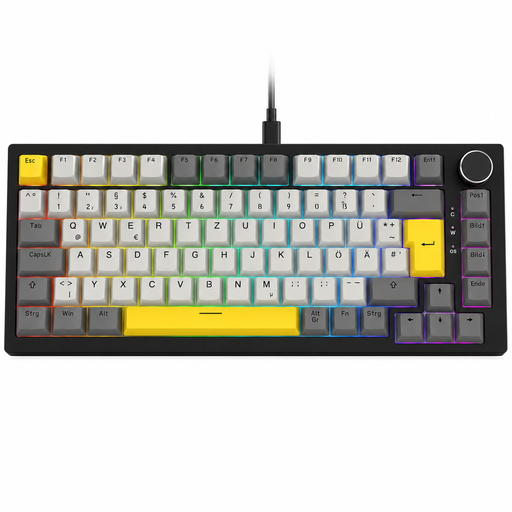
Why this product suits this profile: Its compact German layout combines arrow keys, function keys and a volume control with a wired USB-C connection.
The QWERTZ layout means less adjustment, while the wired connection avoids battery and pairing concerns. Hot-swap support makes future customisation easier.
82 keys, QWERTZ layout, RGB lighting, gasket-mount construction and support for 3-pin switches.

Why this product suits this profile: This 65% model combines a German QWERTZ layout and low-profile switches with three connection options for gaming and multi-device setups.
You’re not limited to Bluetooth: according to the product specifications, USB-C, 2.4 GHz and Bluetooth are all available.
CHERRY MX Low Profile Speed switches, per-key RGB, support for up to three Bluetooth devices and N-key rollover.

Why this product suits this profile: The 68-key format is aimed at users who need plenty of room for their mouse and want features such as adjustable actuation or Rapid Trigger.
The compact design is backed up by clear specifications: 68 keys, magnetic switches and adjustable actuation.
According to the product specifications: adjustable actuation point from 0.2 to 4.0 mm, Rapid Trigger, 8,000 Hz polling rate and RGB lighting.

Why this product suits this profile: The 98% layout retains many function keys and the number pad, while Bluetooth, 2.4 GHz and USB-C make it suitable for different work setups.
The larger design keeps the number pad. You can switch modes to suit your device and application.
97 keys, volume control, TFT display, hot-swap support for 3- and 5-pin switches, and five damping layers.
We’ve put together a comprehensive, regularly updated list of products that meet these strict selection criteria and fully comply with the safety regulations in force in the EU.
Lifespan depends on the switches, keycaps, how often you use the keyboard and how well you look after it. Some models quote a specific number of keystrokes, such as 50 million presses. This is a manufacturer’s specification, not a guarantee of how long the keyboard will actually last. Dust, spills and incorrectly fitted switches can shorten its lifespan.
A 2.4 GHz connection is suitable for many games, provided the keyboard, receiver and computer work together without interference. Bluetooth is handy when switching between devices, but latency can vary depending on the system. For the most consistent connection, USB-C remains a dependable option.
With wired models, there are no regular charging or battery costs beyond the computer’s power consumption. Wireless devices need to be charged, and an internal battery can be harder to replace if it fails. A hot-swappable keyboard could reduce repair or customisation costs over time, as compatible switches can be replaced without soldering.