
Lieferung heute & morgen

Qualitätsgarantie

Willkommens-Angebote freischalten: KOSTENLOSE Lieferung | Bis zu 80 % RABATT | Kostenlose 30-Tage-JoyPlus-Testphase
App herunterladen
The search for a new mechanical gaming keyboard can quickly become overwhelming. The market is flooded with technical jargon, marketing promises, and a bewildering number of models. Many users invest in a keyboard only to find out after a few months that it doesn't meet their needs or has fundamental flaws.
As your Joybuy Product Recommendation Officer, I'm here to help you recognise the common pitfalls and make an informed decision. We'll focus on the facts so you can find a model that precisely fits your needs.
The 2 most common pitfalls when buying a keyboard:
To avoid a bad purchase, you should focus on three core aspects. These are crucial in determining the performance, comfort, and longevity of your future keyboard.
The "switch" is the mechanism under each key that defines the typing feel and response time. Choosing the right switch type is the most important decision. The three main categories are:
A hot-swap keyboard offers additional flexibility here. On these models, the switches can be replaced without soldering, allowing you to try out different types and customise the typing feel to your preferences.
The size of the keyboard affects not only the space on your desk but also its ergonomics and functionality.
When making your selection, be absolutely sure to choose a QWERTZ mechanical keyboard to avoid compatibility issues in German-speaking regions. All models featured here with a German layout are marked accordingly. You should also check the connection options: while a wired keyboard for PC offers the lowest latency, wireless models with 2.4G radio or Bluetooth allow for a clean and flexible setup.
Here are some recommendations tailored to specific user profiles that take the above criteria into account.

Why This Fits Their Persona: Ideal for gamers who want to try out the compact 60% format and customisable RGB lighting without a large budget. The keyboard offers a great entry point into the world of gaming peripherals.
This model is described as "Mechanical-Feel." This means you know upfront that it's a membrane keyboard designed to mimic the typing sensation of mechanical keys, helping you avoid the mistake of expecting a true mechanical keyboard.
Compact 60% layout for maximum mouse space. Adjustable RGB backlighting. According to the manufacturer, the circuit board is IPX4 waterproof.
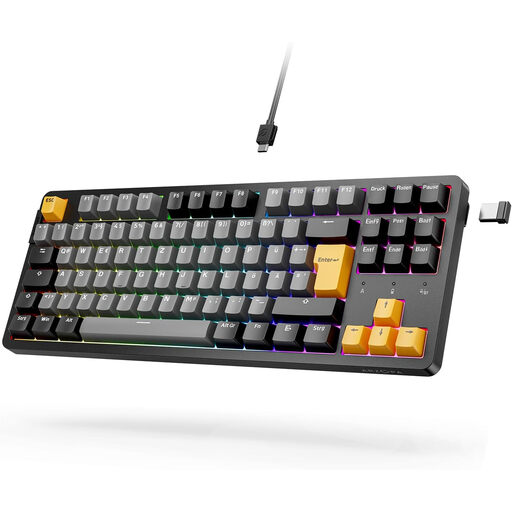
Why This Fits Their Persona: Perfect for users who value customisability and a German layout. The TKL (80%) format is a great compromise between compactness and functionality, while its hot-swap capability allows for experimenting with different switches.
This model features an explicit German QWERTZ layout and is a hot-swap keyboard. This allows you to bypass the two biggest pitfalls: getting the wrong layout and being locked into a single switch type that might not suit you.
Hot-swap sockets for 3-pin and 5-pin switches. Tri-mode connectivity (Bluetooth/Wired/2.4G). Gasket-mount structure for a dampened typing feel.
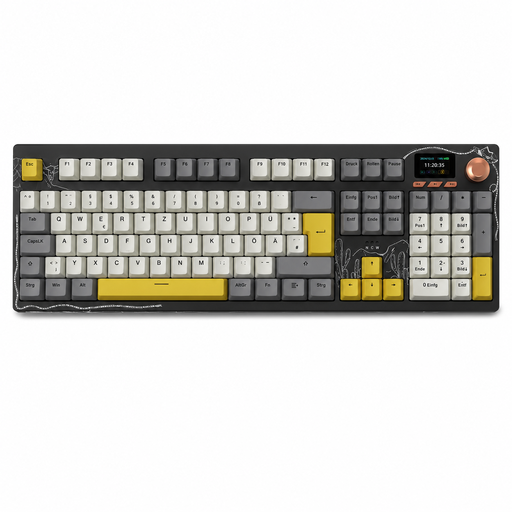
Why This Fits Their Persona: For users looking for a single keyboard for both productive work and demanding gaming. The full-size layout with a number pad and flexible connection modes make it extremely versatile.
This model combines practical features like the QWERTZ layout and number pad with modern functions (TFT screen, hot-swap). It avoids the compromise of sacrificing essential productivity for aesthetics.
Full-size QWERTZ layout with 104 keys. Integrated 1.14-inch TFT colour screen. Hot-swap capable and tri-mode connectivity.
We have compiled a complete, real-time list of products that fully satisfy these strict selection criteria and UK safety regulations.
Linear switches (often red) have a smooth, consistent key travel and are quiet, ideal for fast-paced gaming. Tactile switches (often brown) have a noticeable bump that signals actuation but remain relatively quiet. Clicky switches (often blue) offer the same noticeable bump but also produce a loud clicking sound, which is appreciated by many typists.
Technically, it will work, but it is not recommended. The Z and Y keys are swapped, and important characters as well as German umlauts (?, ?, ü) are only accessible through cumbersome key combinations or software adjustments. For a seamless typing and gaming experience in Germany, a QWERTZ layout is essential.
On a hot-swap keyboard, the mechanical switches can be easily pulled from the circuit board and replaced with other compatible switches without needing a soldering iron. This allows you to customise the typing feel of your keyboard, easily replace faulty switches, or mix different switch types (e.g., linear, tactile) on the same board.