Designers with limited desk space
If you need room for recipe templates as well as your keyboard and mouse, it’s worth checking the actual case dimensions. Ducky lists different dimensions for the One 3 RGB, depending on the format.


If you regularly use the arrow and function keys while laying out pages, a compact 75% layout is a sensible starting point; if space is especially tight, a 65% layout could work. Compare the actual case dimensions and key layout: fewer keys may mean using extra shortcuts, and the switches and connection should suit your workspace.
If you need room for recipe templates as well as your keyboard and mouse, it’s worth checking the actual case dimensions. Ducky lists different dimensions for the One 3 RGB, depending on the format.
If you often position objects using the keyboard, check that the arrow keys and any function keys you need are easy to reach. Adobe explains how to move selected objects in InDesign in small increments using the arrow keys.
If other people are working nearby, the specific switch type and typing noise are important factors to consider. The name of a switch alone doesn’t tell you how loud the complete keyboard will be when you use it.
First, measure the usable desk space, then check your most-used layout commands against the keyboard’s key arrangement. Finally, check the layout, connection and switch type of the specific model.
| Consideration | What to look for | Who will find this most important? |
|---|---|---|
| Room for a mouse and templates | Compare the case width and depth with the available space; weigh up 65% and 75% layouts against the keys you need. | If I need to fit my mouse and recipe templates beside the keyboard, I compare the dimensions of the whole setup. Around 36% of consumers put space requirements first. |
| Layout keys within easy reach | Check whether you need arrow keys, a function row or a number pad for your commands. | If you often move objects with the arrow keys or call up specific commands directly, check that the layout suits your software workflow. Around 29% of consumers focus above all on having the keys they need within easy reach. |
| Typing feel and noise | Choose the specific switch type; if you plan to customise your keyboard, check that it’s hot-swappable and that the switches are compatible. | If I do a lot of typing at a shared desk, switch feel and noise matter more to me than the word ‘mechanical’. Around 21% of consumers prioritise typing feel or noise. |
| Layout and connection | Check that the selected DE-ISO version and the connection and accessories you need are right for you. | If you need a German keyboard layout or a particular connection for your computer, check the specific version you’ve selected. Around 14% of consumers put layout or connection first. |
Even compact keyboards take up space that could otherwise be used for moving your mouse or laying out templates. Dimensions can also vary considerably between models in the same range.
Measure the available space for your whole setup and compare the actual case dimensions rather than relying on percentage figures alone.
Adobe documents how to move selected objects in InDesign in small increments using the arrow keys. Other keys may also be important, depending on the commands you use; a more compact layout may require extra shortcuts.
Make a note of your most-used commands and check them against the keyboard’s actual key arrangement.
A model family may include keyboard layouts for several countries. Keychron’s K3 Max collection includes various ISO layouts, so make sure the specific version you choose matches the German layout you want.
Before buying, check that the listing explicitly identifies the selected version as DE-ISO.
The K3 Max ISO is a 75% option for anyone looking to pair a compact format with arrow and function keys, and check that the German layout is right for them.
The MX-LP 2.1 Compact Wireless is a 65% mechanical keyboard with low-profile switches.
The One 3 RGB comes in several sizes, making it easy to compare options within the same range.
The MX Mechanical Mini is a low-profile mechanical option if switch choice and switching between devices are important to you.
This selection includes mechanical keyboards in compact formats, as well as models with a German layout. Before buying, check that the size, key arrangement and connection suit your workspace.
 No image available
The 65% format is a good fit if desk space is limited and the stated German layout suits you.
68 keys; low-profile MX Speed switches; tri-mode connectivity with 2.4 GHz, Bluetooth or USB-C; RGB.
 No image available
The stated 75% format and ISO-DE layout are worth considering if you’re looking for a compact keyboard with a German layout.
Tri-mode connectivity with Bluetooth, 2.4 GHz and USB-C; hot-swap; VIA compatible.
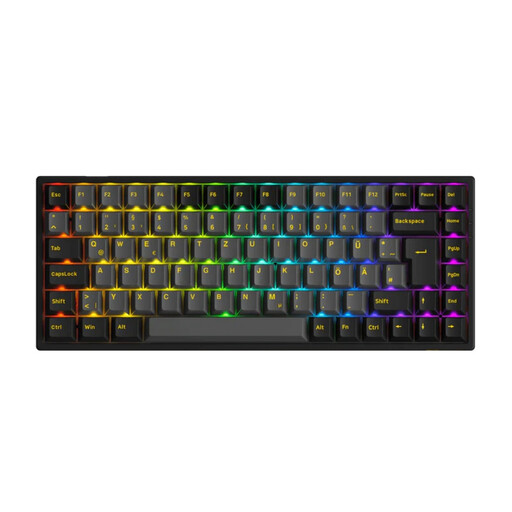 No image available
The stated combination of a 75% layout and ISO-DE is a good fit for a space-conscious workspace with a German layout.
Tri-mode connectivity with Bluetooth, 2.4 GHz and USB-C; hot-swappable; RGB.
 No image available
The stated German layout may suit your typing needs, but ‘Tactile Quiet’ isn’t a measurement of how loud the keyboard will be at your desk.
Tactile Quiet switches; Bluetooth and Logi Bolt; Smart Backlighting.
 No image available
The 75% format includes arrow and function keys, but the stated US QWERTY layout isn’t a German ISO-DE layout.
Flying Fish Linear switches; tri-mode connectivity with Bluetooth, 2.4 GHz and USB-C; hot-swappable.
Start by checking the commands you actually use in your layout software. Adobe explains how to move selected objects in InDesign in small increments using the arrow keys; you can also search its keyboard shortcuts by command. Then compare the keys you need with the model’s layout.
First, check the layout of the keyboard you’ll receive and the connection on your computer. In InDesign, you can search existing commands and create your own command sets under ‘Edit > Keyboard Shortcuts’. Then check that the compact layout has everything you need for the steps you use most often.
No, it depends on the model and version. Keychron says the appropriate K3 Max version supports hot-swapping compatible low-profile mechanical switches; Ducky describes the One 3 RGB as a hot-swappable model. Before buying replacement switches, check the exact version and compatibility.
In Germany, many online purchases generally come with a 14-day right to cancel. The Verbraucherzentrale advises that you must notify the seller that you wish to cancel. Check the details of your specific purchase and any exceptions before budgeting for return postage.
As part of its market surveillance, the Bundesnetzagentur checks, among other things, for CE marking, product traceability and correct manufacturer details. A model or wireless technology label alone doesn’t prove that a specific listing is compliant. In Germany, old keyboards should be taken to an authorised collection point for electrical and electronic equipment.