Interviewers dealing with fan noise
If you’re mainly recording one voice in a room with a fan running, you can control the microphone’s distance and direction.


For a seated memory interview with one person sharing their story, a close-positioned cardioid microphone is a natural starting point. Point its less sensitive side towards the fan and check the position with a test recording. If you want to record both voices separately, or your interviewee will be moving around, a two-microphone set or a lavalier mic with a recorder may be better suited to the conversation. These options do require more planning around attachment, power and files.
If you’re mainly recording one voice in a room with a fan running, you can control the microphone’s distance and direction.
If you want the questions and the stories to be recorded through separate microphone sources, a single microphone between the speakers may not be the right solution.
If your interviewee will be moving around, a microphone worn close to the body with its own recording option can make things easier.
First, decide whether you want to record one voice or both voices separately. Then consider whether you can hold a handheld microphone close to the speaker or whether freedom of movement matters more. Finally, check which recording setup is right for you.
| Your priority | What to check before buying | Who is this important to? |
|---|---|---|
| Clear speech despite fan noise | Polar pattern, distance from the speaker and the fan’s position relative to the microphone’s pickup direction. | If my main aim is to record one seated person clearly, I focus on close placement and careful positioning; around 36% of consumers prioritise a clear recording of one voice. |
| Recording both voices in the conversation | Number of microphones and recording channels, plus how each file is assigned and monitored. | If I also want to record my questions as the interviewer separately, I need a dedicated microphone source for each person; around 29% of consumers prioritise recording two separate voices. |
| Freedom of movement and recording on the device | How the lavalier or recorder system is attached, powered and stores recordings. | If the interviewee moves around during the conversation, a microphone worn close to the body with its own recording function matters to me; around 21% of consumers prioritise mobile recording on the device. |
| Connection and recording setup | Available inputs, required cables and, where applicable, headphone monitoring. | If I want to connect the recording directly to my computer or existing device, I check the connection in advance; around 14% of consumers prioritise a straightforward recording setup. |
An omnidirectional microphone can make it easier to move around, but it also picks up sound from the direction of the fan.
Choose between freedom of movement and a more directional recording based on the seating arrangement, then test the position with a sample recording.
32-bit float describes a recording format; it does not remove ambient sound that has already been recorded. According to the manual, the feature on the RØDE Wireless PRO applies to the transmitter recordings.
First improve the distance and positioning, then listen back to the file that was actually saved.
An XLR microphone needs a compatible microphone input. The connection and cable must be suitable for your recording device.
Before ordering, check the inputs and outputs, as well as what’s included with the specific model.
Depending on the equipment you already have, you may also need a compatible recording device or a required connection cable.
The MD 46 is a dynamic XLR reporter microphone with a cardioid polar pattern.
The PRO41 is a wired cardioid handheld microphone with XLR; the ATR2100x-USB has both USB and XLR connections.
The Reporter is a wired omnidirectional handheld microphone; the Wireless PRO is a two-channel wireless set with two lavalier microphones.
The F2 combines a portable recorder with a lavalier microphone for recording one speaker on the move.
The models below include USB and XLR handheld microphones, as well as lavalier and multi-transmitter options for interviews with one or two speakers.
 No image available
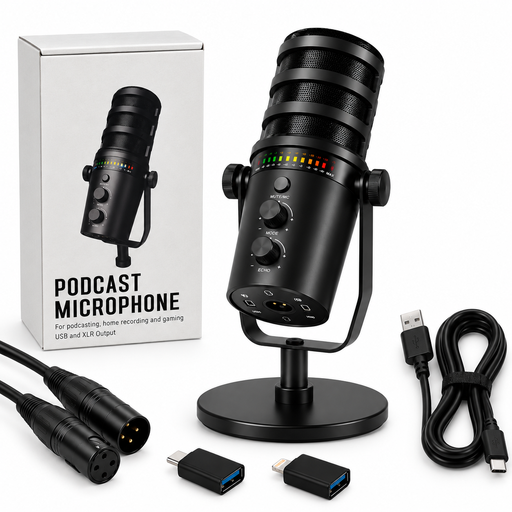
An option for recording one voice with a focused pickup pattern on a computer, if an XLR setup is also suitable.
The set is described as a dynamic microphone with USB and XLR outputs, RGB lighting, gain control, echo, mute and a desk stand. The description specifies a cardioid polar pattern and front-facing pickup.
 No image available
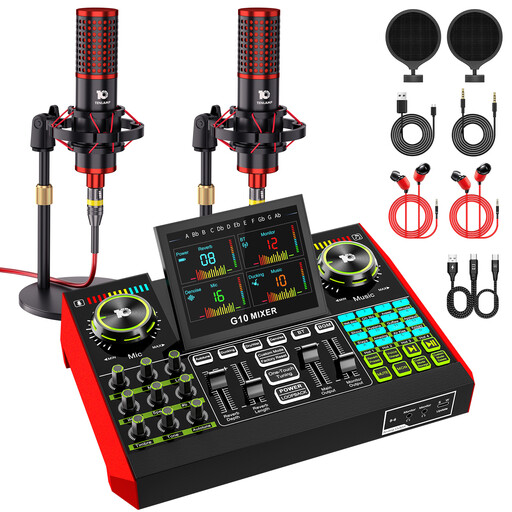
An option if you want the interviewer and the person sharing their story to each have their own microphone source.
Includes two 3.5 mm condenser microphones, a G10 mixer and two disc stands.
 No image available
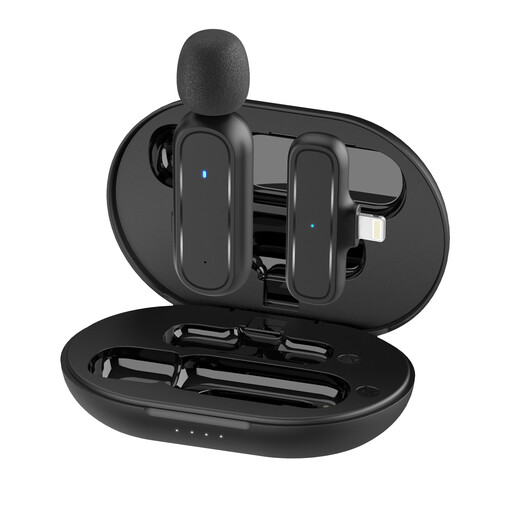
An option worn close to the body for an interviewee, if your recording device has a compatible Lightning connector.
The Lightning version includes one transmitter and one receiver. Before using it wirelessly, check the specific frequency variant and the requirements that apply to it.
 No image available
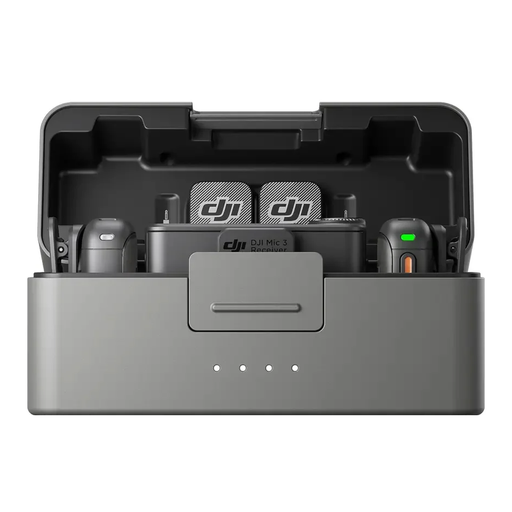
An option if two people are each using a transmitter and you also want to monitor the transmitter recordings.
The set includes two transmitters, one receiver and a charging case. Each transmitter is specified as having 8 GB of internal storage; before using it wirelessly, check the specific frequency variant and the requirements that apply.
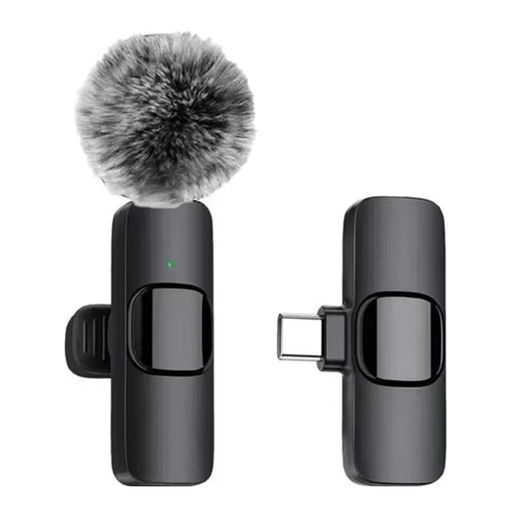 No image available
A microphone worn close to the body for interviews, if your recording device uses the specified Type-C connector.
The model is described as a wireless lavalier microphone with Type-C. Before using it wirelessly, check the specific frequency variant and the requirements that apply.
No. Neither a polar pattern nor a 32-bit float recording guarantees that fan noise will be completely blocked out. Position the microphone as close to the speaker as possible and make a test recording to check which direction the fan is coming from; directional pickup depends on the angle at which the sound reaches the microphone.
Make a test recording of both intended speakers and listen back to the files that were actually saved. Direct headphone monitoring at the microphone is specified for the ATR2100x-USB; the RØDE Wireless PRO transmitter recordings are a separate recording route and should be checked separately.
Check the full signal path and what’s included with the specific version. An XLR microphone such as the Sennheiser MD 46 needs a compatible microphone input; the manufacturer lists an XLR cable as included with the Audio-Technica PRO41, and USB and XLR cables with the ATR2100x-USB.
Not in every case. Under § 201 of the German Criminal Code (StGB), recording words spoken in private without authorisation is a criminal offence. Before the interview, clarify that you have permission to record, and separately confirm any planned sharing or publication. If an organisation processes personal data, the European Data Protection Board says it must identify a legal basis under the General Data Protection Regulation that is appropriate to the specific project; consent is one possible legal basis, but it is not the only one.
No. In its general assignment of April 2026, the Federal Network Agency specifies permitted frequency bands and the related technical and operational conditions. Check the frequency variant of the specific wireless set against the applicable assignment; the model name alone does not mean it is authorised.