What should you look for when buying?
LAN backhaul
A good fit if: there’s a usable network cable between your router and home office.
Trade-off: The cable needs to be in place or installed, but it means the nodes don’t need to connect over Wi-Fi.
Wireless mesh
A good fit if: there’s no cable and an intermediate node can get a good wireless connection to the router or next node.
Trade-off: The backhaul also needs to pass through the walls. Placing a node just beyond the problem wall doesn’t guarantee a strong enough connection.
Powerline with Wi-Fi
A good fit if: there’s no usable LAN connection or suitable place for a wireless node, and you can test it at the sockets you plan to use.
Trade-off: Your electrical wiring and appliances can affect the connection; interference is possible with certain VDSL connections.
| What matters when buying |
What to check |
Who is it important to? |
| Backhaul through or around the walls |
Check for an existing LAN connection, or the wireless node’s location and connection quality. |
If I’m backing up work documents through thick walls, the backhaul from the node to the router needs to work too. Around 36% of consumers put this connection first. |
| Throughput on the backup route |
Consider the backup destination, the LAN ports you need and the complete transfer route. |
For consumers who care about file transfers, the route from the work device to the local or remote storage destination matters. Around 29% prioritise this transfer route. |
| Keeping your existing router |
Check that the router model and software version work with the type of extension you want. |
If I want to keep my router, I need to know whether the extension will work with that specific device. Around 21% of consumers prioritise router integration. |
| Secure, predictable operation |
Check firmware maintenance, Wi-Fi encryption, storage destination requirements and, where relevant, warranty terms. |
When backing up work data, you need to consider security measures and recovery together. Around 14% of consumers put secure, predictable operation first. |
A headline Wi-Fi speed calculated by adding together the rates of different bands isn’t the same as measured throughput for a work backup. TP-Link notes that actual Wi-Fi throughput and coverage for the Deco BE25 depend on factors including building materials and the devices involved. For local backups, also check which ports your computer and storage destination need. For cloud backups, your internet connection is part of the transfer route too.
Joybuy product selection
This selection includes mesh systems and a mesh access point for Wi-Fi coverage across several rooms. Check whether the specific version provides the backhaul to the router you need.
 No image available
TP-Link Deco BE22, 2-pack, Wi-Fi 7
A mesh kit for Wi-Fi coverage across several rooms. If you need a wired backhaul, check that this specific version supports it.
Dual-band; Gigabit Ethernet; two units.
View on Joybuy
 No image available
Ubiquiti U7 Mesh
For use as a mesh access point with a suitable wired uplink. Check the power supply and connection route you’ll need.
The product name lists 5,000 Mbit/s and Power over Ethernet. This headline figure isn’t a measurement of document backup performance at the place you’ll use it.
View on Joybuy
 No image available
TP-Link Deco X1500, 2-pack, Wi-Fi 6
Described as a mesh system for several rooms. Check where you plan to place the node and the complete route to your backup destination.
Dual-band; AX1500; Gigabit ports; two units.
View on Joybuy
 No image available
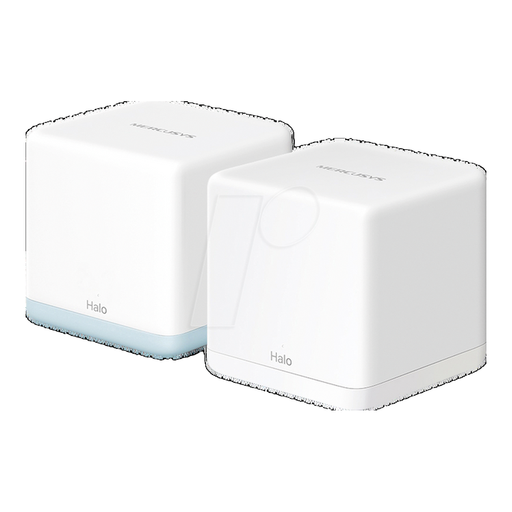
MERCUSYS Halo H1200G AC1200, 2-pack
For extending mesh coverage across several rooms. Check whether placing the second node will allow it to connect back to the router.
Wi-Fi 5; dual-band; Gigabit Ethernet; two units.
View on Joybuy
 No image available
MERCUSYS Halo H25BE, 2-pack, Wi-Fi 7
For mesh Wi-Fi across several rooms. The product description recommends placing the second node in an open area within range of the first.
Dual-band; BE3600; three Gigabit WAN/LAN ports per unit; MU-MIMO; WPA3.
View on Joybuy
Frequently asked questions
Does the mesh node need to be in the home office?
With a wireless connection, the node also needs to get a good signal from the router or next node. Choose its location based on backhaul quality, not just the Wi-Fi signal on your laptop. A network cable removes the wireless link between nodes.
Can I keep my existing router for my backup network?
Yes, if the extension you choose is compatible with your router and the way you want to use it. FRITZ! documents a LAN bridge and mesh integration for the Repeater 3000 AX with a FRITZ!Box running FRITZ!OS 7 or later. This doesn’t automatically apply to other routers.
What should I check after setting it up?
Check the connection to the remote node and test file transfers at the actual backup location. Keep your router firmware up to date and check that you can restore your backed-up documents. A working network connection alone doesn’t confirm that recovery will be successful.
What CE requirements apply to mesh devices in Germany?
According to the German Federal Network Agency, radio equipment covered by the relevant EU harmonisation legislation must bear the CE mark when placed on the EU market. Check that the specific listing shows the appropriate EU version and marking; a model name alone isn’t proof.
Do I need an individual frequency allocation for ordinary home Wi-Fi?
The Wi-Fi frequencies covered by the German Federal Network Agency’s general frequency assignments are intended for public use under the relevant frequency-use conditions. This means ordinary home Wi-Fi doesn’t require an individual frequency allocation. Whether a particular device meets the relevant conditions and product requirements needs to be checked separately.


