Homes where you may be able to run a cable
If you can connect the remote unit using an Ethernet cable, you can avoid a wireless link between the units.


First, check whether uploads are already slow near your router. The Bundesnetzagentur’s broadband measurement tool compares your actual connection speed with the speed agreed in your contract. If your upload speed is fine there, mesh Wi-Fi may improve a weak connection within your home. Ethernet backhaul avoids the wireless link between units, while a wireless node needs to be placed somewhere it can still get a strong enough signal. Mesh Wi-Fi won’t increase your internet connection’s upload speed.
If you can connect the remote unit using an Ethernet cable, you can avoid a wireless link between the units.
If the units need to connect wirelessly, it’s important to place the node somewhere it can still get a usable connection to the rest of your network.
If you already use a FRITZ!Box, first check whether a compatible repeater could extend your existing network.
First, measure the upload speed at your router and find out whether you can run a cable between the units. Then you can choose an extension that suits your router setup.
The figures relate to consumers considering mesh Wi-Fi for this photo-upload scenario; each row shows the main buying priority.
| Priority | What to check when buying | Who is it important to? |
|---|---|---|
| Connection between units | Check for Ethernet backhaul support, compatible ports and a possible route for the cable. | If I can run a cable to the remote unit, I want to avoid the wireless signal having to pass through the walls. That’s why around 36% of consumers put wired backhaul first. |
| Wireless backhaul | Check the number of units and possible intermediate locations; advertised range figures are no substitute for checking the placement. | Without a cable route, I need somewhere to place a unit where it can still connect to the network. That’s why around 29% of consumers prioritise a mesh system that can connect wirelessly. |
| Existing router | Check your router model, mesh integration and preferred operating mode. | If I already use a FRITZ!Box, I want to check for a compatible extension before buying a new system. Around 21% of consumers see connecting to their existing network as their top priority. |
| Upload bottleneck | Compare the upload speed near your router, or ideally over a LAN connection, with the result where you upload your photos. | If uploads are already slow near the router, I want to check whether my internet connection is the limiting factor before buying mesh Wi-Fi. Around 14% of consumers put this check first. |
Actual data speeds depend on factors including building materials, obstacles and your devices. Your internet connection’s upstream speed also limits uploads, regardless of Wi-Fi coverage.
Compare the upload speed at your connection with the result where you use your device before deciding whether you need mesh Wi-Fi.
With wireless backhaul, the connection between units also needs to get past obstacles. Ethernet backhaul uses a different route to carry the data.
Check for an intermediate location with a usable connection, or plan the cable route before you buy.
Adding another node or running a cable later can mean extra work.
According to eero, eero Beacon and eero 6 Extender don’t have an Ethernet port, while eero 6+ has two 1-GbE ports.
Check the ports and the full model name of every node rather than relying on the brand name alone.
An unsuitable add-on node may need to be replaced.
According to eero, extra security and management features may require a separate subscription. For radio equipment sold in Germany, the relevant conformity requirements and accompanying documentation also apply.
Check which extra features you need, and look for the CE mark and required documentation in the specific product listing.
Extra features may require a separate subscription.
The FRITZ!Repeater 1200 AX extends a compatible FRITZ!Box setup, while the FRITZ!Repeater 3000 AX is a tri-band alternative for a wireless connection between units.
The Deco X50 range offers router and access point modes, making it a relevant option for a multi-unit setup with optional Ethernet backhaul.
The eero 6+ is a standalone mesh system set up and managed through an app; choose a pack size that suits the number of units you need.
The products below are mesh kits with two or three units, designed to create a network across several rooms. The variants differ in model and stated standards. Whether the wireless signal can get through thick internal walls depends on where you place the units. Before buying radio equipment for use in Germany, check the CE mark and required accompanying documentation for the specific product listing.
 No image available
A two-unit mesh kit could be suitable for a setup across several rooms; the wireless connection at each location needs to work with the walls in your home.
Wi-Fi 7, dual-band, Gigabit Ethernet, white.
 No image available
Three mesh units are an option if you’re planning to use several nodes; how well they connect through internal walls depends on where you place them.
Dual-band, Gigabit ports.
 No image available
A two-unit mesh kit may suit a setup with two network nodes; check in advance that the planned locations will allow a usable connection.
Wi-Fi 6, dual-band, AX1500, Gigabit ports.
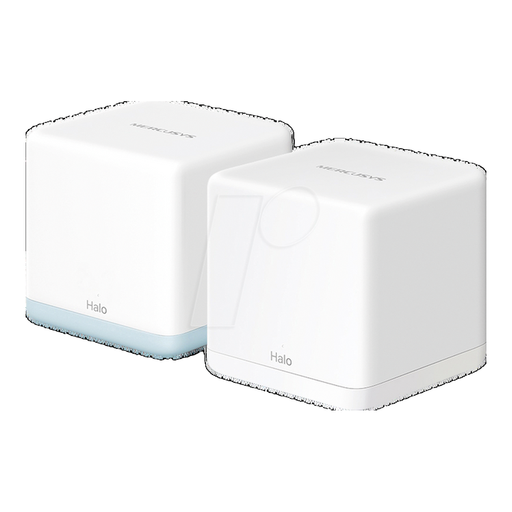 No image available
Two mesh units give you two nodes to build your network; whether the wireless connection can get through your internal walls depends on where you place them.
Dual-band, Gigabit Ethernet ports.
 No image available
This two-unit mesh kit may suit a setup with two nodes; the wireless signal at the planned locations needs to be able to cope with the obstacles.
Wi-Fi 7, BE3600, dual-band, 3 × Gigabit ports per unit.
Compare the upload speed over LAN, if possible, or near your router with the result where you upload your photos, and pay attention to your upstream speed. The Bundesnetzagentur’s broadband measurement tool compares your actual connection speed with the speed agreed in your contract. Differences between the two locations could point to an additional problem with your home network.
TP-Link recommends setting up the Deco units on the same network in the app first, then connecting them with Ethernet cables. In router mode, the satellite should connect to the LAN side of the main Deco or to a switch connected to it. TP-Link describes other connection options for access point mode. You can then check the connection in the Deco app.
The eero 6+ is set up and managed using the eero app. According to eero, extra security and management features are available through a separate subscription. Before buying, check whether you need these features and what warranty and guarantee terms apply to the specific offer.
Radio equipment sold in the German market must meet the relevant EU conformity requirements, including the required conformity assessment, EU Declaration of Conformity and CE marking. The Bundesnetzagentur also advises checking the marking and required accompanying documentation, so make sure to check these in the specific product listing.
No. For 5945–6425 MHz, the Bundesnetzagentur refers to order 76/2025, which explicitly revokes order 12/2025. An older announcement about authorisation is therefore not enough on its own to guide your choice or configuration of a 6 GHz device.