First, measure your internet connection’s upload speed, then check the connection at your workspace. Mesh can improve a weak Wi-Fi link, but it can’t make a slow broadband connection faster. If you have usable Ethernet cabling between floors, a system with Ethernet backhaul may be an option; without cables, the connection between the units and where you place them are crucial. Also check whether you want to keep your existing router and how the mesh system will connect to it.
Who is this relevant to?
Design work in a home office on another floor
If you upload files from a different floor to the router, first check whether the broadband connection itself or the Wi-Fi link to your home office is slowing things down. The German Federal Network Agency offers a test to compare your actual connection speed with the speed agreed in your contract.
A home with Ethernet cabling between floors
If network cables are available on several floors, you can check whether the mesh units can be connected via Ethernet backhaul. TP-Link describes this option for the Deco X50.
A home without Ethernet cabling between floors
If the units have to connect wirelessly, the connection between them matters too. FRITZ! points out that, as well as reception on your device, the quality of the connection between the mesh repeater and the mesh master is important.
What should you look for when buying?
First, check that your internet connection has enough upload speed. Then check the connection at your workspace, the link between floors and how the existing router will be integrated.
| What matters |
What to check before buying |
Who will find this particularly important? |
| Upload speed at your workspace |
Check your broadband connection’s upload speed, then test the connection at your actual workspace. |
If I upload designs from a home office on another floor, I want to know whether the broadband connection or Wi-Fi is slowing things down. Around 29% of consumers prioritise reliable uploads at their workspace. |
| Connection between floors |
Check for existing Ethernet cabling between floors and possible locations for the units. |
If the units need to connect several floors, I check whether a cable route is available or whether there’s a suitable midway location for a wireless unit. Around 29% of consumers prioritise the connection between floors. |
| Router integration |
Check your existing router, connection type and the operating mode specified for the set. |
If I want to keep my router, I want to know how the mesh system connects and is set up before buying. Around 24% of consumers see integrating their existing router as their main concern. |
| What’s included and ongoing costs |
Check how many units you need, whether the system can be expanded and the terms of any optional services. |
When choosing a set, I want to assess what’s included and any future services separately. Around 18% of consumers focus primarily on what’s included and potential ongoing costs. |
Common buying and set-up mistakes
-
Confusing the advertised Wi-Fi rate with upload speed
An advertised Wi-Fi data rate doesn’t tell you what upload speed your broadband connection or the link at your workspace will achieve. The German Federal Network Agency provides a separate test for your connection’s upload and download speeds.
Test your broadband connection first, then check the upload speed at the intended workspace.
-
Placing a unit straight in a dead zone
A wirelessly connected unit needs a usable connection to the main unit or the next unit itself. FRITZ! emphasises that the quality of the connection between mesh components matters just as much as reception on your device.
Check possible midway locations and any existing Ethernet cabling between floors. If using a cable, make sure the specific system supports Ethernet backhaul.
Depending on the connection, you may need an extra node or a different way to connect the units.
-
Assuming optional security services are included permanently
NETGEAR describes Armor for the RBK763S as a subscription service, with the first year included.
Before activating it, check the renewal terms shown and assess the mesh system separately from the optional service.
Subscription terms may apply if you continue using the service after the included period.
Brands worth considering
TP-Link
The Deco X50 is a documented dual-band Wi-Fi 6 option with optional Ethernet backhaul.
- TP-Link lists optional Ethernet backhaul for the Deco X50. According to the German manufacturer’s specification sheet, each unit has three Gigabit ports.
- Advertised coverage and Wi-Fi rates don’t prove what upload performance you’ll get in your particular home.
FRITZ!
The Mesh Set 1600 with three FRITZ!Repeater 1200 AX units is an option if you want to connect a router or extend a FRITZ!Box.
- FRITZ! describes a LAN connection to a router and a Wi-Fi connection to a FRITZ!Box mesh network.
- Before buying, check the set-up recommended for your router. Three units don’t guarantee coverage on every floor.
ASUS
ZenWiFi XT9 is a tri-band Wi-Fi 6 option with router and access point modes.
- The German specification sheet lists separate 5 GHz bands, a 2.5 Gbit/s WAN port and three Gigabit LAN ports.
- The specification sheet doesn’t measure throughput through the floors of a particular home. ASUS notes that specifications may vary by region.
NETGEAR
According to the German manufacturer’s specification sheet, the Orbi RBK763S combines a router and two satellites with a dedicated wireless connection between them.
- A dedicated connection is one technical option to consider if you don’t have Ethernet cabling between floors.
- It doesn’t guarantee a particular connection at your planned location. NETGEAR describes Armor as a subscription service with the first year included; check the terms for later use before signing up.
devolo
The German product page lists WiFi 7 Mesh BE6500 as a two- or three-pack, as well as an expansion unit, and says it can be used behind an existing router.
- The manufacturer lists wired connections and several operating modes.
- The stated combined data rate isn’t the measured upload speed of a single device. Check that the pack option and specific connections meet your needs.
Joybuy products
The Joybuy options below range from Deco mesh sets and individual expansion units to a single UniFi access point. They differ in what’s included and are suited to different expansion plans.
 No image available
TP-Link Deco BE22 (2-Pack)
This two-pack is designed to create a mesh network with two Deco devices; check that they can reach the locations you have in mind.
Wi-Fi 7, dual-band, Gigabit Ethernet.
Joybuy
 No image available
TP-Link Deco M4 AC1200 (3-Pack)
This three-pack is worth considering if you plan to use three mesh units in the locations you have in mind; the connection between them is still key.
AC1200, dual-band, three units.
Joybuy
 No image available
TP-Link Deco M4 AC1200 (1-Pack)
This single mesh unit is described as an addition to an existing Deco network; check that it’s compatible with your current system.
AC1200, dual-band, one unit.
Joybuy
 No image available
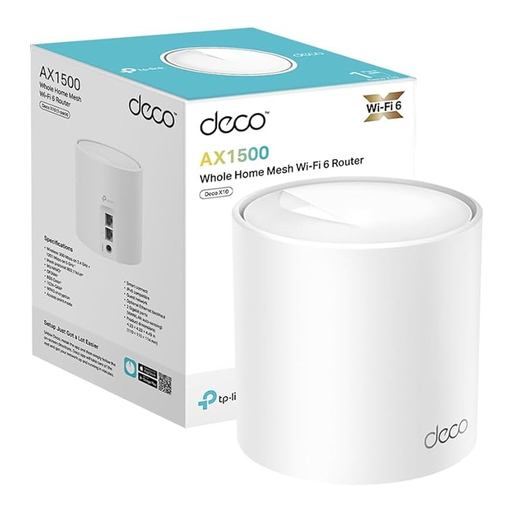
TP-Link Deco X10 AX1500 (1-Pack)
The single X10 unit is described as an extension for an existing Deco mesh network; check that it’s compatible with your current network before buying.
Wi-Fi 6, AX1500, one unit.
Joybuy
 No image available
Ubiquiti U7 Mesh
This single access point is worth considering as part of an expansion with other compatible nodes, not as a complete multi-unit set.
Wi-Fi 7, PoE. According to the product information, power requires an approved PoE injector or a compliant switch.
Joybuy
Frequently asked questions
How can I tell whether mesh can improve slow design uploads?
First, measure your internet connection’s upload speed, then check the connection at your workspace. If the broadband connection itself is already the bottleneck, buying Wi-Fi equipment alone won’t solve the problem.
Where should I put a wirelessly connected mesh unit?
Don’t put it right where there’s no reception: it needs a usable connection to the main unit or the next unit at the planned location. Then check reception on the device you actually use for work.
What should I look out for when it comes to future costs and faults?
Check optional service subscriptions separately from the device. Your statutory rights against the seller and a voluntary guarantee are different things; specific guarantee terms don’t automatically apply to every product from a brand.
Do I need my own frequency allocation for a home mesh Wi-Fi network in Germany?
You don’t need an individual frequency allocation for Wi-Fi use covered by the general allocations, provided you comply with the relevant terms of use. For devices in the 5945–6425 MHz range, the German Federal Network Agency’s allocation applies; the previous order 12/2025 was revoked by order 76/2025.


