What should you look for when buying?
For a garden office, the connection back to the house comes first. Then consider the mounting location, power supply and how the device will work with your existing network.
Wireless connection
Best if: There’s a usable wireless connection between the house and the node location, and you don’t want to run a cable.
Bear in mind: The node needs a suitable connection to the main unit itself; a location further away isn’t automatically better.
Ethernet backhaul or bridge mode
Best if: You can run a network cable to the node or access point, particularly if the wireless connection between the buildings is unreliable.
Bear in mind: The cable route, connections and supported operating mode must be compatible with the specific model and network setup.
| Priority |
What to check before buying |
Who it matters most to |
| Usable wireless connection |
Check the signal at the planned node location; treat model guidance on distance and obstacles as advice, not a guaranteed range. |
If I want to connect the node wirelessly, there needs to be a suitable wireless connection to the house at that location. Around 31% of consumers put this connection first. |
| Wired connection |
Check whether Ethernet backhaul or bridge mode is supported for the specific model and planned network setup. |
If I can run a network cable to the garden office, I want to avoid relying on a wireless connection between the buildings. Around 25% of consumers prioritise a wired connection. |
| Outdoor installation |
For an actual outdoor installation, consider the protection rating, mounting accessories and suitable power supply. |
If I’m installing a node outdoors, I need to plan for an enclosure and power supply that are suitable for the location. Around 19% of consumers make outdoor installation their main priority. |
| Network integration |
Check which router and mesh system you already have, then confirm the desired operating mode and system integration for the specific model. |
If I want to extend my existing network, the node needs to work with the planned main unit. Around 13% of consumers focus on system integration. |
| Overall effort |
Before choosing, check the number of nodes, power requirements and network equipment you already have. |
For my plans, it’s not just about the node: I also need to know whether I’ll need to run a cable or provide additional power. Around 12% of consumers prioritise the overall effort involved. |
Joybuy product options
These product options cover TP-Link Deco systems and indoor nodes, including models that support Ethernet backhaul or can extend a Deco mesh system. They are not specified as weatherproof outdoor devices.
 No image available
TP-Link Deco M4 AC1200, 1-pack
For a Deco mesh node location where a wired connection is an option; this model is designed for indoor use.
AC1200, dual-band, two Gigabit Ethernet ports and Ethernet backhaul support.
View at Joybuy
 No image available
TP-Link Deco M4 AC1200, 3-pack
For a Deco mesh setup with multiple indoor nodes; check that the pack size suits your planned network.
AC1200, dual-band and two Gigabit ports per unit. This set is not specified as a weatherproof outdoor device.
View at Joybuy
 No image available
TP-Link Deco X1500 Wi-Fi 6 AX1500, 2-pack
For a mesh setup with two units and wired devices at a suitable node location.
Dual-band and two Gigabit ports per unit. This set is not specified as a weatherproof outdoor device.
View at Joybuy
 No image available
TP-Link Deco S4 AC1200, 3-pack
For a mesh setup with multiple indoor nodes; check that the pack contents match your network plan.
Dual-band and two Gigabit ports per unit. This set is not specified as a weatherproof outdoor device.
View at Joybuy
 No image available
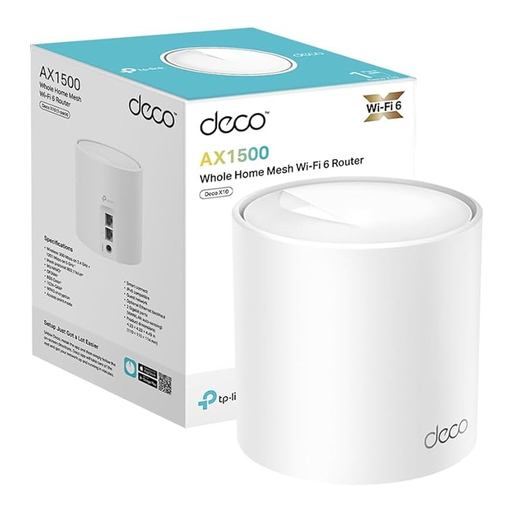
TP-Link Deco X10 Wi-Fi 6 AX1500, 1-pack
An additional unit for extending an existing Deco mesh system; designed for indoor use.
Dual-band and two Gigabit ports. This device is not specified as a weatherproof outdoor device.
View at Joybuy
Frequently asked questions
Where should I place a wirelessly connected node?
Place it somewhere with a suitable wireless connection to the main unit, rather than automatically choosing the furthest point. For a wireless connection, TP-Link recommends placing the Deco X50-Outdoor no more than 15 m from the upstream Deco, with as few obstacles as possible. This is the manufacturer’s recommendation for this model, not a guaranteed distance.
Can a cable to the garden office still be part of a mesh network?
Yes, as long as the devices you choose support the right operating mode. TP-Link describes Ethernet backhaul for the Deco X50; FRITZ! lists bridge mode for the FRITZ!Repeater 3000 AX. Check that the feature is compatible with the devices you actually want to use together.
What should I plan for when powering an outdoor device?
For the Deco X50-Outdoor, TP-Link specifies IEEE 802.3at PoE via a compatible switch or injector, or mains power. For outdoor mains power, the manufacturer describes using a weatherproof outdoor socket and protecting the socket and power cable from rain.
Do I need an individual frequency allocation for private Wi-Fi in Germany?
Individual allocations to users aren’t required for the 2.4 and 5 GHz Wi-Fi frequency bands listed by the Federal Network Agency as generally allocated. This doesn’t mean every frequency setting or outdoor installation is automatically permitted: the applicable terms for the specific device and location still apply.
Is older information about 6 GHz Wi-Fi in Germany still up to date?
Don’t rely on older information without checking the relevant version: the Federal Network Agency expressly revokes Vfg. 12/2025 in Vfg. 76/2025. For a specific purchase or outdoor installation, check the applicable version and its terms.


