Students with Wi-Fi dead spots
If your live lecture keeps buffering at your study spot even though the connection works next to the router, what matters is the signal there and the connection to the next unit.


First, check whether your internet connection or the Wi-Fi at your study spot is holding back your live lecture. Mesh can extend a weak wireless signal around your home, but it can’t improve a slow internet connection. If you have usable Ethernet between floors, a mesh system with Ethernet backhaul could be an option. If not, the connection between the units and how you integrate your existing router are key. The number of units you need depends on your study spots and suitable locations, not just the number of floors.
If your live lecture keeps buffering at your study spot even though the connection works next to the router, what matters is the signal there and the connection to the next unit.
Without network cabling between floors, additional wireless units need to be placed where they can still get a reliable connection to the rest of the network.
If you want to keep your current router, check its connections and the operating mode of the Wi-Fi system before you buy.
A good fit if: You have usable network cables between floors that reach suitable locations for the units.
Things to consider: Check cable routes, available ports and the system’s cabling requirements for your chosen operating mode.
A good fit if: You don’t have Ethernet between floors and can place the units where they’ll maintain a reliable wireless connection to each other.
Things to consider: Ceilings and walls can weaken the connection between units, too. Tri-band or 6 GHz doesn’t guarantee reliable coverage in your particular home.
Worth considering if: You have neither Ethernet between floors nor a suitable wireless location, but do have suitable power sockets.
Things to consider: Your home’s electrical wiring and connected devices can affect performance. According to devolo, interference is possible with certain VDSL profiles.
| What matters | What to check when buying | Who is this important to? |
|---|---|---|
| Signal at your study spot | Check the internet connection and Wi-Fi at your study spot separately; assess possible locations for the units and their backhaul connection. | If my lecture keeps buffering at a desk far from the router, the first thing I care about is the signal right there. Around 36% of consumers put this first. |
| Backhaul without Ethernet | Find locations where the units can connect to each other; check the wireless bands used by the specific model and any possible cable routes. | If there’s no Ethernet between floors, I need a location where the units can stay connected wirelessly. Around 29% of consumers prioritise this wireless backhaul. |
| Connecting your existing router | Check your router model, how the first unit connects, the operating mode and which gateway features you need. | If my router still works, I want to keep it and connect the Wi-Fi system in a way that suits it. Around 21% of consumers put keeping their existing router first. |
| Pack contents and ongoing costs | Check the number of units, how many Wi-Fi locations you actually need, the connections and the terms of any optional services. | Once I’ve worked out how the connection will run, I want to choose the right pack size and understand any optional services. Around 14% of consumers prioritise pack size and possible ongoing costs. |
Your internet connection speed and how Wi-Fi is distributed around your home are two different parts of the connection. A Wi-Fi extender can’t fix a slow internet connection.
Check your internet connection and the affected study spot separately before choosing your hardware.
Each unit needs a reliable connection to the rest of the network. Ceilings, furniture and other obstacles can affect the signal.
Check the backhaul at your planned location and consider using existing Ethernet for backhaul.
With Deco, gateway features and permitted cabling vary depending on the operating mode.
Before you buy, decide which router will remain the gateway and how the units will be connected.
According to devolo, interference from electrical devices and with certain VDSL setups is possible.
Think of Powerline as an alternative that depends on your home, and test the connection at the sockets you plan to use.
For the Deco X50 and Deco XE75, TP-Link lists different options for connecting the units to each other.
According to the manufacturer, the FRITZ!Mesh Set 4200 (3-pack) includes three FRITZ!Repeater 3000 AX units and can connect to an existing router.
According to NETGEAR, the Orbi RBK763S is a tri-band Wi-Fi 6 set with one router and two satellites.
The ZenWiFi XT9 is a tri-band Wi-Fi 6 option with separate 5 GHz bands.
The Magic 2 WiFi 6 next Multiroom Kit combines Powerline with mesh Wi-Fi. According to the manufacturer, it includes one LAN adapter and two Wi-Fi adapters.
The products below cover mesh Wi-Fi and Wi-Fi extension for multiple study spots. For each model, check whether the pack contents, backhaul and router compatibility suit your home.
 No image available
Worth considering for a mesh setup around your home if you have a suitable PoE supply and the required network infrastructure.
Product details list Wi-Fi 7 and a 2.5 Gigabit Ethernet uplink. A suitable PoE supply is required for operation.
 No image available
A three-unit set could be a good option if you need Wi-Fi in several locations and it works with your existing router.
Listed features include dual-band Wi-Fi 5, Gigabit ports and router and access point modes. The offer includes three units.
 No image available
Worth considering for several Wi-Fi locations if a 3-pack and a connection to your existing router suit your planned setup.
Listed features include dual-band Wi-Fi, Gigabit ports and three units. Before buying, check that it supports the router setup you want.
 No image available
Worth considering as an additional unit for a compatible Deco mesh system, if you already have a compatible setup.
The offer includes one unit. For Ethernet backhaul, check that your existing system supports it and how the units need to be connected; you’ll need additional units for a multi-node setup.
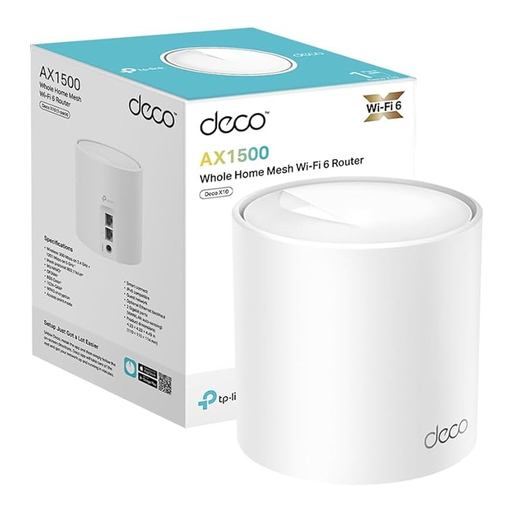 No image available
Worth considering as an additional unit for an existing Deco mesh system, not as a standalone multi-node solution for several floors.
Wi-Fi 6 and two Gigabit ports are listed. The offer includes one unit; the product title specifies a suggested coverage area of homes with 1–2 bedrooms.
Check your internet connection separately from the Wi-Fi at your study spot. The Federal Network Agency’s broadband measurement tool lets you compare the measured data transfer rate of your fixed-line connection with the rate set out in your contract. Mesh won’t improve the performance of the connection itself.
Choose a location where both the connection to the rest of the network and the one to your playback device are reliable. FRITZ! recommends minimising obstacles between the repeater, router and Wi-Fi devices wherever possible. Check your planned locations in your own home.
Yes. TP-Link describes an access point mode that works behind an existing router. In this setup, your existing router handles gateway functions, while some gateway features aren’t available in the Deco app. The cabling options for the satellites depend on the operating mode.
No. The number of floors alone doesn’t determine how many nodes you need. Plan around your study spots, router location and possible backhaul, and check whether the specific offer includes two or three units.
Check the pack contents and terms for optional services for the specific model. FRITZ! lists a five-year warranty and regular updates for the Mesh Set 4200; NETGEAR lists one included year of Armor with the RBK763S. Before you buy, check the terms for continuing to use the optional service.