Learners with an Ethernet connection
You can run an Ethernet cable to the room beyond the wall and want to use it for the connection between your Wi-Fi units.


If you can run an Ethernet cable to your study, a compatible mesh unit with Ethernet backhaul is a good option: the connection back to the main unit won’t need to pass through the wall wirelessly. If you don’t have a cable, a wireless node may work if it still has a good connection to the main unit at your chosen location. Also check whether you can expand your existing mesh network and whether your internet connection itself is performing well enough.
You can run an Ethernet cable to the room beyond the wall and want to use it for the connection between your Wi-Fi units.
You need Wi-Fi in a room further away and want to find a spot where a wireless mesh node can still get a good signal from the main unit. If there’s no suitable spot for a wireless connection, you could also check whether Powerline might work over your existing electrical wiring.
You want to keep your router and first check whether a compatible unit can provide coverage for your study area.
With thick internal walls, it’s not just the connection in your study that matters: the additional unit also needs a working connection back to the main one. So check the cable route, node location and existing network equipment separately.
Suitable if: You can run an Ethernet cable to the additional unit and the system supports Ethernet backhaul.
Things to consider: Running a cable may involve installation work; Ethernet backhaul won’t fix a bottleneck with your internet connection.
Suitable if: Running a cable isn’t practical, but you can get a good wireless connection between the main unit and a suitable midway location.
Things to consider: The return connection also uses Wi-Fi. Putting a node just beyond a wall that blocks the signal won’t automatically fix a weak connection to the main unit.
Suitable if: Your router acts as the mesh base and a node that’s explicitly compatible can reach the room in question.
Things to consider: Check the compatibility and operating mode of the specific device; the word ‘mesh’ alone doesn’t guarantee it will work with your existing network.
Suitable if: Neither a cable route nor a useful midway location for a wireless connection is possible, and you can test the connection using the sockets you plan to use.
Things to consider: The connection between the adapters runs over your electrical wiring. Sockets and sources of electrical interference can affect it.
| What you need | What to check before buying | Who is it important to? |
|---|---|---|
| Connection back to the main unit | Check whether you have a cable route and suitable ports, or whether a possible wireless location has a good connection to the main unit. | If I can run an Ethernet cable to my study, I don’t want the unit’s return connection to have to pass through the wall wirelessly. Around 36% of consumers put a reliable return connection first. |
| Connection in your study | Check the connection where you plan to use your laptop or tablet, and test your internet connection separately. | For me, a usable connection where I study matters more than a strong signal next to the router. Around 29% of consumers prioritise the connection in their study. |
| Router compatibility | Check your router model, mesh function and operating mode against the details for the specific add-on device. | If I already have a mesh network, I want to know whether a compatible node can work with my router before buying anything new. Around 21% of consumers focus above all on compatibility with their existing network. |
| What’s in the box and set-up | Check the pack size, whether you already have a base unit, how many locations you need to cover and, for Powerline, which sockets you plan to use. | I want to know how many units I’ll need and how much installation work is involved. Around 14% of consumers focus on what’s included and the extra work required. |
A wireless mesh node also needs a working wireless connection to the main unit or the next unit in the network.
Check the return connection at your planned location. If you have a usable cable, check whether the specific system supports Ethernet backhaul.
Adding another node or finding a suitable cable route may involve extra planning and installation work.
A single device doesn’t automatically provide two separate mesh units for a new set-up.
Count how many units you need and check the pack size for the specific model. For example, TP-Link offers the Deco BE25 in different pack sizes.
If you don’t have a suitable base unit, you’ll need to add one to your set-up.
devolo says that sockets and sources of electrical interference can affect the connection over your electrical wiring.
Test the connection using the sockets you actually plan to use, and check that the adapters are compatible with each other.
Model specifications and a strong local Wi-Fi connection don’t show how well the signal will pass through your walls or how fast your internet connection is.
Check the return connection, reception in your study and your internet connection separately.
Deco systems are an option if you’re setting up a new mesh network.
FRITZ!Repeaters can extend a compatible FRITZ!Box network to the areas you need.
The ZenWiFi XD5 is described as a mesh system that can use Ethernet connections between units.
Magic 2 WiFi next uses Powerline between sockets and provides Wi-Fi from the adapter in the room further away.
Speed Home WLAN is an option for extending coverage in homes with a compatible mesh base.
The products below are described as wireless mesh kits or as an additional unit for an existing Deco network. With thick walls, the node’s location and its connection to the main unit are still key; the product name doesn’t guarantee wireless performance in your particular study.
 No image available
Described as a two-unit kit for a new mesh set-up. With thick walls, the second node still needs a suitable connection back to the main unit.
Wi-Fi 7, dual-band, Gigabit Ethernet, 2-pack.
 No image available
Described as a three-unit mesh kit for several rooms. Check where you place each node to make sure it can connect to the main unit.
AC1200, dual-band, Gigabit ports, 3-pack.
 No image available
Described as a two-unit mesh kit for several areas of your home. The connection in your study also depends on where you place the units.
AX1500, dual-band, Gigabit ports, 2-pack.
 No image available
Described as a two-unit mesh kit. Check whether the second unit can get a strong enough connection to the main unit at your chosen location.
Wi-Fi 7, BE3600, dual-band, 3 Gigabit ports per unit, 2-pack.
 No image available
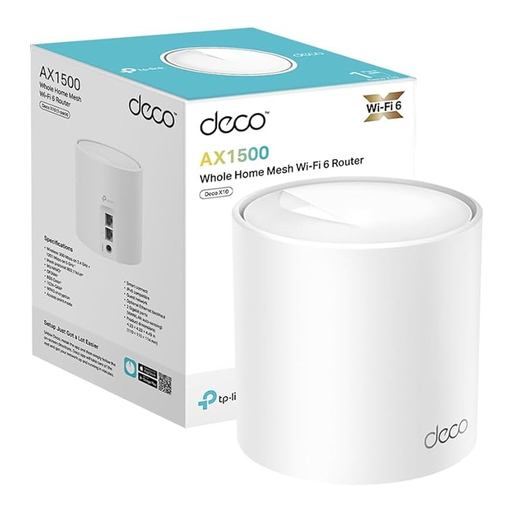
Described as an additional unit for an existing Deco network, not as a complete multi-unit kit for a new mesh set-up.
AX1500, dual-band, 2 Gigabit ports.
Place it somewhere it can still get a good signal from the main unit or the next unit, then check the connection in your study. F.A.Z. Kaufkompass highlights the importance of a sufficiently strong wireless return connection when positioning mesh units.
Set up your Deco units according to TP-Link’s instructions, connect them via Ethernet as required, then check the satellite’s backhaul in the network map in the Deco app. The cabling may depend on whether Deco is operating in router or access point mode.
Test the wall sockets you plan to use and look out for possible sources of electrical interference. For its adapters, devolo recommends plugging them directly into a wall socket rather than a power strip or extension lead, and lists chargers and dimmers as possible sources of interference.
A mesh system won’t fix a bottleneck with your internet connection. The Bundesnetzagentur offers a test for fixed-line connections using a desktop app. Compare the result with your connection in your study before replacing your Wi-Fi equipment.
You don’t need an individual frequency allocation for the Wi-Fi bands allocated for general use, provided you follow the applicable conditions. The Bundesnetzagentur lists bands allocated for general use at 2.4 GHz and 5 GHz, as well as a general allocation for 5945–6425 MHz. This doesn’t allow you to use any frequency, transmission power or device settings you choose.