First, check whether choppy video calls are caused by your internet connection or by the Wi-Fi in the room you’re using. A mesh system won’t fix a bottleneck with your broadband connection. If Wi-Fi is the issue, a compatible repeater can extend an existing FRITZ!Box; a standalone mesh system is another option, particularly if you want to connect nodes using LAN backhaul. For local music sharing, your home network and music service settings matter too—not just the advertised Wi-Fi speed.
Who should consider mesh Wi-Fi?
Households with several video calls at once
If several people share the same internet connection, first work out whether the problem is your broadband, a weak Wi-Fi signal or a dead spot where you’re making the call. Microsoft Support notes that a poor internet connection can affect audio and video quality.
Households with a local music library
If you stream music from a computer or server on your home network, check sharing settings, accounts and device connections as well as Wi-Fi coverage. For Apple Home Sharing, Apple Support says, among other things, that the source computer must be switched on with the Music app or iTunes open.
Households with rooms across multiple floors
When the signal needs to travel through walls and floors, the position of your mesh nodes and the connection between them matter. F.A.Z. Kaufkompass describes a wired backhaul as less prone to interference than a wireless connection.
What should you look for when buying?
Extend your existing FRITZ!Box
A good fit if: You want to keep your FRITZ!Box and improve coverage in a particular room. FRITZ! lists a LAN bridge mode and two Gigabit LAN ports for the 3000 AX.
Keep in mind: Mesh integration requires a compatible FRITZ!Box. The wireless connection to the repeater also needs to be reliable at the location you choose.
Standalone mesh with LAN backhaul
A good fit if: You have, or can install, a suitable network connection between the nodes. TP-Link says the Deco X50 supports optional Ethernet backhaul.
Keep in mind: The cable route and router or access point settings need to work with your existing connection.
Standalone mesh without cables between nodes
A good fit if: You can’t run a network cable between the locations. ASUS lists three wireless bands for the ZenWiFi XT8, while NETGEAR describes the Orbi RBK763S as having a dedicated connection between the router and satellites.
Keep in mind: An extra wireless band won’t make up for a poor connection between nodes. Walls, floors and placement still matter.
If you’re sharing music and making video calls at the same time, what matters most depends on whether the bottleneck is your broadband connection, Wi-Fi, the link between nodes or your music sharing settings.
| Priority |
What to check before buying |
Who is it most important to? |
| Reliable video calls |
Assess broadband performance separately from Wi-Fi reception where you make calls; check for dead spots or congestion there. |
If I’m sharing a music library during a call, I want to know whether the broadband or Wi-Fi is causing the problem. Around 33% of consumers put reliable video calls first. |
| Access to your music library |
Check your sharing method and home network; for Apple Home Sharing, the devices involved need to be set up correctly. |
If devices need to access music on a computer on my home network, I’ll check sharing and connectivity before changing networks. Around 25% of consumers prioritise access to their local music library. |
| Coverage and backhaul |
Check node positions, walls and floors, as well as the available cabling and backhaul support of the specific model. |
If I need coverage across several rooms or floors, I’ll make sure the connection between the nodes works where they’re placed. Around 25% of consumers put coverage across multiple rooms first. |
| Router integration and ongoing costs |
Check your existing router, operating mode and how many nodes you need. Factor in any optional services or subscriptions for the system you’re considering. |
If I want to keep my existing hardware or avoid a complicated changeover, I’ll check how the system integrates and what additional services it offers. Around 17% of consumers prioritise easy integration and manageable ongoing costs. |
Common misconceptions
-
Advertised combined Wi-Fi speed predicts call quality
A bottleneck with your broadband connection and weak Wi-Fi where you’re making a call require different solutions. A new mesh system won’t fix a broadband bottleneck.
Check your broadband and Wi-Fi separately where you use them before choosing a router or mesh system.
-
A mesh node should go right in the dead spot
The node needs a decent connection to the rest of your network. If there’s not enough signal where you place it, the connection between nodes may suffer.
Choose a spot with a decent signal, or connect the nodes by LAN if the model and your existing cabling allow it.
-
Music sharing works automatically with every mesh system
With Apple Home Sharing, access and playback also depend on your home network, Apple ID and an active source computer. The computer needs to be switched on, with the Music app or iTunes open.
After changing your router or mesh setup, test access from the devices you want to use for playback.
-
Optional security services are included indefinitely
Core mesh features aren’t the same as additional security or management services. NETGEAR describes Armor for the RBK763S as a subscription service that includes the first year.
Before buying, check which extra features you need and whether any are sold separately.
Brands to consider
FRITZ!
An option for households that want to keep using a compatible FRITZ!Box and extend its coverage.
- FRITZ! lists three wireless modules, two Gigabit LAN ports and a LAN bridge mode for the Repeater 3000 AX.
- FRITZ! Mesh integration applies to FRITZ!Box routers. Using it as a repeater with another router isn’t the same as using FRITZ! Mesh.
TP-Link
The Deco range includes standalone mesh models with different wireless and connection options.
- TP-Link lists three Gigabit ports per unit for the Deco X50, with optional Ethernet backhaul; the BE25 has two 2.5-Gbit/s ports per unit.
- Manufacturer claims about speed or coverage aren’t a measure of performance in your own home. The X50 and BE25 have different features.
ASUS
The ZenWiFi AX XT8 is a mesh option to consider if you need three wireless bands and several wired connections.
- ASUS Germany lists a 2.5-Gbit/s WAN port and three Gigabit LAN ports for the XT8.
- ASUS notes regional restrictions on 160 MHz in the 5-GHz band. The XT8’s specifications don’t apply to every ZenWiFi model.
NETGEAR
The Orbi RBK763S is a router-and-two-satellite set. The wireless connection between the devices may be a factor when choosing a system.
- NETGEAR lists a dedicated router-to-satellite connection and seven Gigabit ports in total.
- NETGEAR describes Armor as a subscription service that includes the first year. Check which services you want to keep using.
eero
The eero 6+ is an app-managed Wi-Fi 6 mesh option.
- Adding more eero devices may be useful when planning a mesh network.
- Additional security and management features are sold separately; check the terms of the specific offer.
Joybuy products
The Joybuy products below include TP-Link Deco mesh systems and individual Deco units. Before buying, check that the set size and any expansion options suit your existing network.
 No image available
TP-Link Deco BE22, 2-pack
This 2-pack is an option if you want to set up a standalone mesh with multiple units.
Wi-Fi 7, dual-band and two Gigabit WAN/LAN ports per unit are listed. Router and access point modes are supported.
Joybuy
 No image available
TP-Link Deco M4, 1-pack
This single M4 unit may suit you if you want to expand an existing Deco network. You’ll need another compatible unit to create a multi-node setup.
Dual-band Wi-Fi 5, two Gigabit ports and Ethernet backhaul support are listed.
Joybuy
 No image available
TP-Link Deco X1500, 2-pack
This 2-pack is worth considering if you want to connect several areas of your home with Deco mesh nodes.
Wi-Fi 6 AX1500, dual-band and two Gigabit ports per unit are listed.
Joybuy
 No image available
TP-Link Deco S4, 3-pack
This three-unit set may suit you if you’re planning a mesh network across several rooms or floors.
Dual-band AC1200 and two Gigabit ports per unit are listed. According to the product description, the devices can be used with an existing router or modem.
Joybuy
 No image available
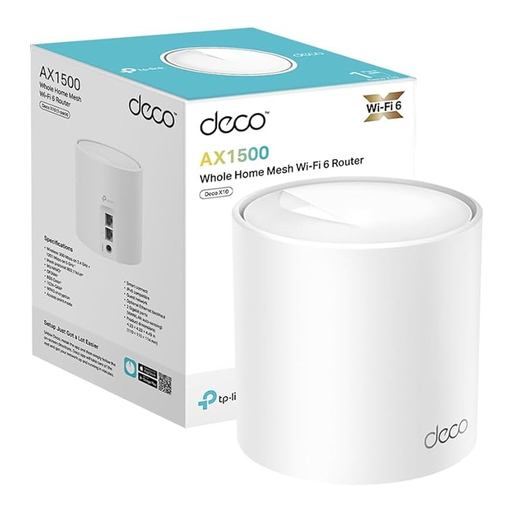
TP-Link Deco X10, 1-pack
This single unit is described as an extra node for an existing Deco mesh, rather than a multi-node set.
Wi-Fi 6 AX1500, dual-band and two Gigabit ports are listed.
Joybuy
Frequently asked questions
Will a mesh system solve choppy video calls?
Not necessarily. Check your broadband performance separately from Wi-Fi reception where you make calls. Microsoft Support lists a poor internet connection as one possible cause, and Germany’s Federal Network Agency provides a desktop app for testing fixed-line broadband.
What should I check for an Apple music library?
For Apple Home Sharing, the devices involved need to be set up correctly on the same home network and with the same Apple ID. Apple Support also notes that the computer sharing the library must be switched on, with the Music app or iTunes open. Other music servers may have their own sharing settings.
What ongoing costs should I check before buying?
Check the optional services for the system you’re considering. NETGEAR describes Armor for the RBK763S as a subscription service that includes the first year, while eero sells additional security and management features separately. This doesn’t mean mesh Wi-Fi always requires a subscription.
What are the rules for 6-GHz Wi-Fi in Germany?
Germany’s Federal Network Agency has allocated the 5945–6425 MHz frequency range for general Wi-Fi use under order 76/2025; the earlier order 12/2025 was revoked. If you’re buying a 6-GHz device, check that it’s intended for Germany and that you meet its operating conditions. The frequency allocation alone doesn’t prove that a specific product complies.


