First, check whether your internet connection or your Wi-Fi is causing problems where you stream, and only then choose a mesh system. With a suitable Ethernet backhaul, the connection between nodes doesn't have to pass through thick walls wirelessly. Without a cable, an additional node needs to be placed somewhere with a good connection to the router or previous node. The maximum Wi-Fi speed alone won't tell you how good the signal will be in the room you want to reach: Netflix recommends at least 15 Mbit/s for 4K streaming on its service, and the Federal Network Agency offers a separate test for your internet connection.
Who might benefit from mesh Wi-Fi behind thick walls?
Film fans with a poor signal at the TV
If your TV or streaming stick is behind thick walls, the signal at the screen matters just as much as the connection between the router and the mesh node. Deloitte Germany lists structural features such as thick walls as a possible cause of Wi-Fi reception problems.
Households with an Ethernet cable already installed
If you can use an Ethernet cable that reaches close to the room where you stream, check whether the specific system supports Ethernet backhaul and has suitable ports. The F.A.Z. Kaufkompass highlights a wired backhaul as a way to improve data transfer rates across a mesh network.
Households with an existing router
If you want to keep using your existing internet connection, check the supported operating mode and compatibility with your router before buying. FRITZ!, for example, describes the Mesh Set 2700 as an extension for a FRITZ!Box or another router.
What should you look for when buying?
First, work out whether your internet connection or Wi-Fi is causing problems where you stream. Then you can choose between a wired and wireless backhaul.
| Priority |
What to look for when buying |
Who is it important to? |
| Signal where you stream |
Check the signal at the TV and at possible node locations; compare the number of units in each set and the placement options. |
If the screen is behind thick walls, I want to know whether a usable signal will reach it. Around 33% of consumers prioritise reception where they stream. |
| Connection between nodes |
Check for Ethernet backhaul and available ports, or find a location with a reliable wireless connection to the router. |
I want to avoid a wireless connection through the walls or find a suitable intermediate location. Around 33% of consumers focus above all on a stable connection between mesh nodes. |
| Speed for picture quality |
Test your internet connection and the connection to your streaming device separately. Netflix recommends at least 15 Mbit/s for 4K streaming on its service; this isn't a general requirement for every streaming service. |
If I want to watch a film at my chosen resolution, the speed at my device needs to be high enough. Around 20% of consumers prioritise streaming performance. |
| Integration and ongoing requirements |
Check the router or access point mode, the ports you need and the availability of firmware updates. |
I want to keep using my existing router and know what setup and maintenance the system requires. Around 14% of consumers pay particular attention to integration and ongoing requirements. |
Which buying mistakes should you avoid?
-
Assuming the advertised maximum speed means you'll get a strong signal through the wall
A high maximum Wi-Fi speed doesn't guarantee that enough bandwidth will reach your TV. A mesh system can't fix an internet connection that's too slow, either.
Test your internet connection and the connection directly at your streaming device separately before choosing a new system.
-
Placing a wireless node right in a dead zone
The node itself needs a reliable connection to the router or previous node. Without a strong enough backhaul, it won't provide reliable coverage to the room you want to reach.
Try possible intermediate locations. If there's a suitable cable route, check whether Ethernet backhaul is an option.
Depending on your setup, you may need another node or to install cabling later.
-
Judging the number of units and operating mode by the product name alone
The number of nodes, available ports and supported operating mode determine whether a set suits your layout and existing router.
Before buying, check the exact version, what's included in the box, the ports and the intended operating mode.
Key brands to consider
FRITZ!
FRITZ! describes the Mesh Set 2700 as an extension for a FRITZ!Box or another router.
- According to FRITZ!, the 2-pack contains two FRITZ!Repeater 2700 units and comes with a five-year warranty.
- Check the exact set version and how it connects to your network; the product details don't guarantee reception in a particular room.
TP-Link
The Deco X50 range is a Wi-Fi 6 mesh system. If you already have cabling in place, this may affect your choice of operating mode.
- TP-Link lists three Gigabit ports and optional Ethernet backhaul.
- A coverage area quoted by the manufacturer doesn't measure reception through the walls in your home.
ASUS
ZenWiFi XD5 may suit households looking for a Wi-Fi 6 mesh system that they can combine with AiMesh-compatible ASUS devices.
- ASUS lists AiMesh support and various placement options.
- Advertised coverage areas and data rates don't predict reception where you stream. For 160 MHz, ASUS lists prerequisites and possible regional restrictions.
devolo
According to the manufacturer, the WiFi 7 Mesh BE6500 is also available as a 2-pack and can be used behind an existing router.
- devolo lists dual-band wireless, three Gigabit ports and a 2.5 Gbit/s port for the 2-pack.
- Check the full model name and exact set version before comparing ports or wireless features.
HUAWEI
According to HUAWEI, the WiFi Mesh X3 Pro is a dual-band system with 2.4 and 5 GHz wireless.
- HUAWEI lists different Ethernet ports for the main router and the extender.
- The advertised wall penetration is a manufacturer claim, not an independent guarantee for a particular building. Check the different set options available.
Joybuy mesh Wi-Fi products
These mesh systems may suit households looking to improve reception where they stream. The selection includes sets with two or three units, across different generations of Wi-Fi.
 No image available
TP-Link Deco BE22, 2-pack, Wi-Fi 7, dual-band
The 2-pack is an option if you want to place two mesh units around your home.
Dual-band Wi-Fi 7; two Gigabit WAN/LAN ports per unit.
Router or access point mode is listed.
View at Joybuy
 No image available
TP-Link Deco M4 AC1200, 3-pack
The 3-pack may suit you if you plan to place mesh units in several locations and want to keep using your router.
Dual-band Wi-Fi 5; two Gigabit LAN/WAN ports per unit.
Three units, plus router and access point modes, are listed.
View at Joybuy
 No image available
TP-Link Deco X1500 AX1500, Wi-Fi 6, 2-pack
The 2-pack is described as a mesh setup with two units.
Dual-band Wi-Fi 6; two Gigabit Ethernet ports per unit.
App-based setup is listed.
View at Joybuy
 No image available
MERCUSYS Halo H3000X AX3000, Wi-Fi 6, 2-pack
The 2-pack is worth considering for a mesh setup with two units.
Dual-band Wi-Fi 6 with MU-MIMO; three Gigabit ports per unit.
App-based management is listed.
View at Joybuy
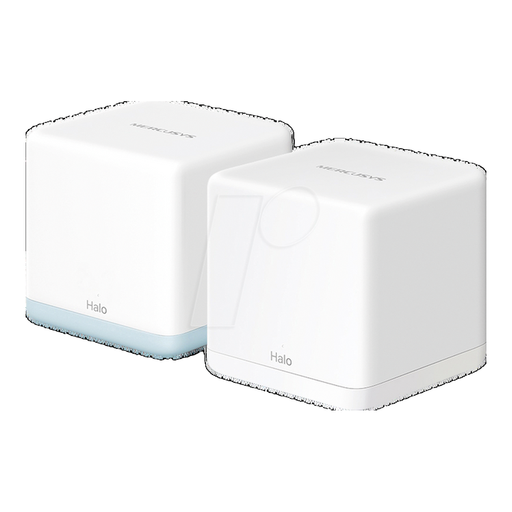 No image available
MERCUSYS Halo H1200G AC1200, 2-pack
The 2-pack is an option if you want to set up two mesh units.
Dual-band AC1200; Gigabit Ethernet ports per unit.
App-based setup is listed.
View at Joybuy
Frequently asked questions
How can I tell whether my internet connection or Wi-Fi is slowing down my film?
Test the speed of your internet connection separately from the connection at your streaming device. The Federal Network Agency offers a test for fixed broadband connections. Comparing different results can help you identify where the bottleneck is.
Where should I place a wireless mesh node?
Place it somewhere with a reliable connection to the router or previous node, while still allowing it to reach the room you want to cover. A node placed right in a dead zone may not have a strong enough backhaul of its own.
What should I do after setting up a mesh system?
Check for firmware updates and use secure login details. The German Federal Office for Information Security recommends keeping firmware up to date; this doesn't tell you what streaming performance to expect.
What else might I need for a mesh setup?
Depending on your layout and the connection between nodes, you may need an extra node or cabling. Before buying, check whether you can use a suitable wireless location or run a cable where it's needed.
Is 6 GHz Wi-Fi generally permitted in Germany?
The Federal Network Agency has published a general allocation for the 5945 to 6425 MHz range, subject to usage conditions. The earlier ruling 12/2025 was revoked by ruling 76/2025. If you're using a 6 GHz device, check that it's the German version and that it meets the conditions of the current ruling. Wi-Fi 7 alone doesn't mean a particular model supports 6 GHz.


