First, check whether the bottleneck is your internet connection or the connection to your TV: a mesh system can’t fix an internet connection that’s too slow. If you can run a network cable to a suitable node location, consider a system with Ethernet backhaul. Without a cable, each wireless node still needs a reliable connection to the previous one. If you have a single dead spot and a compatible FRITZ!Box, a compatible repeater may be all you need rather than replacing your whole network.
Who this guide is for
A cinema room without a network cable
If your TV is behind thick internal walls, you’ll need an intermediate location where an additional node can still get a reliable wireless signal from the router. Deloitte Germany lists thick walls and poorly positioned routers as possible causes of poor indoor Wi-Fi reception.
A home with a LAN connection to the cinema room
If you have network sockets, check whether you can connect the nodes via Ethernet instead of relying on a wireless connection through the walls. F.A.Z. Kaufkompass describes a wired backhaul as a potential benefit for connections between mesh nodes.
A FRITZ!Box home with a dead spot
If reception is poor mainly in one room, extending a compatible existing FRITZ! network could be an alternative to buying a new complete system. Check compatibility and whether a wireless or LAN connection is possible at your planned location.
What to look for when buying
What matters isn’t just the features of the mesh kit, but whether the connection from the router to the TV works at the locations you’ll actually use. If you’re considering mesh Wi-Fi for streaming films through thick internal walls, focus on the buying priority that matters most to you.
Mesh with Ethernet backhaul
A good fit if: There’s a usable network cable between the router and a suitable location for a node.
Things to consider: You’ll need to plan the cable route, available ports and, if necessary, installation.
Wireless mesh
A good fit if: You can’t run a cable, but an intermediate location still gets good reception from the router or previous node.
Things to consider: The wireless connection still depends on the conditions at the chosen location. Triband or dual-band specifications don’t guarantee a particular throughput through walls.
Extend your existing FRITZ! network
A good fit if: You have a compatible FRITZ!Box and mainly want to improve reception in one room.
Things to consider: A single repeater isn’t the same as a multi-device kit; the location still needs to allow for a suitable connection.
| Priority |
What to look for when buying |
Who should pay particular attention |
| Connection between the nodes |
Check whether Ethernet backhaul is possible and whether there’s still a reliable wireless signal at the intermediate location. A LAN cable running only from the TV to a wirelessly connected node won’t fix a weak backhaul connection. |
If I want to avoid a wireless connection through thick walls, I’ll first check whether I can run a cable or use a suitable intermediate location. Around 36% of consumers put the connection between nodes first in this scenario. |
| Reliable playback on the TV |
Measure the connection at the playback device and compare it with a measurement near the router. Netflix recommends a stable connection of at least 15 Mbit/s for a single 4K UHD stream; this is a recommendation for that service, not a mesh performance test. |
If buffering or a drop in film quality is my main problem, what matters to me is the connection actually available at the TV. Around 29% of consumers prioritise reliable playback in this scenario. |
| Keep using your existing network |
Check router compatibility, connection type and how many nodes you need. A standalone FRITZ!Repeater 3000 AX is a different offering from the FRITZ!Mesh Set 4200 with two repeaters. |
If I want to keep my existing router and avoid buying an unsuitable standalone device or complete kit, I’ll check network integration first. Around 21% of consumers prioritise compatibility with their existing network in this scenario. |
| What’s included and ongoing maintenance |
Compare the included devices and ports, as well as the terms for optional services. You’ll also need to plan for software updates and a secure Wi-Fi password. |
If I’m weighing up what’s included, possible add-on services and ongoing maintenance, I want to know the terms of the specific offer. Around 14% of consumers prioritise total costs and maintenance in this scenario. |
Common buying and setup mistakes
-
Placing the node just beyond the thickest wall, in the dead spot
A strong signal between the TV and the node doesn’t tell you whether the node itself has a reliable connection to the router. Adding another unit in the wrong place may therefore leave the underlying problem unresolved.
Check reception at possible intermediate locations. If a suitable wireless connection isn’t available there, look into running an Ethernet cable.
An extra node or a cable installation may need additional space and work.
-
Treating advertised data rates or coverage figures as a measure of performance in your cinema room
Walls, obstacles and client devices all affect the connection. The stated wireless speed therefore doesn’t tell you what throughput will reach the TV.
Check the connection on your playback device and the link between nodes at the planned location, rather than relying on maximum figures alone.
-
Assuming a standalone device, multi-device kit and security service are all the same
The standalone FRITZ!Repeater 3000 AX is a different offering from the FRITZ!Mesh Set 4200 with two repeaters. Security services may also include different core and extra features.
Check which nodes, power supplies and ports are included in the specific version, as well as the terms for optional services.
Extra nodes and optional services may involve additional effort or ongoing costs.
Key brands at a glance
TP-Link
The Deco X50 and Deco BE25 are mesh options with different Wi-Fi and port specifications.
- TP-Link documents optional Ethernet backhaul for the Deco X50. The German version of the Deco BE25 is listed with two 2.5 Gbit/s ports per unit.
- Manufacturer figures for wireless speeds and coverage don’t show the throughput you’ll get through your specific walls. For the Deco BE25, make sure you’re looking at the German BE3600 version.
FRITZ!
The FRITZ!Repeater 3000 AX may suit you if you want to extend a compatible existing network; the FRITZ!Mesh Set 4200 is a standalone kit with two of these repeaters.
- FRITZ! lists three wireless bands, automatic updates and a five-year manufacturer’s warranty for the kit.
- The features of a standalone repeater aren’t the same as what’s included in the kit. You’ll still need to check the connection at the planned location.
ASUS
The ZenWiFi XD5 is an option for homes considering Ethernet backhaul or integration with a compatible AiMesh router.
- ASUS documents Ethernet backhaul and AiMesh support for this model.
- The advertised combined wireless speed and coverage area aren’t a measurement of performance in your cinema room.
eero
The eero 6+ is a dual-band option for a mesh network within the eero system.
- eero documents wired backhaul between devices with Ethernet ports.
- eero notes that the eero Beacon and eero 6 Extender don’t have Ethernet ports. That makes choosing the right devices important.
NETGEAR
The Orbi RBK763S is a router and satellite kit that NETGEAR describes as having a dedicated connection between the router and satellites.
- NETGEAR lists triband Wi-Fi, seven Gigabit ports and one included year of Armor for the kit.
- These manufacturer specifications don’t guarantee uninterrupted streaming through walls. Check the service terms for the specific version.
Joybuy products for wireless mesh
This selection features wireless mesh systems with two or three units. Before buying, check possible locations for the nodes and the relevant EU documentation for the specific device version.
 No image available
TP-Link Deco BE22, 2-pack
A wireless mesh system with two units for homes looking to improve coverage across several rooms.
Wi-Fi 7, dual-band, Gigabit Ethernet.
View at Joybuy
 No image available
TP-Link Deco M4, 3-pack
Three mesh units for consumers who want to connect several rooms to a single network.
Dual-band AC1200, Gigabit ports.
View at Joybuy
 No image available
TP-Link Deco S4, 3-pack
Three units for consumers who want to cover several living areas with a mesh system.
Dual-band AC1200, Gigabit ports.
View at Joybuy
 No image available
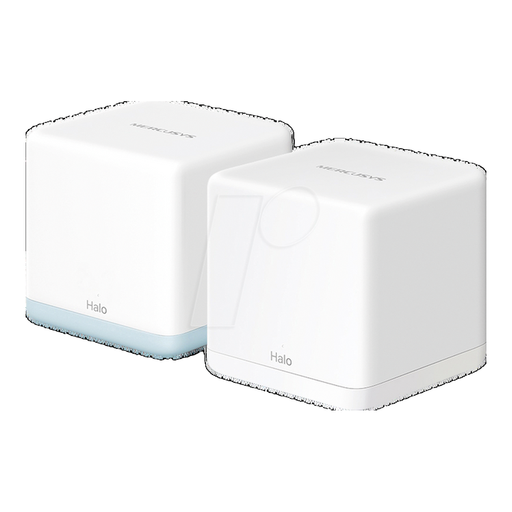
MERCUSYS Halo H1200G, 2-pack
Two mesh units for consumers who want to connect two rooms to a shared mesh network.
Dual-band AC1200, Gigabit Ethernet.
View at Joybuy
 No image available
MERCUSYS Halo H25BE, 2-pack
Two mesh units for consumers who want to cover several rooms with a wireless mesh system.
Wi-Fi 7 BE3600, dual-band, three Gigabit ports per unit.
View at Joybuy
Frequently asked questions about mesh Wi-Fi
How can I tell if I need a new mesh system?
Compare the connection at your TV with the one near the router, and check your internet connection separately. Netflix offers a speed test on playback devices; the German Federal Network Agency’s broadband measurement tool lets you compare your internet connection with the agreed data rate. If the internet connection itself is the bottleneck, a mesh kit won’t fix it.
Where should I place a wirelessly connected node?
Don’t automatically put it in the room with the worst reception: the node needs a sufficiently good connection to the router or previous node itself. Try an unobstructed intermediate location; obstacles and the router’s position can also affect reception.
Do I definitely need Wi-Fi 7 to watch a 4K nature film?
The resolution alone doesn’t mean you need Wi-Fi 7. Netflix recommends a stable connection of at least 15 Mbit/s for a single 4K UHD stream; what matters is the connection actually available on your playback device. Whether a newer Wi-Fi standard will help depends, among other things, on your devices and the connection between the nodes.
What ongoing costs and maintenance should I consider?
Check the terms for optional security services before signing up: TP-Link lists a free basic plan and charges for Pro with HomeShield on the Deco X50; NETGEAR includes one year of Armor with the Orbi RBK763S. Keep your device software up to date and protect your Wi-Fi with a secure password.


