First, check whether your internet connection itself provides enough upload speed: mesh Wi-Fi can’t make a slow connection faster. If thick walls make the wireless link between your router and home office unreliable, Ethernet backhaul is an obvious solution. If you can’t run a network cable, consider a wireless mesh system with a well-positioned node, or try Powerline using the sockets you plan to use.
Who can benefit from mesh Wi-Fi?
Drafts from a home office with poor signal
If you regularly upload large files, check your broadband connection and the connection in your home office separately. Ofcom explains how to compare your broadband connection’s actual speed with the speed stated in your contract.
Homes without network cabling
If thick walls stand between your router and workspace, you’ll need to position a mesh node somewhere it can still get a decent connection. If that isn’t possible over Wi-Fi, Powerline could be an alternative, but test it using the sockets you plan to use.
Extending your existing home network
If you want to combine your existing router with additional units, check the system’s operating mode and what’s included in the box. TP-Link says Deco is set up using a mobile app and TP-Link ID; according to FRITZ!, the FRITZ!Mesh Set 4200 includes two FRITZ!Repeater 3000 AX units.
Which buying criteria matter?
Start by comparing your internet connection’s upload speed with the connection in your workspace. Then decide whether Ethernet, a well-positioned wireless node or a Powerline test is the best fit for your home.
| What you need |
What to look for when buying |
Who it matters most to |
| Reliable uploads |
Check your broadband upload speed and the connection in your workspace separately; consider Ethernet backhaul and suitable ports. |
If I regularly upload drafts, I want to know whether my broadband connection or the link in my home office is slowing things down. Around 36% of consumers put reliable uploads first. |
| Wi-Fi coverage through walls |
Check the connection back to the network from your planned node location; if the Wi-Fi signal is poor there, consider Ethernet or Powerline too. |
If my workspace is behind thick walls, I need a spot where the node can still connect to the rest of the mesh. Around 29% of consumers prioritise Wi-Fi coverage in these areas. |
| Connecting to your home network |
Check that your existing router, modem connection, operating mode, app requirements and number of units are compatible. |
If I want to keep using my existing home network, the right setup and what’s included in the set are essential. Around 21% of consumers put home network integration first. |
| What’s included and extra costs |
Check the pack size and how many units you need; only factor in paid add-on services if you actually want them. |
If I want a clear picture of everything included and any potential extra costs before buying, I compare sets and features carefully. Around 14% of consumers prioritise the total cost and extra features. |
Common buying mistakes
-
Assuming the combined Wi-Fi speed guarantees fast uploads
The advertised combined Wi-Fi speed doesn’t tell you what upload speed you’ll get in your home office. The connection between mesh units and your broadband connection also affect upload speeds. Bitkom and VATM also point out that the internet speed you pay for is shared among everyone using it in your household.
Check your broadband upload speed and the connection in your workspace separately. Treat product specifications as technical features, not as a guaranteed upload speed in your home.
-
Putting a wireless node in a dead spot
A mesh node needs a good enough connection back to the rest of the network. So placing it behind the thickest wall could leave you with the same bottleneck.
Try an intermediate position first. If it can’t get a decent connection back to the network there, consider Ethernet or testing Powerline.
-
Choosing 6 GHz as a solution for walls based on speed alone
TP-Link describes the 6 GHz band on the Deco XE75 as a possible wireless link between units. That doesn’t prove it will provide a reliable connection through the walls in your home.
Check the connection where you plan to place the units and make sure your devices support the band. If the signal is heavily weakened, consider a different way to connect them.
-
Assuming Powerline will work like interference-free cabling
devolo warns that some sockets can deliver slower speeds and that electrical interference can affect the connection. The manufacturer also says you should be aware of possible interactions with certain VDSL profiles.
Test the sockets you plan to use during a typical upload, and check that the connection works with your broadband service.
Key brands at a glance
TP-Link
Deco models offer different ways to connect units and wireless configurations. For uploads through thick walls, the planned backhaul and the number of units you need matter more than the combined Wi-Fi speed.
- For the Deco BE25 sold in Germany, TP-Link lists two 2.5 Gbit/s ports per unit, as well as wired and wireless backhaul.
- The XE75’s additional 6 GHz band doesn’t prove that it will provide a reliable connection through the walls in your home. Deco also needs an external internet source; setup requires a mobile app and TP-Link ID.
FRITZ!
FRITZ! offers individual repeaters for targeted coverage, as well as mesh sets with multiple units. The right option depends, among other things, on your existing home network and how many units you need.
- According to FRITZ!, the FRITZ!Mesh Set 4200 includes two FRITZ!Repeater 3000 AX units. The standalone 3000 AX has two Gigabit LAN ports.
- A single repeater isn’t the same as a set with several units. Wi-Fi speed ratings don’t prove you’ll get a particular upload speed through the walls in your home.
devolo
Magic 2 WiFi 6 next combines mesh Wi-Fi with Powerline. It could be an option if walls make a wireless connection unreliable and you can’t use a network cable.
- According to devolo, the Starter Kit includes two adapters, with the connection between them using your home’s electrical wiring.
- devolo warns that performance may be lower at some sockets, electrical interference can affect the connection, and certain VDSL profiles may cause issues. You’ll need to test how it performs in your home.
Mesh Wi-Fi products at Joybuy
These Joybuy products are mesh Wi-Fi systems designed to connect different areas of your home. Check the pack size, backhaul options and ports against the setup you have in mind.
 No image available
TP-Link Deco BE22, 2-pack
A two-unit set could be a good choice for a mesh network covering several rooms.
Wi-Fi 7, dual-band and two Gigabit Ethernet ports per unit.
Router or access point mode.
View at Joybuy
 No image available
TP-Link Deco M4 AC1200, 3-pack
Three units are an option if you want to connect several areas of your home to the same mesh network.
Dual-band Wi-Fi 5 and two Gigabit LAN/WAN ports per unit.
Router and access point modes.
View at Joybuy
 No image available
TP-Link Deco X1500 AX1500, 2-pack
Two units could be a good choice for a mesh network with nodes in different areas of your home.
Dual-band Wi-Fi 6 and two Gigabit Ethernet ports per unit.
App setup; router and access point modes.
View at Joybuy
 No image available
MERCUSYS Halo H3000X AX3000, 2-pack
Two units could be a good option for connecting different areas of your home to one mesh network.
Dual-band Wi-Fi 6, MU-MIMO and three Gigabit ports per unit.
App management.
View at Joybuy
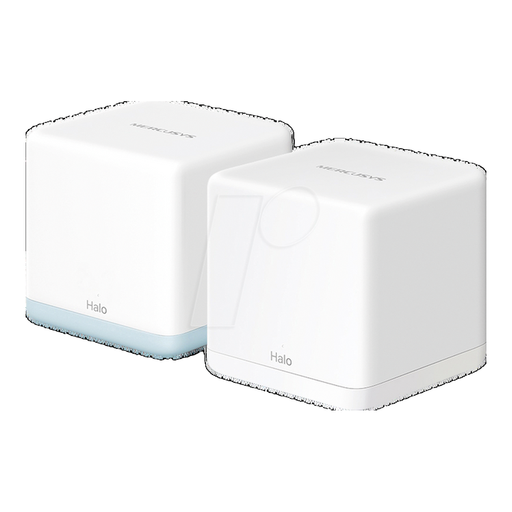 No image available
MERCUSYS Halo H1200G AC1200, 2-pack
Two mesh units are an option if you want to connect two areas of your home.
Dual-band Wi-Fi 5 and Gigabit Ethernet ports.
A single network with automatic switching to the strongest signal, according to the product description.
View at Joybuy
Frequently asked questions
How can I tell whether my broadband connection or Wi-Fi is slowing down uploads?
Where possible, compare your broadband connection’s upload speed without the problem wireless link with the connection in your workspace. Ofcom offers a broadband speed test to compare your connection’s actual speed with the speed stated in your contract; mesh Wi-Fi won’t increase the speed provided by your broadband connection.
Where should I place a mesh unit that connects wirelessly?
Don’t automatically put it in the area with the weakest signal: the unit itself needs a good enough connection to the rest of the mesh. Try an intermediate position. If you have a usable network cable, Ethernet backhaul can replace the wireless link between units.
What should I test before using Powerline permanently?
Test the sockets you plan to use during a typical upload. devolo recommends plugging adapters directly into wall sockets and identifies power supplies and dimmers as possible sources of interference. The manufacturer also warns of possible interactions with certain VDSL profiles.


