First, consider how the access point near your study area will connect to the router. If you can run an Ethernet cable, you can avoid a wireless link between the nodes. Without a cable, a mesh node needs to be placed somewhere it can still receive a usable signal. If neither option is possible, powerline with Wi-Fi may be an alternative, although performance depends on your electrical wiring. Then check whether you need a single access point or a set, and whether its operating mode is compatible with your existing router.
Who is this buying guide for?
Students who may be able to run an Ethernet cable
If you can run a network cable close to your desk, you can connect an access point there by cable. FRITZ! documents LAN bridge mode for the FRITZ!Repeater 1700, while ASUS describes Ethernet backhaul for AiMesh and ZenWiFi.
Students who can’t run a cable
If running a cable isn’t an option, you could place a wireless node somewhere in between, where it can still receive a signal. TP-Link notes that building materials and obstacles can affect actual throughput and coverage.
Students without a usable wireless connection
If you can’t run a cable and there’s no suitable place for a wireless node, powerline with Wi-Fi could be an alternative worth considering. devolo describes a connection over your electrical wiring, but performance can vary between sockets.
What should you look for when buying?
Mesh with LAN backhaul
Suitable if: you can run a network cable close to your study area.
Bear in mind: the cable route and ports need to work, and the correct LAN or Ethernet backhaul mode must be supported.
Mesh with a wireless connection
Suitable if: there’s a spot in between where the node can still get a usable connection to the router or another node.
Bear in mind: adding another node won’t automatically fix an already weak wireless connection through thick walls.
Powerline with Wi-Fi
Suitable if: neither LAN nor a suitable wireless location is available, and you have suitable sockets.
Bear in mind: sockets and electrical interference can affect the connection; interference may occur with certain VDSL connections.
| Buying priority |
What to look for |
Who it matters most to |
| Connection between nodes |
Check for a LAN port, a documented backhaul mode and a suitable route for the cable. |
If I can run a cable close to my study area, I want to avoid a wireless link between the nodes. Around 36% of consumers prioritise a wired connection. |
| Location for a wireless node |
Check possible locations in between and the connection there; advertised data rates aren’t a guarantee of performance in the room beyond your walls. |
If I can’t run a cable, I need a location where the wireless node can still connect to the rest of the network. Around 29% of consumers prioritise a wireless connection. |
| Powerline as an alternative |
Check the sockets, the connection at the destination and compatibility with your existing adapters. devolo recommends plugging adapters directly into a wall socket wherever possible. |
If neither LAN nor a usable wireless location is available, powerline could work for me. Around 21% of consumers prioritise this alternative way to connect. |
| How much coverage to add |
Compare the number of nodes you need with the options available as a single unit or set, and check that it will work with your existing router. |
If my existing network can still be used as it is, I only want to add the access points I need. Around 14% of consumers focus on extending their network selectively. |
Which buying mistakes should you avoid?
-
Assuming advertised Wi-Fi speeds match download speeds behind a wall
TP-Link describes its stated Wi-Fi speeds as theoretical, and lists building materials, obstacles and end devices among the factors that affect throughput and coverage.
First, decide how the nodes will connect, then check the location you have in mind.
-
Placing a wireless node somewhere it can’t get a usable signal
The additional access point needs its own connection to the rest of the network. Simply adding another node won’t fix an already weak wireless link.
Try a location in between, or plan for a wired connection if possible.
-
Treating powerline as a guaranteed replacement for a network cable
devolo warns that performance can vary between sockets and may be affected by electrical interference. It also notes that certain VDSL profiles may experience interference.
Check the connection at the sockets you plan to use and at the destination before relying on powerline.
-
Choosing an oversized set or incompatible expansion adapters
A set may include more nodes than you need. devolo notes that Magic and dLAN adapters aren’t compatible with each other.
First work out how many access points you need. If you’re expanding your system, check the exact product family.
Key brands to consider
FRITZ!
A relevant option if you already use a FRITZ!Box or are looking for a compatible repeater.
- FRITZ! documents LAN bridge mode for the FRITZ!Repeater 1700.
- The FRITZ!Mesh Set 4200 includes two FRITZ!Repeater 3000 AX units. The manufacturer’s stated coverage of 3–5 rooms isn’t a measurement of your specific home.
TP-Link
A relevant option if you’re considering a standalone Deco mesh system with a wireless or wired connection.
- For the German Deco BE25, TP-Link lists two 2.5 Gbit/s ports and theoretical dual-band Wi-Fi speeds of 2,882 Mbit/s at 5 GHz and 688 Mbit/s at 2.4 GHz.
- TP-Link notes that actual throughput and coverage depend on factors including building materials and obstacles. Check that you’re choosing the right version before buying.
ASUS
A relevant option if router, access point or AiMesh node mode and Ethernet backhaul are important for your home network.
- ASUS lists router, access point and AiMesh node modes for the ZenWiFi BD4, along with two 2.5 Gbit/s ports.
- ASUS notes that specifications may vary by region and package. If you use managed switches, check the documented backhaul setup.
devolo
A relevant option if you want to provide Wi-Fi at the destination over your electrical wiring, rather than running a new LAN cable or relying on a wireless link.
- According to devolo, the Magic 2 WiFi 6 next Adapter connects over your electrical wiring and provides Wi-Fi at the destination.
- Performance may be low at some sockets, and devolo also describes possible interference with certain VDSL connections. Magic and dLAN adapters aren’t compatible with each other.
Mesh systems at Joybuy
The mesh systems below are designed to provide Wi-Fi across several areas of your home. If you have thick walls, focus on where you can place the nodes and how the units will connect to each other.
 No image available
TP-Link Deco BE22 Wi-Fi 7, 2-pack
The two-pack can be placed in different areas of your home. Check that the second node’s planned location will still receive a usable connection.
Dual-band system with Gigabit WAN/LAN ports on each unit.
View at Joybuy
 No image available
TP-Link Deco M4 AC1200, 3-pack
Three units let you cover several rooms. Before buying, check whether you really need the extra nodes for your home.
Dual-band system with Gigabit WAN/LAN ports on each unit.
View at Joybuy
 No image available
TP-Link Deco X1500 Wi-Fi 6, AX1500, 2-pack
This two-pack is designed to cover several areas of your home. What matters is whether there’s a strong enough connection to the rest of your network at the intended location.
Dual-band system with Gigabit Ethernet ports on each unit.
View at Joybuy
 No image available
MERCUSYS Halo H1200G AC1200, 3-pack
Three units are designed to cover several rooms. Check that you can find a suitable location for each node with a connection to your network.
Dual-band system with two Ethernet ports on each unit.
View at Joybuy
 No image available
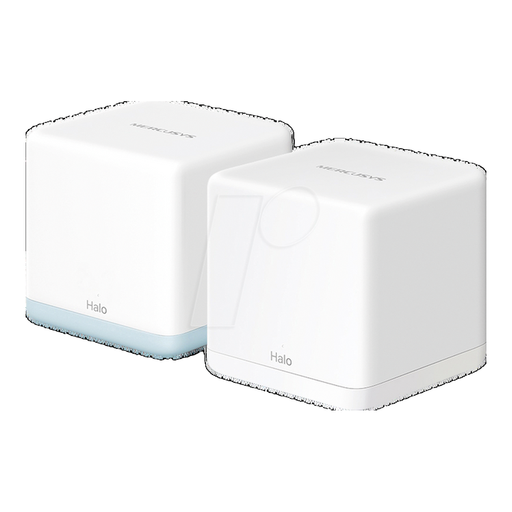
MERCUSYS Halo H1200G AC1200, 2-pack
The two-pack can be placed in different rooms. Check the wireless signal at the location of the second node.
Dual-band system with Gigabit Ethernet ports.
View at Joybuy
Frequently asked questions
Do I need to replace my internet router to use a mesh system?
Not necessarily. Depending on the model and setup, an access point can work with your existing router. TP-Link notes that Deco needs an external internet source. Before buying, check the connection and operating mode required by the specific device.
How can I tell whether a slow download is caused by Wi-Fi or my internet connection?
The German Federal Network Agency’s Breitbandmessung tool lets you compare your connection’s measured data rate with the rate agreed in your contract. Also check the Wi-Fi connection separately in your study area: a connection speed test alone won’t tell you whether a planned mesh node location is suitable.
What should I bear in mind when installing a powerline set?
devolo recommends plugging adapters directly into a wall socket wherever possible, rather than into a multiway extension lead. Check the connection at the intended location; interference can occur with certain VDSL connections.
How can I tell if a Wi-Fi device is intended for the German market?
Wi-Fi radio equipment covered by the relevant EU harmonisation legislation must carry the CE marking. The German Federal Network Agency also sets out retailers’ obligations to check labelling and required accompanying documentation. Check the specific device version; CE marking says nothing about Wi-Fi performance.
Do I need an individual frequency allocation to use Wi-Fi at home?
For the Wi-Fi frequency bands generally allocated by the German Federal Network Agency, you don’t need an individual allocation just to use a device designed for normal use. You should still check that the specific device version and the way you use it comply with the applicable requirements.


