Presenters in Wi-Fi dead zones
If you want to present from a distant room, check the actual signal there rather than relying solely on advertised coverage figures. Microsoft Support recommends testing Wi-Fi in different parts of your home.


For presentations in rooms separated by thick internal walls, first check whether you can get a usable connection both where you’ll be presenting and at the potential location of a mesh node. If there’s a suitable route for a cable, Ethernet backhaul can connect the nodes; without a cable, the wireless node still needs a connection to the main unit. The Wi-Fi Alliance notes that walls and cabling affect Wi-Fi coverage, while screen casting also needs to work between your computer and display.
If you want to present from a distant room, check the actual signal there rather than relying solely on advertised coverage figures. Microsoft Support recommends testing Wi-Fi in different parts of your home.
How the nodes connect to each other is key. If you have an Ethernet cable, check whether the mesh system supports Ethernet backhaul. As the Wi-Fi Alliance explains, walls and cabling can affect Wi-Fi coverage.
Good Wi-Fi coverage isn’t always enough: your computer and display need to support the chosen casting method and communicate with each other. Microsoft Support says Miracast is required for the wireless Windows projection method it describes.
A good fit if: there’s a usable cable route between your router and the node, and the wireless signal struggles to pass through the wall.
Keep in mind: the cable route, ports and backhaul support of the specific system all need to be compatible.
A good fit if: there’s no cable route, but a potential midway position still gets a usable connection to the main unit.
Keep in mind: an extra node won’t help if it can’t get a strong enough backhaul connection itself.
A good fit if: your router and internet connection are working, and only the room where you present has a weak signal.
Keep in mind: check whether the additional node will work with your existing mesh or create a separate network.
Before you buy, work out whether the problem is actually Wi-Fi reception or screen casting. The buying criteria below are for consumers considering mesh Wi-Fi for presentations in rooms separated by thick internal walls.
| Buying criterion | What to look for | Who it matters most to |
|---|---|---|
| Reception where you present | Test the connection in the actual spot and work out how many nodes you need and where to put them. | If I need a reliable connection in the room where I present, I want to check reception right there. Around 26% of consumers would put reception where they present first. |
| Node backhaul | Check whether Ethernet backhaul is supported and whether there’s a cable route; without a cable, the node needs to be placed somewhere within range. | If the wall makes it difficult for the router and node to connect, I want to know whether a cable or a reachable midway position is an option. Around 26% of consumers would prioritise the mesh node’s backhaul connection. |
| Communication with the display | Check the casting method and test your computer and display together; with Chromecast, client isolation can prevent them from communicating. | If I want to present wirelessly, my computer and display need to be able to communicate using the chosen method. Around 21% of consumers would make screen casting their top buying priority. |
| Working with your existing router | Check your router model, preferred operating mode and mesh compatibility before choosing a kit or an additional node. | If I want to keep using my router, I want to add a suitable extension rather than replace it hastily because of one room with a weak signal. Around 16% of consumers would prioritise keeping their router. |
| Overall cost and upkeep | Factor in the nodes and cables you’ll need, as well as any subscriptions and updates required for self-managed router hardware. | If I want to keep ongoing maintenance and the overall effort in check, I look at the hardware, cabling and optional services together. Around 11% of consumers would put manageable overall costs first. |
The satellite also needs a usable connection to the main unit. If it’s already in a spot without a strong enough signal, placing it close to your presentation device won’t solve the problem.
Check the connection status at the planned location. If the wireless link isn’t strong enough, try a more accessible midway position or consider Ethernet backhaul.
Depending on where you place it, you may need an extra node or a cable route.
Walls, your home’s layout and cabling all affect real-world coverage. A general product claim therefore can’t tell you how well the signal will reach your room.
Test the connection where you’ll present and at the planned node location. Treat model specifications as product information, not measurements of your building.
Having Wi-Fi coverage doesn’t guarantee that your computer and display can communicate using your preferred casting method. With Chromecast, client isolation can prevent a connection; the wireless Windows projection method described by Microsoft requires Miracast support.
Test your computer, receiver and casting method together before choosing networking hardware.
A kit connected to your existing router and an extension to an existing mesh network may require different operating modes and set-up steps.
Check your router model against the mesh system’s supported integration options and router or access point mode.
An unsuitable operating mode can mean extra set-up work or devices you don’t need.
The Deco X50 range is a standalone Wi-Fi 6 mesh system. TP-Link Germany says optional Ethernet backhaul is supported.
The ZenWiFi XD5 can be used as a standalone mesh system or in a compatible AiMesh configuration. ASUS describes Ethernet backhaul as one possible connection method.
FRITZ! describes the Mesh Set 4200 as comprising two or three FRITZ!Repeater 3000 AX units. According to FRITZ!, it can be connected to an existing router or used to extend a FRITZ!Box.
NETGEAR describes the Orbi RBK763S as a tri-band kit comprising a router and two satellites for multiple Wi-Fi locations.
eero 6+ is an app-based Wi-Fi 6 mesh system; the variant described is a two-pack.
This selection includes TP-Link Deco mesh systems for multiple locations, as well as individual units for extending a Deco network in specific areas.
 No image available
The 2-pack is an option if you want to set up mesh nodes in multiple locations.
Wi-Fi 7, dual-band and Gigabit Ethernet.
 No image available
The 3-pack is an option if you want to spread mesh nodes across several rooms.
AC1200, dual-band and Gigabit ports.
 No image available
The 3-pack is an option for consumers who want to set up several Deco nodes.
AC1200, dual-band and Gigabit ports.
 No image available
The single unit may suit you if you want to extend a compatible Deco network in a specific area.
AC1200, dual-band and Gigabit ports.
The single pack contains one mesh unit; you’ll need additional compatible units for multiple nodes.
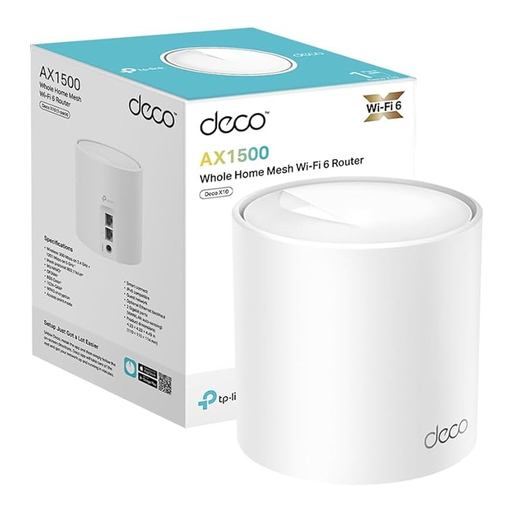 No image available
This single Deco unit is for consumers who want to extend an existing Deco mesh in a specific area.
Wi-Fi 6 AX1500, dual-band and 2 Gigabit ports.
The mesh extension described requires an existing Deco network; the single pack isn’t a complete multi-node kit.
Only if the node can get a usable backhaul connection to the main unit from there. Check the connection status at the planned location. If the wireless link is too weak, try a more accessible midway position or Ethernet backhaul.
First, check which casting method you’re using. With Chromecast, AP or client isolation can prevent devices from communicating; for the wireless Windows projection method described by Microsoft, the target display must support Miracast. These requirements don’t apply universally to every presentation solution.
Compare the connection in the same locations before and after making the change, and check the node connection status. Microsoft Support recommends testing Wi-Fi in different parts of your home; if you manage your own router hardware, remember to keep it updated too.
Depending on the solution, you may need a cable, extra nodes or optional services. NETGEAR describes Armor for the Orbi RBK763S as a subscription service with the first year included. You’ll also need to factor in updates for self-managed router hardware; check the terms of the specific offer.