Learners with Wi-Fi dead spots
If you stream your language lesson behind thick walls, the most important thing is the reception where you study. With a wireless mesh, the connection between the nodes also needs to be strong enough at that point.


A wireless mesh is a good option if an additional node placed part-way between your router and your learning space can still get a strong connection to the rest of the network. If the thick walls also obstruct this connection, Ethernet backhaul is a more predictable option, provided you have a suitable LAN cable and the right ports. Also check whether you can keep using your existing router and how many nodes you actually need.
If you stream your language lesson behind thick walls, the most important thing is the reception where you study. With a wireless mesh, the connection between the nodes also needs to be strong enough at that point.
If you can connect a remote node using a network cable, you can avoid sending the backhaul signal through the walls. Check whether your chosen system supports Ethernet backhaul.
If your internet router works reliably and you only need better Wi-Fi coverage where you study, a compatible mesh add-on could be an alternative to replacing your router. The connection method and operating mode depend on the system.
For your learning space, it’s not just the Wi-Fi signal on your device that matters. The connection between the router and the remote mesh node is important too.
| Consideration | What to check before buying | Who should pay particular attention? |
|---|---|---|
| Reception where you study | Check possible locations between the router and your learning space, as well as the connection between the nodes. | If I’m studying behind thick walls, a usable signal where I take my language lesson is what matters most. Around 36% of consumers put reception in their learning space first. |
| Backhaul between the nodes | For a LAN connection, check the ports and support for Ethernet backhaul. Without a cable, look for a suitable wireless location or test powerline adapters in your home. | If the wireless signal has to pass through difficult walls, I pay particular attention to a reliable connection between the router and the remote node. Around 29% of consumers prioritise a stable backhaul connection. |
| Keeping your existing router | Check how the first node connects and which operating mode is required for the specific kit. | If my internet router works, I mainly want to extend the coverage without replacing it unnecessarily. Around 21% of consumers prioritise keeping their existing router. |
| Overall cost and running costs | Compare the number of nodes you need and what’s included. Also consider power consumption, updates and secure passwords. | If I’m running devices all the time, I consider power consumption and secure management as well as the number of nodes I need. Around 14% of consumers prioritise overall cost and running costs. |
An additional mesh node still needs a usable connection to the rest of the network. If it’s already in a Wi-Fi dead spot, it may not be able to provide reliable coverage where you study.
Before buying, check for possible locations part-way between the router and your learning space. If there isn’t a suitable wireless connection there, plan to use Ethernet backhaul.
Depending on where you place it, you may need another node or have to install a LAN cable later.
Wi-Fi 7 doesn’t automatically mean that every model uses a 6 GHz band. For example, TP-Link describes the Deco BE25 as a dual-band system using 2.4 and 5 GHz.
Compare the wireless bands supported by the specific model rather than relying on the Wi-Fi generation alone.
Some powerline sockets may deliver low data rates, and electrical appliances can also interfere with the transmission. The results depend on the installation in your home.
Test the sockets you plan to use before relying on powerline for backhaul. If the connection isn’t suitable, try a different socket or another connection method.
Deco mesh systems are an option if you want to set up your own Wi-Fi mesh.
The FRITZ!Mesh Set 4200 could suit households that want to keep their existing router and set up a mesh with several nodes.
According to ASUS, the ZenWiFi XD5 is a mesh option for households that can use an Ethernet connection between the nodes.
Magic 2 WiFi 6 next combines Wi-Fi with a backhaul connection over your electrical wiring. It could be an alternative route if you don’t have a LAN cable installed.
The following mesh Wi-Fi systems are designed to connect multiple rooms. Before choosing, check that the number of nodes and the features listed suit your learning space and existing router.
 No image available
This two-unit kit could suit you if you want to set up a mesh across several rooms.
The product name lists Wi-Fi 7, dual-band and Gigabit Ethernet. The description also mentions router and access point modes.
 No image available
The three-unit version could be worth considering for several rooms; check whether you really need all the nodes.
The product name lists AC1200, dual-band and Gigabit ports. The access point mode mentioned in the description is relevant if you want to keep using your existing router.
 No image available
This two-unit kit is an option if you want to place mesh nodes in different parts of your home.
The product name lists Wi-Fi 6, dual-band and Gigabit ports.
 No image available
This two-unit kit could suit you if you want to set up a single mesh network across several rooms.
The product name lists Wi-Fi 6 AX3000, dual-band and three Gigabit ports per unit.
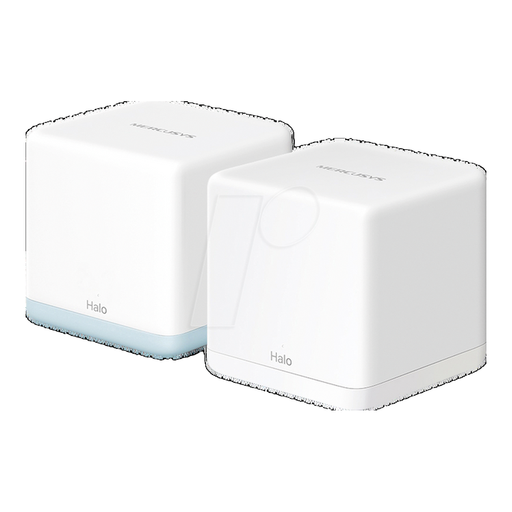 No image available
This kit with two Halo units could be suitable for setting up a mesh across several rooms.
The product name lists AC1200, dual-band and Gigabit ports. The description also mentions an app for setup and management.
With wireless backhaul, place the node somewhere it can still get a strong enough connection to the rest of the mesh and provide coverage where you study. Don’t simply put it at the furthest point in the Wi-Fi dead spot. With Ethernet backhaul, a suitable LAN cable can carry the backhaul connection.
Not necessarily. According to FRITZ!, you can connect the FRITZ!Mesh Set 4200 to an existing router via LAN. For a different kit, check the required connection method and operating mode.
Keep the firmware up to date and protect the system’s management settings with strong passwords. The Federal Office for Information Security recommends these measures for Wi-Fi. Additional devices left on all the time use electricity. To calculate the cost, you’ll need the devices’ actual power consumption and your electricity tariff.