Who is mesh Wi-Fi suitable for?

Families with a Wi-Fi dead spot behind solid walls

If you need a signal in your video room, find a suitable location for the next wireless node or a wired connection. The node’s connection to the router matters too, as FRITZ! notes in its guidance on positioning repeaters.

Families with video storage on their home network

Existing LAN connections and the ports on the devices involved are important for connecting your storage to your playback device. F.A.Z. Kaufkompass describes wired backhaul as generally more powerful and less prone to interference than a wireless connection between mesh nodes.

Households with an existing mesh router

If you want to keep using your existing network equipment, check that the specific router is compatible and supports the mode you plan to use. FRITZ! explains how certain mesh settings can be carried over to compatible FRITZ!Box systems; this cannot be assumed to apply to routers from other brands.

What should you look for when buying?

Ethernet backhaul

Suitable if: you have a usable LAN connection between the router and mesh node, and both support wired backhaul.

Consider: The connection between the nodes requires suitable cabling and ports.

Wireless mesh

Suitable if: you can’t run a cable, but can position a node where it has a good connection to both the router and the video room.

Consider: The wireless link between nodes can become a bottleneck. Placing a node in the middle of a dead spot won’t solve the problem.

Powerline mesh

Suitable if: you don’t have a LAN connection and testing shows that the connection over your electrical wiring is good enough at the sockets you plan to use.

Consider: Transfer speeds can vary depending on the socket and electrical interference. Manufacturers’ descriptions of how the technology works are no guarantee of performance in a particular home.

Priority What to check when buying Who it matters most to
Connection through thick walls Test reception where you plan to place the node; check for existing LAN connections and Ethernet backhaul support. If I need to reach the video room, the node’s connection matters just as much as the signal it receives there. Around 36 % of consumers prioritise a connection through thick internal walls.
Reliable video streaming Check where your video storage and playback device will be, as well as the LAN ports on the nodes. If I want to watch videos from storage on a device on my home network, the connection across the entire route matters to me. Around 29 % of consumers put reliable video streaming first.
Connecting your existing router Check the router model, supported mesh or access point mode, and connection to the main node. If I want to keep using my router, I need to know whether additional mesh equipment will work with it. Around 21 % of consumers prioritise integrating their existing network equipment.
Overall cost and effort Compare what’s included, how many nodes you need, any existing cabling and, if relevant, the powerline connection at the sockets. If I want to avoid extra devices or installing a new cable, the effort involved in the whole setup matters to me. Around 14 % of consumers focus mainly on the overall effort and equipment required.

Common buying and planning mistakes

  • Placing a wireless mesh node in a dead spot

    The node needs to receive a strong enough signal from the router itself. Otherwise, the bottleneck simply moves to the node.

    Check the location and connection quality before deciding how many nodes you need.

    Depending on your home’s layout, you may need another node or a cable run.

  • Confusing the TV’s LAN port with wired backhaul

    A cable from the TV to the mesh node won’t automatically remove the wireless connection between that node and the router.

    Map out the whole route from your video storage to the playback device and check which sections are actually wired.

    Wired backhaul may require an additional cable between the mesh nodes.

  • Assuming powerline data rates are guaranteed throughout your home

    devolo notes that some sockets can deliver low transfer speeds and that electrical devices can affect the connection.

    Test the sockets you plan to use under your actual usage conditions.

    Testing sockets takes time. If the connection isn’t good enough, you may need an alternative cabling solution.

  • Assuming a single extender is a complete multi-node kit

    A single extender and a multi-pack are designed for different starting points. Check whether you already have a compatible mesh base unit.

    Compare what’s included with your existing network equipment and the number of nodes you need.

    Without a suitable base unit, you may need another compatible device.

Key brands at a glance

FRITZ!

FRITZ! offers repeaters to extend compatible FRITZ!Box systems, as well as the FRITZ!Mesh Set 2700, which the manufacturer says can also be used with routers from other brands.

  • For the FRITZ!Repeater 2700, the manufacturer documents LAN operation and the transfer of certain settings within a FRITZ!Box mesh.
  • These additional FRITZ!Box features do not automatically apply to routers from other brands. The information does not prove how well the product performs in homes with thick walls.

TP-Link

Depending on the model and operating mode, Deco systems offer wireless or Ethernet backhaul. According to the manufacturer, the Deco PX10 adds powerline to the connection between nodes.

  • TP-Link describes Ethernet connections between Deco units and documents the cabling required for different operating modes.
  • The manufacturer’s description of the PX10 does not promise a particular level of performance at a specific socket or in a specific home.

devolo

The WiFi 7 Mesh BE6500 is a mesh system with LAN ports. Separate devolo products use powerline.

  • devolo lists one 2.5 Gbit/s port and three Gigabit ports per BE6500 unit.
  • The manufacturer’s powerline guidance notes that transfer speeds can be low at some sockets and affected by electrical devices; it does not provide performance measurements for the BE6500.

eero

eero describes an app-based mesh system for households looking to set up their own mesh network.

  • According to eero, a device with an Ethernet port can use wired backhaul.
  • For gateway setup, eero requires a device with an Ethernet port and a compatible mobile app. This does not guarantee wireless range behind solid walls.

Mesh products on Joybuy

These products are designed to provide mesh Wi-Fi across several rooms. Before choosing, check which operating mode and ports will work with your home network.

TP-Link Deco BE22 (2-Pack)

TP-Link Deco BE22 (2-Pack)

This two-unit set is worth considering if you want to connect several rooms and link devices by Ethernet.

Wi-Fi 7, dual-band and two Gigabit WAN/LAN ports per unit.

View on Joybuy

TP-Link Deco M4 Mesh WiFi System AC1200 (3-Pack)

TP-Link Deco M4 AC1200 (3-Pack)

This three-unit set is an option if you want to connect several rooms to the same mesh network.

Dual-band, AC1200 and two Gigabit ports per unit; the product description lists router and access point modes.

View on Joybuy

TP-Link Deco S4 Mesh WiFi System AC1200 (3-Pack)

TP-Link Deco S4 AC1200 (3-Pack)

This set could suit a mesh network across several rooms if three nodes fit your planned setup.

Dual-band AC1200 and Gigabit ports on every unit; the product description lists router and access point modes.

View on Joybuy
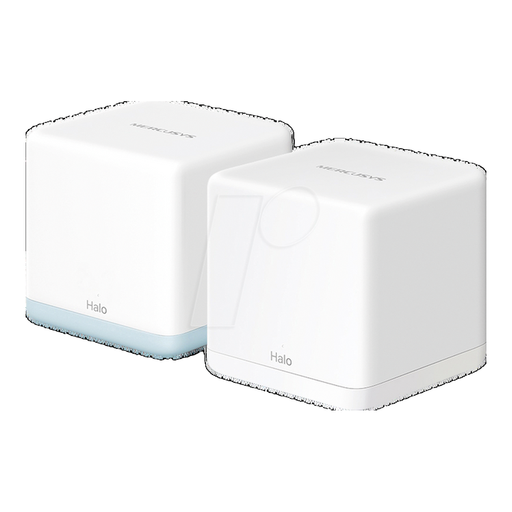
MERCUSYS Halo H1200G AC1200 Mesh WiFi System (2-Pack)

MERCUSYS Halo H1200G AC1200 (2-Pack)

This two-unit set is an option if you need mesh across several rooms and Ethernet ports on the nodes.

Dual-band AC1200 and Gigabit Ethernet ports; the product description says setup is via the MERCUSYS app.

View on Joybuy

Ubiquiti U7 Mesh

Ubiquiti U7 Mesh

This mesh access point is only worth considering if PoE power and management through UniFi Network are compatible with your existing network infrastructure.

The model is listed as featuring Wi-Fi 7, a 2.5 Gigabit Ethernet uplink and PoE.

View on Joybuy

Frequently asked questions

Does a wireless node need to be placed in the room with no reception?

No. With a wireless connection, the node also needs a good link to the router, so look for a location where it gets a decent signal from both sides. If you have a suitable LAN connection, you can connect the node by cable instead.

How do you connect Deco nodes by cable?

The connection depends on the Deco operating mode. In router mode, TP-Link describes connecting the satellite to the LAN port on the main Deco or its switch; other connection options apply in access point mode. Check the instructions for your specific setup.

What should I compare when checking what’s included and the warranty?

Check whether you need a single extender or a complete set, and factor in any extra powerline devices or cable installation. The five-year warranty that FRITZ! lists for the Mesh Set 2700 is a manufacturer’s statement for this product range, not an industry-wide warranty period.

How can I tell whether a wireless device meets CE requirements?

According to the Federal Network Agency, products covered by the relevant EU harmonisation legislation and placed on the EU market must carry the CE marking. Check the marking and documentation for the specific device; they are not independent proof of its range or performance.

Which German 6 GHz rules apply to Wi-Fi devices?

In Order 76/2025, the Federal Network Agency specifies the 5945–6425 MHz frequency range and revokes Order 12/2025. If you’re considering a 6 GHz device, check that it is the German version and review the current terms of use. A Wi-Fi 7 label alone does not confirm that a 6 GHz band is available or that the device can operate at every location.