Readers recording at a busy desk
If other people are working nearby, the microphone’s position and a test recording are important for assessing which background sounds will be picked up.


When other people are working at the same desk, a microphone you can position close to yourself, with a suitable pickup pattern, is a sensible starting point. To find out whether background noise will still be audible, make a test recording in your actual workspace. Consistent audiobook chapters also depend on keeping the microphone in a stable position and having a reliable way to monitor the sound. USB makes it easy to connect to a computer, while recording via XLR requires a suitable interface.
If other people are working nearby, the microphone’s position and a test recording are important for assessing which background sounds will be picked up.
A repeatable speaking position and headphone monitoring help you keep your distance and levels consistent across multiple recording sessions.
If you can record at a quiet time, you can also consider a condenser microphone and the interface it requires.
At a shared desk, a test recording made in your usual working conditions should help you decide on the microphone type and connection. Audio-Technica recommends positioning dynamic microphones close in front of the speaker; even so, other people’s voices may still be audible.
| What matters | What to check before buying | Who is this important to? |
|---|---|---|
| Background noise and room sound | Check the pickup pattern and the side you speak into. Position the microphone securely close to your voice, then listen back to a test recording. | When I record at a busy desk, I want to hear how much of the surrounding noise makes it into my chapter. Around 36% of consumers put reducing audible background noise first. |
| Consistent chapters | Check for a mount that lets you recreate the same position, as well as the headphone connection and monitoring options on the model you choose. | When recording across several sessions, I want to keep my distance and levels as consistent as possible and catch mistakes as I speak. Around 29% of consumers prioritise consistent chapter recordings and monitoring while recording. |
| Easy computer connection | For USB, check computer compatibility. For XLR, factor in an interface and monitoring setup. Assess hybrid models separately for each signal path. | If I want to get started on my computer without extra equipment, a compatible USB connection is essential. Around 21% of consumers prioritise an easy computer connection. |
| More sound options in a quiet space | Make a test recording in the intended location. For an XLR condenser microphone, check the required power supply and interface. | If my recording space is quiet enough, I want to compare condenser options and what they require. Around 14% of consumers prioritise sound shaping in a quiet recording space. |
Manufacturers’ claims about microphone or software features do not prove that conversations at your particular desk will reliably disappear from your recording.
Record a short test in your usual working conditions and listen to it through headphones. Audible interference may mean you need to record again or do extra editing. Do not record other people’s conversations without permission.
On hybrid microphones, digital processing and monitoring features may be tied to the USB signal path and unavailable via XLR.
Before buying, check which features you can actually use with the connection you intend to use. An XLR setup may also require a suitable interface and monitoring arrangement.
Consistent chapters also depend on the mount, connections and monitoring setup. What’s included varies by model.
Check the details for the exact version and compare them with the accessories you already have. Depending on the model, you may need a suitable mount or interface.
The MV7+ combines USB-C and XLR with a headphone connection, while the SM7B is a dynamic XLR microphone.
The dynamic PodMic USB offers USB and XLR connections, as well as a headphone output.
The dynamic ATR2100x-USB offers USB and XLR outputs. The manufacturer lists a desktop stand and cables as included accessories.
The LCT 240 PRO is an XLR condenser option for a sufficiently quiet recording space.
The MB 7 Beta USB is a dynamic USB/XLR microphone designed for close-up speaking.
The models below are mainly dynamic USB/XLR microphones for recording speech at a desk. A wireless microphone system offers an alternative, with transmitters you can position on your body.
 No image available
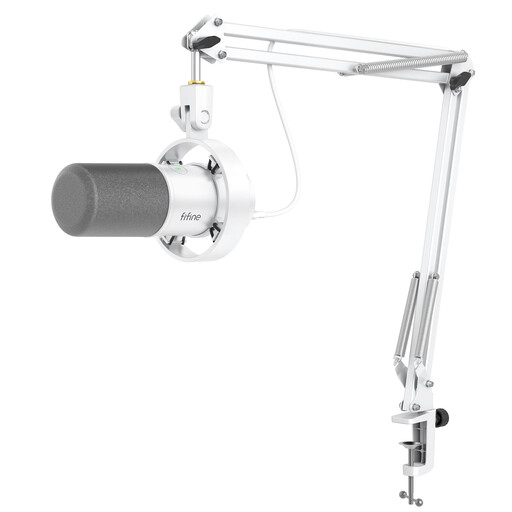
This dynamic USB/XLR microphone and boom arm set is suited to recording speech at a desk, with a positionable microphone.
The cardioid pickup pattern and headphone connection described in the product details help with positioning and planning how you’ll monitor the sound. According to the description, the function buttons only work via USB; an XLR cable is not included.
 No image available
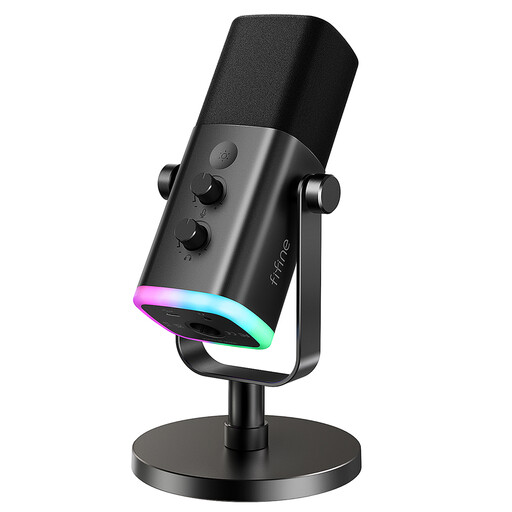
The desktop stand gives you a way to set up the microphone on your desk if you’d rather not attach it to a boom arm.
The model is described as a dynamic USB/XLR microphone with a unidirectional pickup pattern and headphone connection. According to the description, the RGB lighting and function buttons are USB-dependent; the boom arm and XLR cable are not included.
 No image available
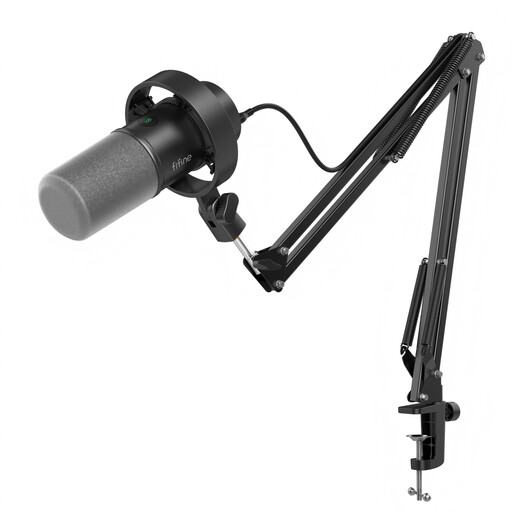
The boom arm set lets you adjust the microphone’s position on your desk.
According to the description, the dynamic microphone offers USB/XLR, a unidirectional pickup pattern and a headphone connection. The function buttons are active only when connected via USB; an XLR cable is not included. The C-clamp is specified for desks less than 2 inches thick.
 No image available
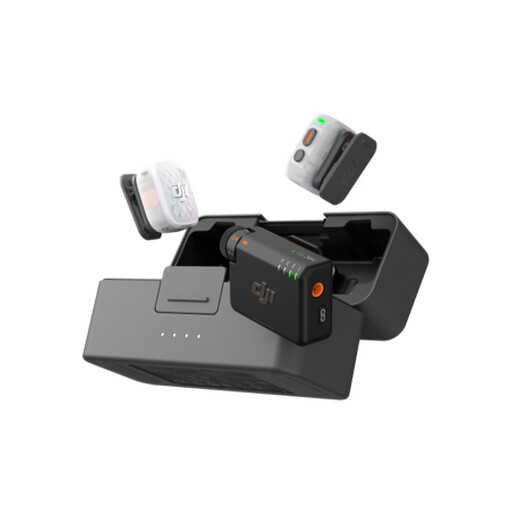
This wireless system may suit you if you’d rather use a transmitter positioned on your body than a desktop microphone.
According to the product name, the set includes two transmitters, a receiver and a charging case. The transmitters are described as having internal 32-bit float recording and storage. Check that this recording method suits your computer and editing workflow.
 No image available
The desktop stand is an option if you want to set the microphone up on your desk.
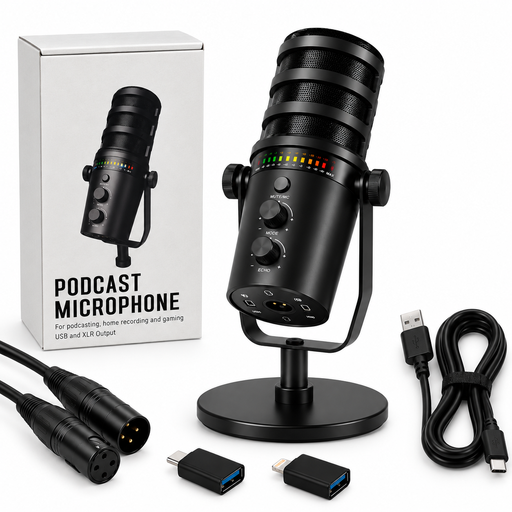
The product title lists USB-C/XLR, gain control, echo, mute and RGB. The description lists a cardioid pickup pattern and a headphone connection.
No, not without permission. Section 201(1) of the German Criminal Code (StGB) covers the unauthorised recording of another person’s non-public spoken words on an audio medium. Choose a time or place where such conversations will not be recorded, or obtain the necessary permission in advance. This does not mean that every personal audiobook recording at a shared desk is prohibited.
Not just because you have read the text aloud yourself. The German Patent and Trade Mark Office explains that novels may be protected by copyright, including rights relating to reproduction and making works available to the public. Check the necessary usage rights for the specific work and intended use. Your own texts and works in the public domain should be assessed separately.
Choose a speaking position you can recreate, check which side to speak into and listen back to short test recordings, including louder passages. The ATR2100x-USB, PodMic USB and MV7+ are described as having a headphone connection. Make sure the monitoring feature you want is available with the connection you choose.
For the LEWITT LCT 240 PRO, the manufacturer lists an XLR connection and 48 V phantom power. You’ll need a suitably equipped interface and a way to monitor the sound. This power requirement applies to this model and not necessarily to every microphone.
Under the EU rules outlined, consumers buying from a commercial seller generally have a two-year statutory legal guarantee against the seller. Check who your seller is. Any additional manufacturer’s warranty is separate.
A microphone on its own cannot ensure that a finished audio file meets a publishing platform’s requirements. If you plan to publish through ACX, check its current submission requirements and test the edited file. If you have not chosen a platform, ACX requirements are not a general requirement when buying a microphone.