Pronunciation teachers
You record individual words and longer explanations, and want to check P and S sounds in a test recording rather than relying on sound claims alone.


For long German pronunciation lessons, a close-miked dynamic USB microphone can be a good starting point if you record on your own from a fixed position and can hear background noise in the room. In a quiet room, a directional USB condenser microphone is another option. What matters most is keeping your speaking position consistent, testing with P and S sounds, and using a reliable recording setup with enough storage space.
You record individual words and longer explanations, and want to check P and S sounds in a test recording rather than relying on sound claims alone.
You want to monitor your levels and voice during longer solo recordings, and check your storage space, computer and recording setup before you start.
You speak in a spot where you can hear fan or room noise, and can try keeping the microphone close and in the same position.
A good fit if: You speak on your own from a fixed position, can place the microphone close to you, and background noise is distracting in your test recording.
The trade-off: You need to maintain a consistent position throughout the take; a directional pickup pattern does not guarantee noise-free audio.
A good fit if: Your room is quiet enough in a test recording and you want a recording setup that plugs straight in.
The trade-off: Test the specific model to see whether it picks up breath sounds, room acoustics and desk noise at your speaking distance.
USB gives you a direct connection to your computer. XLR is an option if you already have, or are planning to get, a suitable audio interface. An extra connection on its own says nothing about how clear or long a recording will be.
| What you need | What to check before buying | Who should consider this? |
|---|---|---|
| Clarity of individual sounds | Record P and S sounds and a complete sentence; test the microphone position and pop filter. | If you want to assess individual sounds in the saved recording, focus on how your actual practice words sound. Around 31% of consumers put speech clarity first. |
| Monitoring long takes | Check headphone monitoring and level controls; confirm the recording time and available storage beforehand. | If you want to record longer explanations without unnecessary interruptions, you need control over the entire recording setup. Around 25% of consumers prioritise monitoring long takes. |
| Room and background noise | Make and listen back to a test recording in your intended spot, with your usual fan and desk noise. | If you can hear a fan or room noise in the background, check whether speaking from a consistent, close position helps. Around 25% of consumers focus primarily on room noise. |
| Connections and controls | Check the computer connection, cable, headphone socket and any audio interface you may need. | If you want to keep using your existing or planned setup, make sure the connections and controls are compatible. Around 19% of consumers put connection flexibility first. |
A directional pickup pattern or a manufacturer's claim about noise reduction does not guarantee that fan and other background noise will disappear. In its test of the original Shure MV6, the surrounding noise remained audible.
Make a test recording in the spot you plan to use, with the fan running and from your usual speaking position.
In its test, COMPUTER BILD heard noticeable popping with the RØDE NT-USB Mini; the original Shure MV6 it tested produced slightly harsh S sounds.
Compare saved test recordings using the sounds you plan to teach, and check the microphone position and pop filter.
Recording time and dropouts can also depend on available storage, computer load or cables.
Test the entire recording setup with a longer recording, then back up the finished take before editing.
The original Shure MV6 and the MV6 Gen 2 are separate models. An XLR setup may also require a suitable external recording device.
Check the full model name, connections and included accessories against the recording equipment you already have.
The AT2040USB is a dynamic USB microphone with a hypercardioid pickup pattern, designed to focus on a single voice.
The PodMic USB offers USB-C and XLR for voice recording, while the NT-USB Mini is a compact USB condenser alternative.
The Profile USB is a directional USB condenser microphone for a fixed voice-recording setup.
The UM 6.0 ADVANCED is a USB model with switchable cardioid and omnidirectional pickup patterns.
The original MV6 is a dynamic USB model with automatic level adjustment and a headphone socket.
The selection includes dynamic USB or USB/XLR microphones for a fixed voice-recording setup, as well as wireless lavalier systems for portable setups.
 No image available
For recording a single voice, with a direct USB connection or an XLR recording setup.
Unidirectional pickup pattern, USB and XLR connections, plus a headphone socket and mute button. According to the product details, the microphone controls only work in USB mode; an XLR cable is not included.
 No image available
For a fixed recording setup where you can position the microphone with a boom arm.
Dynamic USB/XLR microphone with gain control, mute button and headphone socket. A windscreen and shock mount are listed as kit contents; according to the product details, the controls only work in USB mode, and an XLR cable is not included.
 No image available
For voice recording at a fixed desk setup, with USB or XLR connection.
Cardioid pickup pattern, gain control, mute function and headphone socket with real-time monitoring. According to the product details, an XLR cable is not included.
 No image available
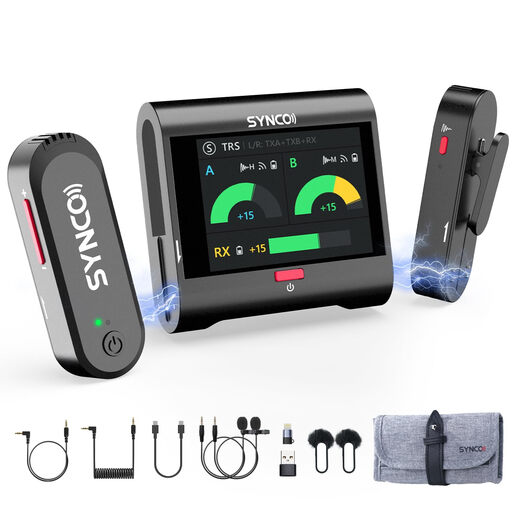
A portable lavalier alternative if you want a wireless system with two microphones instead of a desk microphone.
The product is described as offering stereo, mono and safety channel modes, as well as TRS, TRRS and USB-C outputs. Real-time monitoring and adjustable levels are also listed.
 No image available
A portable lavalier option if you also want to consider the local recording feature described.
The product details list three levels of DSP noise reduction and local recording to a TF card. A TF card is not included, according to the product details.
For the wired computer setups covered here, a general battery-life figure for the microphone is not the key factor. Check how much recording time your software allows, how much storage space is available and whether your connection is reliable, then record a longer test. Audacity lists storage space and recording format as factors; dropouts can also be caused by computer load or faulty cables.
Position the microphone according to its pickup direction and keep it in the same place when comparing recordings. The recommendation of around 5–10 cm applies specifically to the RØDE PodMic USB, not every model. Test P sounds with a pop filter, check the level during your loudest passages, and listen back to the saved recording.
Test the whole recording setup before starting a long take and check how much storage space is available. Audacity lists computer load and damaged cables or connections as possible causes of gaps and dropouts. Also save a copy of the finished recording as an audio file before editing.
Recording another person's non-public speech without authorisation is a criminal offence under § 201 StGB. Before recording, check that you have the necessary permission. If personal data is processed, there must be a legal basis for doing so; consent is one possible legal basis, but not the only one.