Solo speaker in an echoey room
You’re recording the introduction on your own and can stay close to a directional microphone.


For an introduction recorded solo, a directional dynamic microphone with USB or USB/XLR is a natural starting point, provided you can speak close to and directly in front of it. Audio-Technica recommends positioning this type of microphone directly in front of the speaker, no more than 200 mm away. A test recording is still important, as directionality alone won’t eliminate room echo. If you plan to record both interview voices afterwards, make sure you have microphones and inputs for both people: an XLR microphone needs a suitable audio interface to connect to a computer.
You’re recording the introduction on your own and can stay close to a directional microphone.
You want to record without a separate audio interface and monitor your voice as you record.
You want to record the conversation after the introduction too, so you’ll need to plan microphones and inputs for both people.
A good fit if: you’re recording solo at your computer and can position the microphone close in front of you.
Consider: The close speaking position may be visible on camera, and you’ll still need to make a test recording in the room.
A good fit if: you already have a suitable audio interface or plan to use several separate inputs.
Consider: For voice-over work with the SM7B, Shure specifies at least 60 dB of preamp gain. This figure doesn’t apply to other models as a general rule.
A good fit if: you need to switch between recording setups or want to place the microphone further away.
Consider: A setup for two people may pick up more of the room. Check the results with a test recording.
| What you need | What to look for when buying | Who is it important for? |
|---|---|---|
| Clear solo voice recordings | Look for directional recording and a stable, close speaking position; test it in the room where you’ll actually be recording. | If I’m recording the introduction on my own in an echoey room, I want to speak close to the microphone and limit how much of the room is picked up. That’s why around 36% of consumers put room acoustics first. |
| Quick connection and monitoring | Check that the recording device has a USB connection, see which cables are included and look for a headphone socket. XLR alone isn’t enough for a direct connection to a computer. | If I want to get started on a laptop without a separate interface and monitor my voice directly, a straightforward connection is essential. Around 29% of consumers prioritise getting started with recording easily. |
| Recording both voices in a conversation | Decide in advance whether each person will have their own microphone or whether they’ll share one; choose connections and recording software to suit. | If the interview has two voices after the introduction, I want to plan the microphone setup for the whole conversation. Around 21% of consumers prioritise recording both voices. |
| Expanding your setup later | Check whether you want USB and XLR on the same model, and what connection equipment you already have. Only apply gain specifications to the model they refer to. | If I want to switch to an interface later, I want to plan the connections and accessories from the start. Around 14% of consumers prioritise expandability. |
The further away you are, the more room sound may be picked up in the recording. This trade-off matters even more when sharing a microphone.
Test your planned speaking position and seating arrangement in the room itself before deciding to share a microphone.
For digital recording on a computer, an XLR microphone needs suitable additional connection equipment. With the SM7B, you’ll also need to consider the available preamp gain for voice-over work.
Check the complete signal chain, not just the microphone. Depending on your setup, you may need an audio interface, a suitable preamp and cables.
Polar patterns and DSP features describe a model’s characteristics, but they don’t tell you how a recording will sound in your room.
Listen to a test recording at your planned distance, with any background noise, before settling on a setting.
The ATR2100x-USB combines a dynamic handheld microphone with USB and XLR, making it an option for a close-recorded solo introduction.
The MV7+ offers USB-C and XLR for voice recording, while the SM7B is an XLR option for a compatible signal chain.
The dynamic PodMic USB combines USB-C and XLR for voice recording.
The Q2U is a dynamic USB/XLR handheld microphone with accessories for getting started with voice recording.
The Yeti offers USB and switchable recording patterns for different speaking situations.
This selection includes dynamic USB/XLR microphones for close-recorded speech, as well as wireless systems for two-person interviews.
 No image available
For close-recorded speech at your computer; the boom arm lets you position the microphone where you need it.
Dynamic and unidirectional, with a recommended speaking distance of 2 to 6 inches. USB-C and XLR connections, a headphone socket, mute button and gain control are listed. A USB-C cable is included; a separate XLR cable is required but not included.
 No image available
For close-recorded speech at your computer, with a desktop stand included for added convenience.
Dynamic and unidirectional, with a recommended recording distance of 2 to 6 inches. USB-C and XLR connections, a headphone socket, gain control and mute button are listed. A desktop stand and USB-C cable are included; an XLR cable and boom arm aren’t. According to the product description, the microphone features and RGB lighting are only available in USB mode.
 No image available
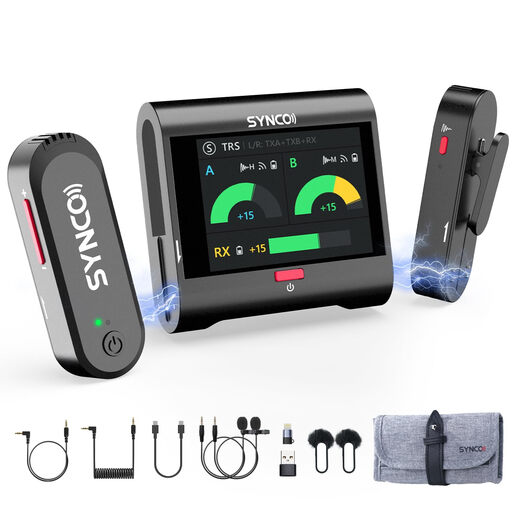
The two transmitters are useful if you’re recording an introduction followed by both voices in the conversation.
The set includes two transmitters, one receiver and a charging case. The product description lists internal recording and compatibility with cameras, smartphones and PCs. The advertised AI noise cancellation is a manufacturer claim, not a guarantee of how it will sound in your particular room.
 No image available
For recording speech on a PC or laptop, with a desktop stand included in the set.
Dynamic design with a cardioid pattern; USB-C and XLR outputs are listed. The set also includes a headphone socket, gain control, mute button and desktop stand.
 No image available
For interviews with two people, when you want to record each voice using its own transmitter.
The product description lists two transmitters, stereo, mono and safety channel output, and 15 gain levels. Connections for cameras, smartphones and computers, along with real-time monitoring, are also listed. Three levels of noise cancellation are described as a product feature; you should test the results in your own room.
Record a test sentence in the position you plan to use, then listen back with headphones. For this type of microphone, Audio-Technica recommends positioning it directly in front of the speaker, no more than 200 mm away. Shure’s SM7B guide specifies 2.54 to 15 cm for that particular model; this isn’t a general distance recommendation for all microphones.
Yes. To record digitally on a computer, you need suitable signal conversion, usually through an audio interface. For voice-over work with the SM7B, Shure also specifies at least 60 dB of gain; this figure applies to that model and use case.
No. Factor in how you plan to connect it and what’s included. Check whether a stand and cables are included, and allow for the necessary connection equipment if you’re using XLR. What’s in the box can vary by model.
Not without permission: section 201 of the German Criminal Code makes it a criminal offence to record another person’s non-public spoken words without authorisation. Get the other person’s permission before recording. For recorded telephone calls, the German Data Protection Conference also explains that, as a rule, the consent of the other person on the call is required under data protection law. This guidance on telephone calls doesn’t automatically apply to every interview situation.