What to consider when buying
Directional dynamic XLR handheld microphone
A good fit if: you can focus on the person speaking and hold the microphone close to them.
Consider: The cardioid pattern picks up less sound from outside its main direction, but it won’t remove fan noise completely. You’ll also need a suitable XLR input and to point the microphone at each new speaker.
Omnidirectional dynamic XLR reporter microphone
A good fit if: speakers change frequently or can’t reliably speak in one fixed direction.
Consider: An omnidirectional microphone is more forgiving of changing speaking angles, but it also picks up the fan from other directions. You’ll still need an XLR recording setup.
Two body-worn wireless microphones
A good fit if: both people need their hands free during a mobile interview and should speak close to their own microphone.
Consider: Check the number of transmitters, receiver connection, power supply and wireless conditions at the location. Transmitter backups, such as those described by RØDE for the Wireless PRO, don’t prove that fan noise will disappear.
Dynamic USB/XLR handheld microphone
A good fit if: you’ll mostly record at a computer and want the option of using an XLR recording setup too.
Consider: USB and XLR outputs offer different connection options, so check that your specific recording device and the cables you need are compatible. USB alone won’t record two voices.
Compact recorder with built-in stereo microphones
A good fit if: you want to capture the atmosphere of the location as well as the voices, without using a separate handheld microphone.
Consider: Built-in X/Y microphones record a scene, so check how clear the speech is with the fan running. The 32-bit float format specified by Zoom is not noise cancellation.
The percentages below relate to consumers choosing a microphone for interviews with a fan running. Before you buy, compare recordings made with your actual interview style and intended recording device.
| Priority |
What to check before buying |
Who it matters to |
| Speech clarity with fan noise |
Pickup pattern and speaking direction; make a test recording with the fan running. |
If the fan is running continuously, I want to make sure even quiet parts of the interview are clear. Around 36% of consumers put speech clarity with fan noise first. |
| Clarity when speakers change |
Whether you can point the microphone at each speaker and how both voices sound in a test recording. |
If speakers change quickly, I want to record both voices without losing track of the speaking angle. Around 29% of consumers prioritise speaker changes. |
| Freedom of movement during the interview |
Number of transmitters and microphones included; receiver connection and wireless conditions at the location. |
If we’re moving around during the interview, I want to record both voices while keeping our hands free. Around 21% of consumers prioritise freedom of movement. |
| Connection to existing recording equipment |
Microphone input, cables or recorder required, and headphone monitoring. |
If I want to record with the equipment I already have, I need to check the signal path in advance. Around 14% of consumers prioritise an easy connection to their recording device. |
Joybuy products for voice recording
A USB/XLR microphone for recording speech in a fixed position, where you can place the microphone close to the person speaking.
 No image available
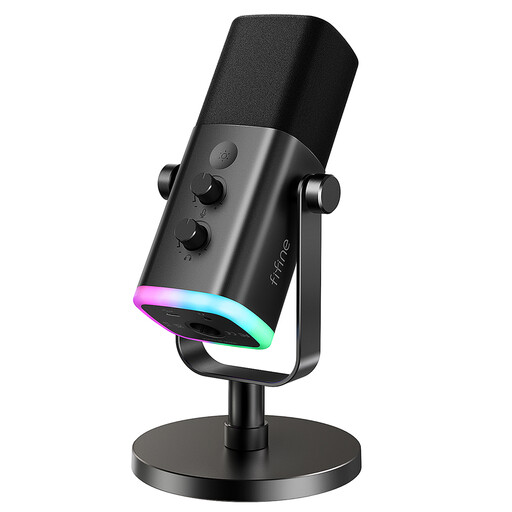
FIFINE AM8 USB/XLR microphone
For interviews recorded in a fixed position, when you can place the microphone close to the person speaking and connect it to a computer or a suitable XLR recording setup.
The product description specifies a dynamic, unidirectional design and recommends a distance of 2–6 inches. It has USB-C and XLR outputs; headphone monitoring is described for USB operation. For XLR operation, you’ll need a suitable input and a separate XLR cable, which isn’t included.
Joybuy
Frequently asked questions
Is a 32-bit float recorder enough to remove fan noise from a recording?
No. Zoom describes 32-bit float as the H1essential’s recording format and its built-in microphones as X/Y stereo microphones; the format alone won’t separate fan noise from a voice. A listening test at the intended location is still essential.
What else do I need with an XLR handheld microphone?
You’ll need a suitable microphone input on a recorder or audio interface, as well as an appropriate connection. The Sennheiser MD 46 and RØDE Reporter have XLR connections; the Audio-Technica ATR2100x-USB also offers USB for recording to a computer.
How can I avoid handling noise and fluctuating volume?
Keep a directional microphone at a steady distance from whoever is speaking and point it away from unwanted sound sources. Shure recommends this positioning for the SM58; listen to a short test recording before the interview.
Can I simply record and publish a conversation about changes in the neighbourhood?
Not necessarily. Under § 201 of the German Criminal Code (StGB), recording another person’s words spoken in private without their permission is a criminal offence; certain uses may also be covered. If personal data is processed, information obligations generally apply. Where processing is based on consent, guidance from the German Data Protection Conference says that consent must be voluntary, informed and specific to the case. Discuss the recording and how you plan to use it with everyone involved before the conversation; the legal assessment of a particular publication depends on the circumstances.
Can I use any wireless microphone in Germany without checking anything else?
No. In its general frequency allocation of April 2026, the Federal Network Agency lists permitted frequency bands and technical and operational conditions. Check the frequency band of the specific system against the applicable allocation; the product name alone won’t answer this question. The order explicitly replaces, among other things, general allocation 109/2025.


