What should you look for when buying?
First, decide how you’ll record the greeting and transfer it to your phone system. Then choose a connection, setup and monitoring features to suit that process.
| What you need |
What to check before buying |
Who is this important for? |
| A clear voice despite reflections in the booth |
Polar pattern and speaking side; a consistent close-mic position. |
If I’m recording alone in a booth with noticeable reflections, I want to know whether my voice will remain clear at a consistent distance. For around 36% of consumers, controlling the sound of the booth is the top priority. |
| Easy connection and a practical setup |
USB connection and included cables; desk stand or microphone arm, and available space. |
For straightforward computer recording, I want to connect the microphone without a separate audio interface and position it securely. Around 29% of consumers prioritise a simple computer setup. |
| Monitoring the recording and audio levels |
Headphone socket and accessible monitoring or gain controls; test with quiet and emphasised passages. |
If I want to check uncertain passages as I speak, accessible monitoring and level controls help me keep an eye on the recording. This is a priority for around 21% of consumers. |
| Using the greeting with your phone system |
Check in advance whether you can upload a file or need to record the greeting directly over the phone; check the requirements of your specific system. |
To use my finished greeting with my phone system, I need to know how to upload it and what file formats are accepted. This workflow is the main consideration for around 14% of consumers. |
Microphones and sets at Joybuy
This selection includes USB microphones for voice recording as well as wireless lavalier sets. Before buying, check that the pickup pattern, design, connection and mount suit your booth and recording device.
 No image available
FIFINE K688CTW USB/XLR dynamic microphone with boom arm, white
Could suit close-mic speech recording on a computer if you want to use headphone monitoring and a microphone arm.
Unidirectional recording, USB and XLR connections, a headphone socket, gain control and a mute function are listed. An XLR cable is not included; the C-clamp is designed for desktops under 2 inches thick.
View at Joybuy
 No image available
FIFINE AM8 USB/XLR dynamic microphone with desk stand
A possible choice for computer-based voice recording if you want a desk stand and direct monitoring.
USB/XLR, a headphone socket, gain control, a mute function and an integrated windscreen are listed. An XLR cable and microphone arm are not included; according to the description, the RGB lighting and function buttons work only in USB mode.
View at Joybuy
 No image available
USB condenser microphone with RGB lighting, 7-piece set
Could work for USB voice recording on a PC if the condenser design and included accessories suit your recording setup.
The description lists a headphone socket, real-time monitoring, a mute function and a Type-C adapter. Check that the set’s connections are compatible with your recording device.
View at Joybuy
 No image available
SYNCO P2XT wireless USB-C microphone
This lavalier model is designed for mobile voice recording. Check that this design suits a fixed speaking position in your booth.
A USB-C receiver and real-time monitoring are listed. The description also gives a battery life of up to six hours.
View at Joybuy
 No image available
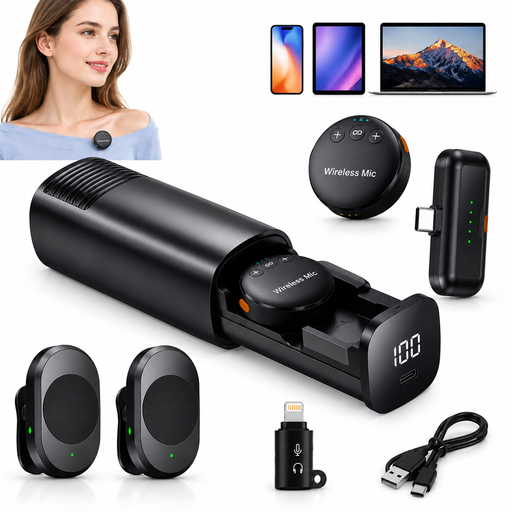
Wireless lavalier microphone set with two transmitters
This set is described as suitable for two speakers or flexible positioning. The microphones are omnidirectional, so they’re less directly suited to a preference for directional recording in a small booth.
USB-C and Lightning connections, as well as real-time monitoring, are listed. The product name specifies 2.4 GHz and latency under 20 ms.
View at Joybuy
Frequently asked questions
Do I have to use a USB microphone for a short phone greeting?
No, not for every recording setup. Telekom documents how to record a greeting directly using a landline phone with its Telekom SprachBox. If you’d rather create an edited file on a computer, you’ll need a suitable way to record to your computer.
How can I stop my small booth from sounding dull or echoey?
Point the microphone towards your mouth, keep the speaking distance consistent and listen back to a test recording made in that exact booth. RØDE recommends around 5–10 cm for the PodMic USB; this recommendation doesn’t automatically apply to other models. With directional microphones, changing your distance can also affect the bass.
Can I upload any recording as a phone greeting?
No, it depends on the phone system. For the FRITZ!Box 7682, FRITZ.com specifies a maximum length of 60 seconds and either WAV at the recommended 8000 Hz, 16-bit and mono, or MP3 at a fixed bit rate of 128 kbit/s, 44.1 kHz and stereo. These requirements don’t automatically apply to other models or services.
What should I check about the mount and what’s included before buying?
Check the specific model or set to see whether it includes the right mount and the cables you need. Manufacturers may offer different options, such as a desk stand or a microphone arm. Make sure the exact set you choose will also fit in your booth.
Do the same rules apply to recording my greeting as to recording a phone call?
These are different activities. Section 201(1) of the German Criminal Code (StGB) covers, among other things, recording another person’s non-publicly spoken words without authorisation. This does not mean there is a blanket ban on recording your own greeting; if you also want to record other people’s phone calls, that is a separate matter.


