Who needs to make this decision

Group discussions with several voices

If you want to capture conversations clearly and possibly edit each voice separately, the number of inputs and microphone placement are important factors to consider. Zoom describes the H6essential as having four XLR/TRS combo inputs. You’ll need to plan your microphones and recording setup accordingly.

Anyone responsible for long recordings

For a longer session, your recording plan should include monitoring, power and the storage method you’ll actually use. Zoom says the H6essential continues recording in new files when a file exceeds 2 GB; you’ll still need to make sure the power source and memory card are suitable for your recording.

Single voices recorded on a computer

For an introduction or a longer solo contribution, a USB microphone can connect directly to a compatible computer. Audio-Technica, Sennheiser and RØDE list USB models with headphone connections in their respective product specifications. Check software compatibility and microphone placement beforehand.

What to look for when buying

USB microphone for one voice

A good fit if: You mainly record one voice close to the microphone on a compatible computer.

The trade-off: A direct connection saves you from buying a separate interface, but one microphone track won’t give you separate tracks for different voices.

One shared microphone

A good fit if: A small group can sit close enough together, and a test recording at the intended table captures everyone clearly.

The trade-off: The setup stays simpler, but it’s harder to edit individual voices separately when they’re all on one track.

Separate microphones with a recorder or interface

A good fit if: Several people need their own microphone positions and tracks that can be edited separately.

The trade-off: Extra microphones, cables and equipment need space and preparation. If you’re using a recorder, you’ll also need to plan for power and storage.

What you need What to check before buying Who it matters to most
Keep a long recording under control Check that the microphone model has a headphone output and suitable controls. With a recorder, check that the power source and memory card suit your planned recording setup. If you don’t want to leave a long recording running unattended, plan how you’ll monitor it and manage storage. Around 42% of consumers prioritise monitoring and keeping a recording going.
Capture several voices With one shared microphone, test the seating arrangement and clarity. With separate microphones, match the number of inputs you need to the number of speakers. If you want to edit voices individually, you’ll need suitable microphone positions and enough inputs. Around 33% of consumers prioritise control over individual voices.
Get started easily on a computer Check the USB connection and software compatibility. If you might expand your setup later, make sure the connection method will work for that, too. If you mainly record your own contribution, a direct USB connection can make it easier to get started. Around 25% of consumers prioritise a simple connection to a computer.

Common buying mistakes to avoid

  • Assuming similarly named USB and XLR versions are the same

    The PodMic USB and PodMic have different connection options. RØDE says you’ll need an XLR cable and an audio interface to record on a computer with the PodMic alone.

    Check the full model name before buying and decide whether you want to record directly via USB or through XLR and an interface.

    With the XLR-only model, you’ll need a suitable cable and an audio interface as part of your recording setup.

  • Planning to use one directional microphone for the whole group without testing it

    The direction of the microphone, the distance from it and the seating arrangement all affect which voices it picks up. Audio-Technica describes sharing a USB microphone as a possible option for an interview, but doesn’t guarantee it will work for every room or seating arrangement.

    Test it at the intended table with everyone taking part. If one shared recording isn’t enough, plan for separate microphones and the inputs they’ll need.

    A setup with separate voice tracks may require additional microphones, inputs and stands.

  • Assuming microphone specifications guarantee a long recording

    A microphone alone doesn’t automatically provide power or storage for your recording setup. For the H6essential, Zoom says recording continues in new files when a file exceeds 2 GB.

    Test the complete recording setup before the session and back up the recording afterwards.

    If you’re using a recorder, make sure a suitable memory card and power source are part of your preparations.

Key microphone brands at a glance

Audio-Technica

The ATR2100x-USB offers USB and XLR connections for recording a single voice up close.

  • Audio-Technica lists USB-C and USB-A cables, an XLR cable and a desktop tripod as included accessories.
  • Microphone direction still matters; the product specifications don’t show that one microphone will pick up an entire group evenly.

RØDE

The PodMic USB and PodMic are different models with different connection options.

  • RØDE lists USB-C, XLR and headphone monitoring for the PodMic USB.
  • For computer recording with the PodMic alone, RØDE specifies an XLR cable and an audio interface. Make sure you don’t confuse the two models.

Shure

The MV7+ is a USB-C/XLR podcast microphone for recording one voice from a fixed position.

  • Shure lists a headphone connection, an automatic level function and digital noise processing.
  • The features described don’t guarantee a particular result in every room. Check the stated app compatibility requirements.

Sennheiser

The Profile USB is a USB condenser option for recording one voice at a table.

  • Sennheiser lists gain, mix and headphone controls, as well as a desktop stand for the Profile USB.
  • The user guide highlights microphone direction and distance, so check the microphone position in the room where you’ll be recording.

Zoom

The H6essential is a recorder with a built-in X/Y capsule and four XLR/TRS inputs.

  • Zoom describes multitrack recording and continuing in new files when a file exceeds 2 GB.
  • You’ll need to include a suitable power source and memory card in your setup. The features don’t guarantee a particular recording time for every configuration. A recorder won’t replace every separate microphone a speaker may need.

Joybuy products for recording a single voice up close

The Joybuy products below are mainly suited to recording one voice close to a computer. Some kits also include a microphone arm or mixer. If you want to edit each voice separately in a group discussion, you’ll still need a planned multi-microphone setup.

FIFINE K688CTW dynamic USB/XLR microphone with boom arm

FIFINE K688CTW USB/XLR microphone kit

For recording one voice close to a computer, with a boom arm for positioning the microphone at your desk.

Dynamic microphone with USB and XLR connections, headphone output, mute button, boom arm and shock mount. A separate cable is needed for the XLR connection; it isn’t included.

Joybuy

FIFINE AM8 dynamic USB/XLR microphone with desktop stand

FIFINE AM8 USB/XLR microphone

For recording one voice on a computer, if a desktop stand and mute button suit your setup.

Dynamic microphone with USB and XLR connections, headphone output, mute button and desktop stand. The XLR cable isn’t included.

Joybuy

Cardioid USB condenser microphone with scissor arm

USB condenser microphone kit with scissor arm

For recording one voice on a computer, if you want to position a kit with an arm and pop filter at your desk.

Cardioid USB condenser microphone with headphone monitoring and mute button. According to the product description, the kit includes a scissor arm, shock mount and pop filter.

Joybuy

Cardioid USB condenser microphone with monitoring

USB condenser microphone with monitoring

For recording one voice on a computer, if you want to monitor the microphone signal directly while recording.

Cardioid USB condenser microphone with headphone output for latency-free monitoring, gain control and mute button. The kit includes a scissor arm, shock mount and pop filter.

Joybuy
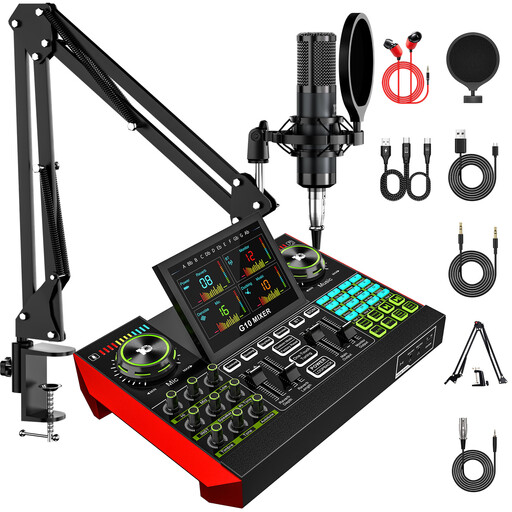
Yinkaer G10-P15-XB podcast microphone kit with audio mixer

Yinkaer G10-P15-XB podcast microphone kit

For a setup that includes a microphone and an audio mixer or sound card as a kit.

The kit includes a 3.5 mm condenser microphone, an audio mixer or sound card, and a boom arm stand.

Joybuy

Frequently asked questions

Is one microphone enough for two people at a table?

It can work if both people sit in a position that suits the microphone and a test recording at the actual recording location captures both voices clearly. Audio-Technica says sharing a USB condenser microphone is an option for interviews, while noting that the surroundings can affect the result. Separate microphones and suitable inputs give you more control over individual voices.

What should I check before a long recording?

Test the complete recording setup, including power, storage and monitoring, before the session starts. Zoom says the H6essential can be powered by batteries or USB and continues recording in new files when a file exceeds 2 GB. Even so, check the specific memory card and power source you’ll be using.

Do I need extra equipment to connect an XLR microphone to a computer?

For computer recording with the RØDE PodMic alone, the manufacturer specifies an XLR cable and an audio interface. The PodMic USB is a different model and also offers a direct USB connection.

Who should I contact if my microphone is faulty?

For a consumer purchase, the seller is responsible for your statutory rights when goods are faulty. The European Union’s consumer information states that these rights generally apply for at least two years from receipt of the goods, and distinguishes them from any additional commercial guarantee. The type of contract and individual circumstances still matter.

Can I simply record a book discussion in Germany?

Not in every case: section 201 of the German Criminal Code (StGB) makes it a criminal offence, among other things, to record another person’s non-public spoken words without authorisation. Before you start, check with everyone involved that you’re entitled to make the recording. Any later publication must be considered separately.