Storytellers recording long takes in a home studio
If you record longer fairy tales in one place, a suitable speaking position, controllable levels and headphone monitoring are important things to consider when choosing a microphone.


For long fairy-tale recordings, your space and speaking position are the first things to consider. If you can speak at a consistent, close distance and room noise is a problem, a dynamic speech microphone may be worth considering. In a quiet room, you could also look at a condenser microphone. For long takes, a stable position, level control and headphone monitoring are key. If you need to record without a fixed computer setup, a portable recorder is another option. This overview is based on the features described for each device, not on comparative sound testing.
If you record longer fairy tales in one place, a suitable speaking position, controllable levels and headphone monitoring are important things to consider when choosing a microphone.
If you can speak close to the microphone at a consistent distance, make a test recording to hear how clearly the noise in your room comes through.
If you record in different places, a recorder can be used without a desk-based setup. Check that its power supply and storage media are suitable for the planned recording time.
When it may suit you: If you tell stories on your own, can stay close to the microphone and find that room noise is distracting in a test recording, consider this type for your speaking position.
Things to consider: Keeping a consistent distance and finding a suitable position still matter for long takes. The microphone type alone will not eliminate room noise.
When it may suit you: If your room is quiet and you want to control the level or headphone signal on the microphone, compare the controls on the specific models you’re considering.
Things to consider: Direction and distance affect the recording level. Also check whether the desk stand or another mount will work with your reading setup.
When it may suit you: If you want to use both USB and XLR in a suitable, quiet setup, check the signal paths and the accessories you’ll need for each.
Things to consider: According to RØDE, 32-bit float output on the RØDE NT1 5th Generation is available over USB with suitable software settings, but not through the analogue XLR output.
When it may suit you: If you record stories in different places without a computer permanently connected, consider a recorder with built-in microphones.
Things to consider: The built-in microphones will pick up your surroundings too. Test your voice and the room at the intended recording location, and check that the power supply and storage media will last for the planned recording time.
| Priority | What to check when buying | Who it matters most to |
|---|---|---|
| Managing long takes | Headphone output and level control; a mount that keeps the microphone in a stable position. | When I record long fairy tales in one place, I want to be able to monitor my voice and levels throughout the take. Around 36% of consumers make managing long takes their top priority. |
| Taking room noise into account | Make a longer test recording in the room you’ll be using; check the position and controls against your speaking style. | If noise in the room could interfere with my storytelling, I want to hear how it comes across in a test recording first. Around 29% of consumers make reducing distracting room noise their top priority. |
| Recording a storytelling voice in a quiet room | Try quiet and loud passages, as well as sibilant sounds; check what’s included and whether you need USB or XLR. | In a quiet room, I want to hear how my voice sounds when recorded at the distance I plan to use. Around 21% of consumers see how a microphone captures the voice in a quiet room as their most important buying priority. |
| Recording in different places | Check that the storage media, power supply and headphone monitoring will suit the planned recording time; test the setup at the recording location. | If I collect stories in different places, I need a recording option that isn’t tied to my desk. Around 14% of consumers make recording in different locations their top priority. |
For the NT1 5th Generation, RØDE specifies that 32-bit float output is available over USB when the recording software is set up appropriately. This feature isn’t available over XLR.
Check your connection and software settings before relying on this feature for a long take.
According to the manufacturer, the Sennheiser Profile USB comes with a desk stand and USB-C cable. A shock mount for the Audio-Technica AT2020USB-X is an optional accessory, not the same as the desk stand supplied with the microphone.
Check what’s included against the position you plan to use while reading.
You may need to pay extra for an arm or shock mount.
The Zoom H1essential’s built-in X/Y microphones pick up your surroundings too. Portability alone doesn’t tell you how clearly your voice or ambient noise will come through at a particular location.
Test your voice and surroundings at the planned recording location, and check your storage media and power supply before a long take.
The Shure MV7+ is a dynamic speech microphone with USB-C and XLR, designed for a fixed, single-voice setup.
Sennheiser says the Profile USB is also suitable for computer-based voiceover recording. Its gain, mix and headphone controls are on the microphone.
The AT2020USB-X is a USB condenser microphone with a desk stand, headphone socket and mix control.
According to RØDE, the NT1 5th Generation combines USB and XLR in a studio condenser microphone.
The Zoom H1essential is a portable recorder with built-in X/Y microphones and an additional USB microphone function.
The following Joybuy products include dynamic USB/XLR microphones and USB condenser microphones for voice recording in a fixed setup.
 No image available
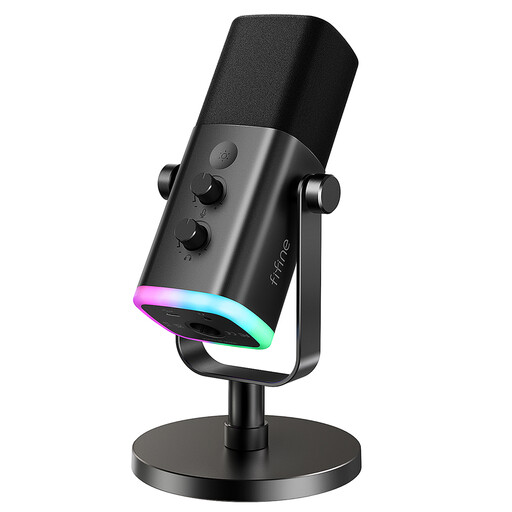
For close, consistent speaking in a fixed setup; the description lists voice recording and headphone monitoring.
Dynamic microphone with USB and XLR connections; gain control, mute button and headphone socket for USB use. A speaking distance of 2 to 6 inches is recommended for the input level described. XLR cable and microphone arm are not included; the function buttons are inactive when using XLR.
 No image available
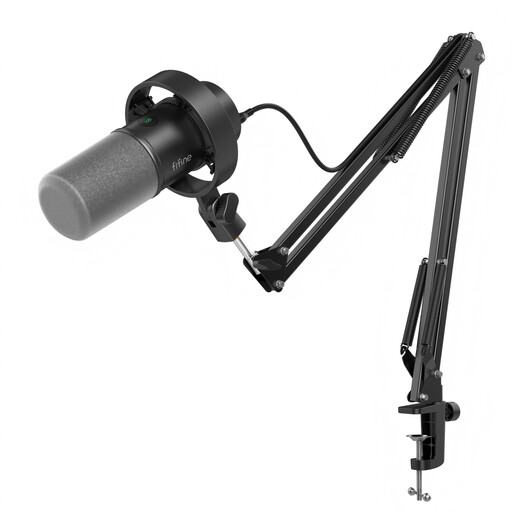
For longer recordings at your desk, if an adjustable microphone position and level control while recording over USB are important to you.
Dynamic USB/XLR microphone with a supplied boom arm that can be adjusted horizontally and vertically. Gain control, mute button and headphone monitoring are listed for USB use. According to the description, the desk clamp is designed for desks less than 2 inches thick. An XLR cable is not included, and the function buttons are inactive when using XLR.
 No image available
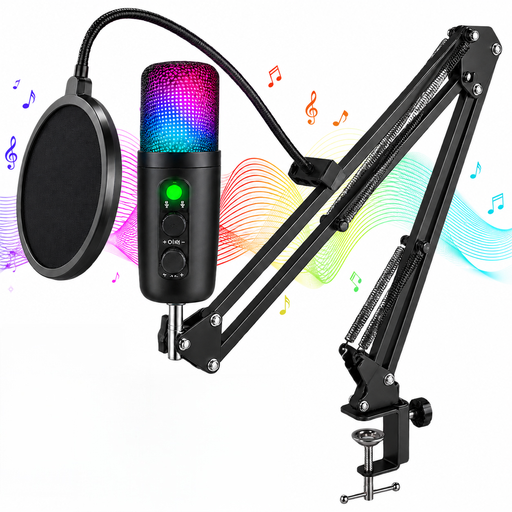
For USB voice recording on a PC, if you want to use headphone monitoring and a mute button directly on the microphone.
Condenser microphone with USB connection and Type-C adapter; headphone monitoring and a mute button are listed as features.
 No image available
For PC recording with headphone monitoring and controls on the microphone, if you want an adjustable desk setup.
Cardioid pickup pattern and USB operation; gain control, mute button and headphone socket are listed. According to the description, the setup includes a scissor arm and a shock mount.
Record a passage with both quiet and loud speech from the position you plan to use. Listen back through the headphones you intend to use and check the input level. Sennheiser lists distance and direction as important factors affecting the recorded signal on the Profile USB.
Yes, if you’re recording to a memory card. Zoom’s quick guide lists a microSD slot and support for microSDHC and microSDXC cards. Before recording, check that the card and power supply are suitable for the recording setup you plan to use.
No. RØDE specifies 32-bit float output for the USB connection and requires suitable microphone and recording session settings; XLR is an analogue output.
Section 201 of the German Criminal Code (StGB) makes it a criminal offence to record another person’s privately spoken words without authorisation. The full text is published on Gesetze im Internet. If you’re recording other people, check beforehand that you have permission to do so; this provision concerns the words of another person.
No. You can’t tell from the description ‘fairy tale’ alone. Section 64 of the German Copyright Act (UrhG) generally sets a term of 70 years after the author’s death. Under Section 3 of the UrhG, creative translations and adaptations may also be protected in their own right. Check the rights to the specific version of the text before publishing it; the legislation is available on Gesetze im Internet.