Lieferung heute & morgen

Qualitätsgarantie

Willkommens-Angebote freischalten: KOSTENLOSE Lieferung | Bis zu 80 % RABATT | Kostenlose 30-Tage-JoyPlus-Testphase
App herunterladen
There is a distinct moment at the end of a long day. A moment when the outside world falls silent, and we retreat into a space of concentration. For many, this space is digital—a meticulously crafted world that comes to life on the screen of a handheld console. The ritual is simple: pick up the device, launch the game, and immerse yourself in another reality. Yet, this transition is often interrupted by an unwelcome pause: the loading screen. A disruption that pulls us from our desired state of flow, reminding us of the mechanical limitations of technology.
The pursuit of a seamless experience is a core principle of modern design. It's not merely about aesthetics, but about eliminating the friction that disrupts the flow of our actions. In the digital realm, this friction manifests as waiting. The latency between command and execution, between the desire to enter a world and the actual entry. Modern games, especially demanding AAA titles, are complex architectures of data. Their worlds are expansive, their textures detailed. The task of loading this data quickly and reliably falls to an often-overlooked component: the memory card.
For a long time, expanding a handheld console's storage was a question of quantity—how much space is available? Today, the focus is shifting to the quality of access. The introduction of the microSD Express standard marks a paradigm shift. By leveraging technologies like PCIe and NVMe, previously reserved for desktop systems, the architecture of data storage is being redefined. Instead of a narrow bridge, a multi-lane highway for data is created. A theoretical read speed of up to 900 MB/s is not just a number; it is the technical foundation for a sense of immediacy. A fast microSD card for gaming thus becomes an integral part of the experience itself, not merely a passive container.
The best tools are those that disappear into their function, becoming invisible. They do not distract; they enable concentration. A modern gaming memory card should follow this principle. It is not an ornament, but a precision instrument working inside a Nintendo Switch or Steam Deck to ensure seamless interaction. Its purpose is to minimise the gap between the digital and the experienced reality.
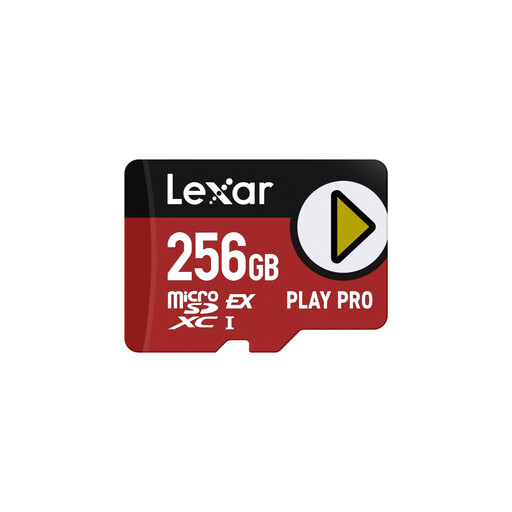
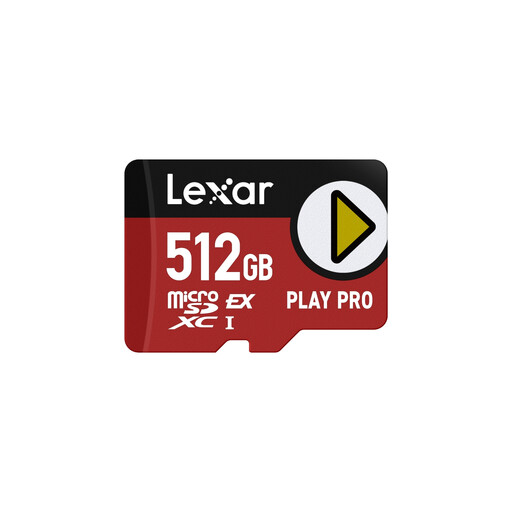
An object that embodies this philosophy is the Lexar PLAY PRO MicroSDXC Express Card. Its technical design is a commitment to an uninterrupted experience. The A2 rating supports faster application loading, further reducing wait times when launching games and apps. For users with extensive digital libraries, variants with 512 GB or even 1 TB of capacity offer the ability to keep a multitude of worlds at hand without compromising on speed. The physical robustness of the card—its resistance to water, shock, and temperature fluctuations, as described by the manufacturer—is a quiet assurance that one's digital collection remains protected even under the rigours of daily mobile use.
Ultimately, it is about curating technology to serve our intentions. Choosing an NVMe microSD is less a technical upgrade and more a deliberate decision for quality and an undisturbed state of flow. It is the recognition that in the digital space, too, the details make the difference—and that true speed reveals itself in the silence of uninterrupted concentration.
For those who wish to explore a broader selection of objects designed with these principles of performance and durability, further inspiration can be found in the directory for Memory Cards for Gaming Consoles.