
Lieferung heute & morgen

Qualitätsgarantie

Willkommens-Angebote freischalten: KOSTENLOSE Lieferung | Bis zu 80 % RABATT | Kostenlose 30-Tage-JoyPlus-Testphase
App herunterladen
Shopping for a new microwave can quickly become overwhelming. Manufacturers advertise high wattages, countless automatic programmes, and innovative designs. But not every feature is worth the extra cost. Many buyers fall into common traps, leading to an unsuitable appliance or unnecessary expense. This guide will help you cut through the noise and make an informed decision.
Before you decide on a model, three fundamental parameters should be clear. These determine whether the appliance fits your needs and your kitchen.
Choosing the form factor is the first and most important decision.
The cavity capacity, specified in litres, should match your household size.
An often-overlooked aspect is the turntable. A microwave without a turntable (with a flat ceramic base) offers a completely flat surface. This allows for the use of square casserole dishes and maximises the usable space.
The range of functions determines what you can do with the appliance.
Here are a few models tailored to specific user profiles that avoid the common pitfalls mentioned.

Why it's a great fit: Ideal for students, small kitchens, or as a secondary appliance. It focuses on the essential functions without unnecessary bells and whistles, offering simple, intuitive operation via two rotary knobs.
This appliance deliberately skips complex auto-programmes (Trap 3) and offers 700 watts—a perfectly sufficient power level for everyday tasks, so you don't pay for unnecessarily high wattage (Trap 1).
Solo microwave with a 20-litre cavity and 5 power levels. Its mechanical controls are robust and less prone to failure than complex digital displays.
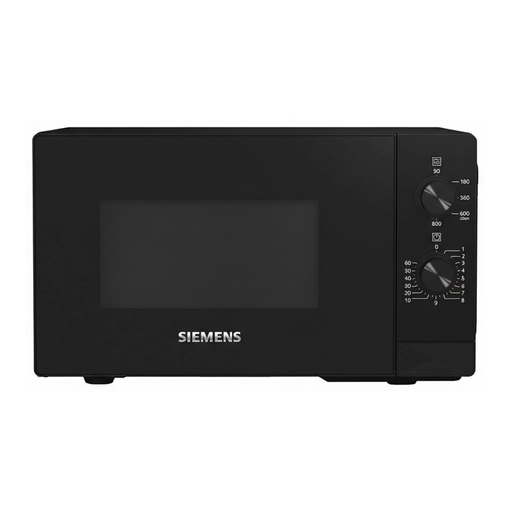
Why it's a great fit: For anyone who values a cohesive kitchen design. The elegant, black glass front integrates seamlessly into modern kitchen units. As a freestanding microwave, it's flexible but can also be installed as an under-cabinet unit.
The focus here is on design and core functionality. With 800 watts and a selection of targeted auto-programmes, it delivers solid performance without inflating the price with rarely used special features (Trap 3).
Elegant design in Black with LED interior lighting. The humidClean function simplifies cleaning using steam. Operation is straightforward thanks to its user-friendly control system.

Why it's a great fit: A multi-function appliance for those who want to do more than just reheat. It combines a microwave, grill, convection, and even a steam function, making it a true oven replacement for smaller dishes.
This appliance solves the problem of limited space (Trap 2) by eliminating the turntable. Its 25-litre cavity is fully usable, even for square dishes. The extra functions here aren't gimmicks; they provide real added value.
A combination model with grill and convection, plus a steam function. The microwave without a turntable (ExtraSpace) offers maximum flexibility. Includes practical auto-programmes like dough proofing and yoghurt making.
We've compiled a complete, up-to-date list of products that fully meet these strict selection criteria and all relevant safety standards.
1. How many watts should a microwave have? For most everyday tasks like reheating leftovers, defrosting frozen food, or cooking vegetables, 700 to 800 watts of power is perfectly adequate. While higher-wattage appliances can potentially heat food faster, the difference is often marginal in daily use. Higher power is most useful in combination models with a grill or convection function to achieve good baking and browning results.
2. What is the advantage of a microwave without a turntable? A microwave without a turntable (also known as a flatbed microwave) uses special technology to distribute the microwaves evenly throughout the cavity. The biggest advantage is the gain in usable space. Since nothing rotates, you can also fit large, square casserole dishes or multiple small containers inside at the same time. Furthermore, cleaning the smooth ceramic base is much easier than cleaning a turntable and its roller ring.
3. What is the most effective way to clean a microwave? For a simple clean, place a microwave-safe bowl of water with a few lemon slices inside the appliance. Heat it on the highest setting for about five minutes. The resulting steam will loosen grease and dried-on food residue. Afterwards, you can simply wipe the interior with a soft cloth. Some models, like the Siemens FF020LMB2, offer special cleaning programmes (e.g., humidClean) that simplify this process even further.