
Lieferung heute & morgen

Qualitätsgarantie

Willkommens-Angebote freischalten: KOSTENLOSE Lieferung | Bis zu 80 % RABATT | Kostenlose 30-Tage-JoyPlus-Testphase
App herunterladen
Choosing a new microwave can quickly become overwhelming. The market ranges from simple solo models for just a few pounds to multifunctional combination units that can almost replace a conventional oven. But not every feature is useful for every household. Many buyers invest in expensive features they never use, or get frustrated with impractical details in daily life. This guide will help you navigate the common pitfalls and find a microwave that truly fits your needs.
As your Joybuy Product Recommendation Officer, I'll analyse the market for you and highlight the criteria that really matter when making a purchase decision.
Before we dive into the technical details, let's look at the most common mistakes that lead to dissatisfaction.
To make the right decision, you should examine three core parameters that determine the practical value of your future microwave.
A microwave's power is measured in watts. For basic tasks like reheating and defrosting, 700 to 800 watts are generally sufficient. Combination models with grill or convection functions require more power, often over 1000 watts for the additional features.
A key technological advancement is the inverter microwave. While conventional microwaves regulate their power by switching the full wattage on and off (e.g., 50% power = 5 seconds on, 5 seconds off), an inverter microwave delivers a constant, lower stream of energy. The result is significantly more even and gentle heating and defrosting of food.
The interior capacity is a key criterion.
The interior design is just as crucial. A freestanding microwave with a flatbed design (microwave without a turntable) uses the entire cavity more efficiently and simplifies cleaning, as there are no moving parts in the way.
Think carefully about which functions you'll actually need in your daily routine:
Based on the criteria above, we've put together a few models for different user profiles.

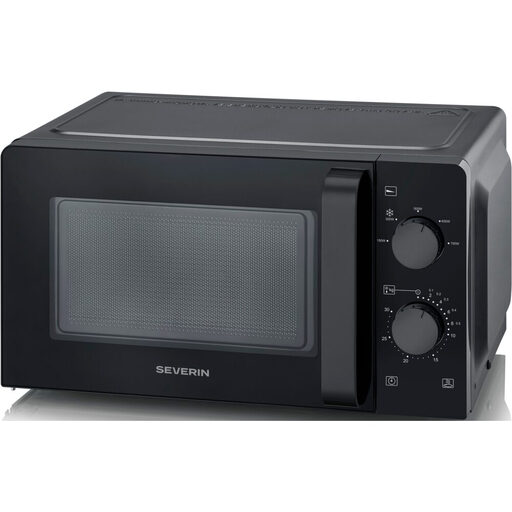
Why it's a great fit: Ideal for students, singles, or as a secondary appliance. It focuses on the core functions of heating and defrosting and is extremely easy to operate with its mechanical dials. The compact design saves valuable space in small kitchens.
This appliance avoids the 'feature trap' by deliberately omitting complex extra functions like a grill or convection. You only pay for what you really need.
Intuitive operation via two rotary knobs for power and time; 700 watts of power and a 20-litre capacity are designed for everyday tasks.

Why it's a great fit: This appliance is a true all-rounder for families and home cooks. It combines a microwave, grill, convection, and a steam function. It can take the load off your main oven or replace it entirely for quick meals.
The 'space illusion' is solved by the ExtraSpace technology. The flatbed design without a turntable maximises the usable area in the 25-litre cavity, so even square casserole dishes fit without a problem.
Combines four cooking methods in one appliance; the AutoClean program makes cleaning significantly easier.
Why it's a great fit: For users who value precise and gentle cooking but don't need combination features. The inverter technology ensures excellent results when defrosting and reheating delicate foods.
This model solves the problem of unevenly heated food (hot on the outside, cold on the inside) that often occurs with standard microwaves. The constant power delivery of the inverter technology cooks more gently and evenly.
Innovative inverter microwave for precise power control; compact design with a 19-litre volume.
We have compiled a complete, up-to-date list of products that fully meet these strict selection criteria and all relevant safety standards.
A simple method is to heat a microwave-safe bowl of water with a few slices of lemon or a splash of vinegar on the highest setting for several minutes. The resulting steam loosens grime, which can then be easily wiped away with a cloth. Some models, like those from Bauknecht or Gorenje, also offer special AutoClean or AquaClean programs that automate this process.
A conventional microwave regulates power by cycling: it switches the full power on and off in intervals. An inverter microwave, on the other hand, can deliver power continuously and at various levels. This leads to more even cooking results, prevents food from drying out, and is particularly beneficial for defrosting, as the edges don't start to cook while the centre is still frozen.
That depends on your needs.