Housemates who eat at different times
If you don’t all eat at the same time, you can reheat individual chilled portions one after another. Clear settings and a cavity that lets you take the portion out to stir it make the process easier.


If several people are reheating chilled pasta individually and at different times, an easy-to-use solo microwave is a sensible place to start. First, check that your usual plates and bowls will fit inside. A grill or hot-air function is mainly worth considering if you’ll use it for other dishes too. Neither replaces chilling the pasta, stirring it or heating it thoroughly: the German Federal Institute for Risk Assessment (BfR) recommends heating food to at least 70 °C for two minutes throughout.
If you don’t all eat at the same time, you can reheat individual chilled portions one after another. Clear settings and a cavity that lets you take the portion out to stir it make the process easier.
If you use plates and bowls of different sizes, compare the space available with the containers you actually use. The turntable, cavity floor and internal dimensions all affect what will fit.
If you regularly want to grill or bake as well as reheat food, you may want to consider extra functions. It’s also worth checking how much usable space there is inside.
| Priority | What to look for when buying | Who it matters most to |
|---|---|---|
| Easy to use | Check how to set the power and time, and whether you can easily take your portion out to stir it. | If I want to reheat individual portions at different times without complicated programmes, straightforward controls matter; around 36% of consumers put ease of use for single portions first. |
| A safe routine | Plan to chill the pasta. Also check that the container is suitable for the power setting you’ll use and that you can stir the food part-way through. | If you prepare pasta to eat later, you need a routine that includes suitable chilling and careful reheating; around 29% of consumers prioritise this kind of safe planning. |
| Container fit and space | Compare the dimensions of your plates and bowls with the internal dimensions and the turntable or usable floor space. | If my usual bowls fit and the microwave sits in the space I’ve chosen, it’s easier for everyone to use; around 21% of consumers prioritise this kind of fit. |
| Extra functions and energy use | Choose a grill or hot-air function only if you’ll actually use it. Check any available information on energy use and standby separately from the microwave output power. | If you regularly want to prepare other dishes as well as pasta, or need to consider running costs, compare the extra functions and energy-use information; around 14% of consumers put this first. |
The German Environment Agency states that microwaves do not have an energy label showing their energy consumption. So a promoted efficiency class should not be confused with an official energy label for microwaves.
Compare the available information on energy use and standby, and consider which functions you actually need.
The BfR points out that some bacterial toxins produced in food can be heat-stable. Reheating won’t reliably undo the effects of unsuitable storage.
Cool prepared food and keep it in the fridge until just before you reheat it to eat.
For the Severin MW 7774, the manufacturer states a capacity of 25 l and an effective usable volume of 12.6 l. The turntable and internal dimensions can also affect whether your pasta bowl will fit.
Measure the containers you usually use and compare their dimensions with the specific microwave, rather than relying on the litre figure alone.
The freestanding solo microwave FFL020MW0 is an example of a model with rotary controls.
The R-200WW is an example of a solo microwave with mechanical controls.
The MG 20 Ecostyle Ceramic combines a microwave and grill with a cavity floor instead of a turntable.
The MW 7774 is an example of a combination microwave with microwave, grill and hot-air functions.
The MG23K3614AW/EG is an example of a microwave with a grill and two rotary controls.
The following Joybuy models include solo microwaves for individual portions and combination models for households that also want to use other cooking functions.
 No image available
A good fit for households considering a cavity floor without a conventional turntable, as well as extra functions for reheating.
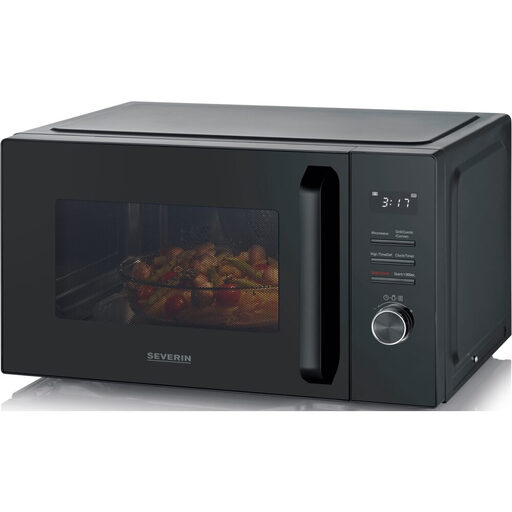 No image available
An option for households considering other cooking functions as well as reheating. Before buying, check which functions and settings will be useful in your daily routine.
The product name specifies a power rating of 1000 W.
 No image available
The solo design suits a household that mainly wants to reheat individual portions and doesn’t need extra cooking functions.
The product name specifies 19 l and 700 W.
 No image available
This solo model is designed for individual portions, without the need for extra cooking functions.
The product name specifies 20 l, 700 W and six power levels.
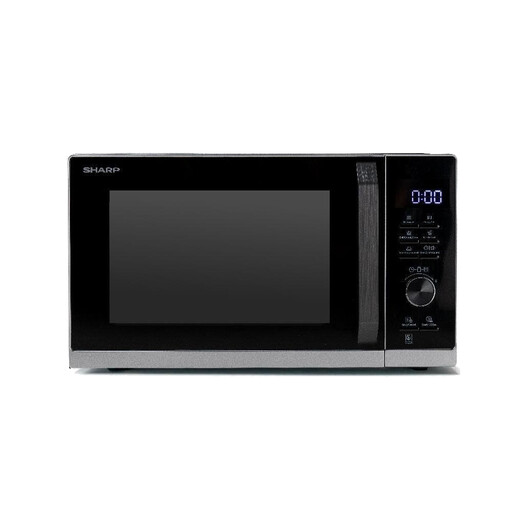 No image available
A combination microwave is worth considering if you’ll use other cooking functions as well as reheating; check that the cavity will fit your containers.
The product name specifies 27 l, along with 900 W, 1000 W for the grill and 2100 W for the hot-air function.
If you’re eating at different times, the German Federal Institute for Risk Assessment recommends cooling prepared and heated food, then keeping it in the fridge until just before reheating it to eat. Some bacterial toxins that have already formed can be heat-stable, so reheating won’t reliably undo the effects of unsuitable storage.
The BfR recommends heating food to at least 70 °C for two minutes throughout. Stir the pasta part-way through heating. If in doubt, you can check the temperature with a suitable food thermometer. This doesn’t give you a fixed heating time for every portion.
No. For plastic containers, follow the manufacturer’s guidance on microwave suitability, temperature and the maximum permitted wattage. Glass and ceramic containers must also be suitable for the intended use and undamaged.
The German Environment Agency states that microwave ovens do not have an energy label showing their energy consumption. Compare the available information on energy use and standby, as well as the functions you actually need; microwave output power is not a measure of energy consumption.