Anyone reheating individual portions
If people in your household eat at different times, you’ll want to reheat prepared pudding one portion at a time and keep things simple. The BfR offers guidance on stirring and storing hot food.


For individual portions, a straightforward solo microwave with selectable power levels is a good place to start. Germany’s Federal Institute for Risk Assessment (BfR) recommends heating food evenly in the microwave and stirring it from time to time; wattage or an automatic programme alone cannot guarantee the result. If you’re reheating egg-based vanilla custard, finer power control may be useful, but it’s no substitute for stirring or storing the food safely between meals.
If people in your household eat at different times, you’ll want to reheat prepared pudding one portion at a time and keep things simple. The BfR offers guidance on stirring and storing hot food.
When reheating egg-based vanilla custard, you’ll want to control the heat carefully and stir as it warms. A Good Food recipe recommends gentle heating and stirring to prevent lumps.
For individual bowls, compare the external dimensions, cavity size and controls rather than focusing mainly on extra programmes. The manufacturers’ specifications for individual models can help you decide.
First, check that you can easily adjust the power and cooking time, and pause the microwave to stir. Then consider whether your bowls will fit and whether you’ll use the features for other dishes too.
| What matters | What to look for when buying | Who is it important to? |
|---|---|---|
| Consistent results with small portions | Selectable power levels and a cooking time that’s easy to adjust and pause. | When I’m reheating small portions, I want to control the heat gradually and pause easily to stir. Around 36% of consumers prioritise an even consistency. |
| Serving food safely at different mealtimes | Plan how to chill the food separately from the appliance; choose controls that let you stir and check the temperature. | If the next portion won’t be eaten until later, safe storage matters as much to me as reheating. Around 29% of consumers prioritise safely serving food at different times. |
| Fit and ease of use | Compare the external dimensions and usable cavity space with the room you have and the size of your bowls. | If I mainly reheat a single bowl, I want an appliance that fits in my kitchen and is easy to set. Around 21% of consumers prioritise space and straightforward controls. |
| Versatility and cleaning | Check that any extra programmes and the stated interior-care requirements suit the food you actually prepare. | If I want to use the microwave for other dishes too, useful extra features and practical cleaning matter to me. Around 14% of consumers prioritise versatility and maintenance. |
A programme name doesn’t tell you whether the food will stay hot enough throughout. The BfR says hot-held food should be at least 60 °C throughout; for longer storage, hot food should be cooled to below 7 °C within a few hours.
Chill prepared portions according to how long they’ll need to be stored, and only reheat the next portion when you’re ready to serve it. Don’t rely on the keep-warm function alone.
Dr Oetker’s recipe for starch-based pudding calls for repeated stirring while it heats. This is a preparation instruction, not general guidance for reheating chilled leftovers or egg-based custard.
Look for selectable power levels and an easy way to pause the microwave for stirring. Don’t apply a recipe’s cooking times to different portions or recipes without checking first.
LG describes the additional materials warranty as covering the Smart Inverter magnetron, not the entire appliance. This is separate from your statutory rights against the seller.
For any specific offer, check which parts are covered, how long the cover lasts and what exclusions apply to the voluntary warranty.
Bosch’s FFL020MW0 is a freestanding solo microwave with a 20 l capacity and rotary controls.
According to LG Germany, the MS2595CIS solo microwave has a 25 l capacity, Smart Inverter technology and EasyClean.
The M 20 Ceramic Gourmet is a solo microwave with a 20 l capacity and a flat base without a turntable.
Samsung Germany’s MS23K3513AW/EN solo microwave has a 23 l capacity, automatic programmes and a ceramic enamel interior.
The NN-SD37 is a solo microwave with an inverter and seven stated power levels.
This selection features freestanding microwaves for reheating individual portions, with a range of power levels and control types.
 No image available
The stated inverter technology and six power levels give you several settings for different stages of reheating.
19 l capacity, 700 W, six power levels, defrost function and turntable.
 No image available
Six power levels and a 30-minute timer let you set the power and cooking time manually.
20 l capacity, 700 W, defrost function, interior light and turntable.
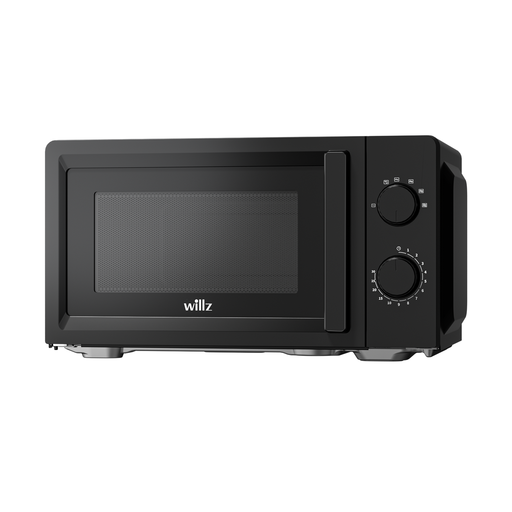 No image available
The product name highlights its compact design and straightforward operation.
20 l; listed with a 230 V plug in the product name.
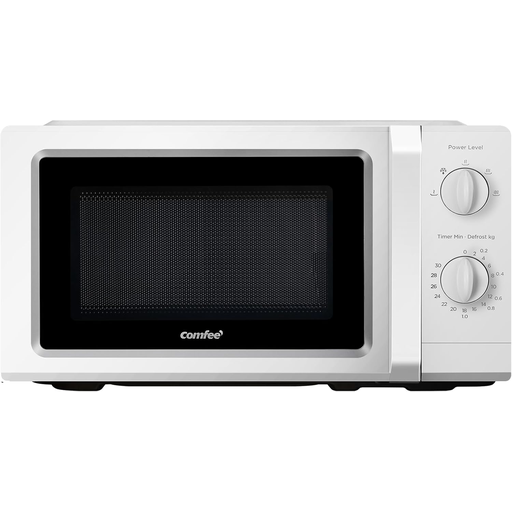 No image available
Five power levels give you a choice of settings for reheating individual portions.
19 l capacity, 700 W, defrost function, 30-minute timer and 245 mm turntable.
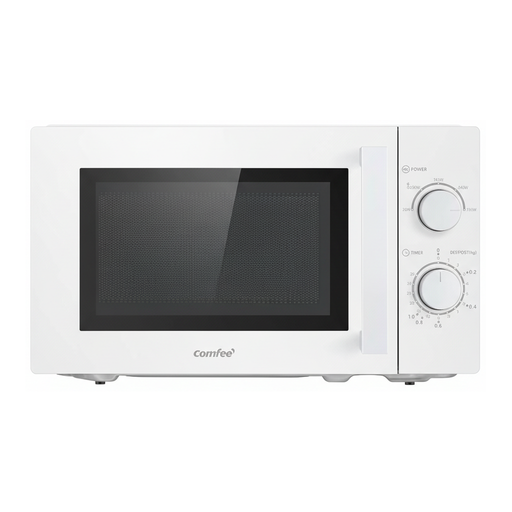 No image available
The product name specifies mechanical controls and five power levels for manual adjustment.
20 l capacity, 700 W, defrost function and interior light.
No. A switched-off appliance won’t keep food warm at a controlled temperature. The BfR recommends keeping hot food at a minimum of 60 °C throughout; for longer storage, hot food should be cooled to below 7 °C within a few hours. Chill prepared portions accordingly and only reheat the next portion when you’re ready to serve it.
No. The programme name alone can’t guarantee that. The BfR recommends heating food evenly and stirring it from time to time. Official kitchen hygiene guidance recommends heating food to at least 70 °C throughout for two minutes; wattage and programmes are no substitute for checking the temperature.
Not without making adjustments. The approximately 600 W setting and repeated stirring in Dr Oetker’s pudding recipe apply to making starch-based pudding from powder and milk, not to reheating food in general. A recipe for egg-based custard recommends gentle heating and stirring; if you’re unsure whether it has been stored safely, food safety comes before the consistency you’re aiming for.
Check the suitability, temperature and wattage information for each container. The consumer advice centre recommends staying within the stated temperature range and observing the maximum wattage for your tableware. If a plastic container doesn’t specify a maximum wattage, don’t simply use the microwave’s highest power setting.
If the door is visibly damaged or worn, Germany’s Federal Office for Radiation Protection recommends having it checked by the service department and, if necessary, repaired or replaced. In Germany, statutory rights against the seller are separate from a voluntary warranty; the relevant warranty terms set out what that cover includes.