If you reheat individual portions of carrots
If you mainly want to reheat chilled, already-cooked portions while your kitchen is being renovated, easy-to-adjust microwave power and a simple timer matter more than extra oven functions.


If you mainly want to reheat individual portions of cooked carrots and other leftovers while your kitchen is being renovated, a freestanding solo microwave with adjustable power and enough room for your dish will usually do the job. Check the external dimensions, required clearances and whether your dish will fit. A grill or convection function is only relevant if you also want to cook other dishes in it. To store leftovers safely and heat them thoroughly, it’s also important to follow the food hygiene advice from the German Federal Institute for Risk Assessment.
If you mainly want to reheat chilled, already-cooked portions while your kitchen is being renovated, easy-to-adjust microwave power and a simple timer matter more than extra oven functions.
If you need to fit the microwave among other temporary kitchen appliances, allow for the door to open and check the ventilation guidance for the specific model, as well as its external dimensions.
If your bowls are large or square, their dimensions and the usable space inside the microwave matter more than the capacity in litres alone. If it has a turntable, your dish will also need enough room to rotate.
A good fit if: You mainly reheat individual portions and your dish fits on the turntable.
The trade-off: The turntable and cooking cavity limit the size and shape of dishes that will fit, so compare the usable dimensions rather than just the capacity in litres.
A good fit if: You often use large or square dishes that aren’t practical on a turntable.
The trade-off: Even without a turntable, you’ll need to check the dimensions of your dish and the cooking cavity. A flatbed doesn’t guarantee even heating.
A good fit if: You need to fit large dishes, or need a grill or oven function for other cooking tasks during the renovation.
The trade-off: Extra capacity or heating functions aren’t needed just to reheat carrots, and may take up more worktop space.
| Buying priority | What to check | Who it matters most to |
|---|---|---|
| Reheat portions with control | Power levels and timer settings; enough room to stir and check the food. | If I reheat portions of different sizes, I want to be able to adjust the time and power gradually. Around 40% of consumers in this buying situation are likely to prioritise this. |
| Fit the microwave into a kitchen renovation | External dimensions, door opening and the model-specific ventilation clearances. | If worktop space is temporary and limited, there needs to be room for the appliance, its open door and the required ventilation. Around 30% of consumers here are likely to prioritise a suitable installation. |
| Use your existing dishes | Compare dish dimensions with the cavity opening and usable space; allow for the turntable. | If I want to keep using larger or square bowls, it’s essential that they fit. Around 20% of consumers are likely to put this first. |
| Use other cooking functions | Only allow for grill or convection functions you’ll actually use, and the extra space they require. | If you also need to bake or grill during the renovation, extra heating functions can be useful. Around 10% of consumers are likely to prioritise these tasks over reheating alone. |
You don’t need a grill or convection function just to reheat cooked carrots. Whatever appliance you use, the German Federal Institute for Risk Assessment recommends heating food to at least 70 °C throughout for two minutes.
The capacity of the cooking cavity alone won’t tell you whether a dish will fit through the opening or rotate freely on a turntable.
Measure your microwave-safe dish and compare its dimensions with the opening, cooking cavity and, if applicable, turntable of the specific model.
If none of your dishes fit, you may need to find another microwave-safe one.
A manufacturer’s claims about convenience or heat distribution don’t prove that every portion of cooked carrots will be hot enough throughout.
Heat the portion carefully, stir it and check any cooler spots. The German Federal Institute for Risk Assessment recommends heating food to at least 70 °C throughout for two minutes.
The required ventilation clearances depend on the specific model and how it is installed. The Bosch instructions for the model ranges covered explicitly state that these clearances must be observed.
Before choosing a spot during your kitchen renovation, check the external dimensions and installation guidance for the exact appliance you’re considering.
The required clearances may reduce the space you actually have available.
The FFL023MS2 freestanding solo microwave is one example of a model for reheating individual portions when space is limited.
The M 20 Cube Ceramic is a solo microwave without a turntable, making it a design worth considering if you use square dishes.
The MW 7761 is a solo microwave without a turntable, with two dials to set the power and time.
The NN-ST64QWEPG solo microwave is a useful comparison for households looking to fit larger dishes.
This range of Joybuy microwaves includes solo and combination models for reheating leftovers. Extra grill or convection functions are available for other cooking tasks. For the specific mains-powered household appliance you’re considering, check the relevant EU information and, where required, the CE marking. According to Your Europe, the European Union’s information service, CE is a manufacturer’s declaration, not an independent quality mark.
 No image available
An option if you want to use grill or convection functions as well as reheat food, and need to fit square dishes without a turntable.
Glass base without turntable; microwave, grill and convection; ten power levels.
 No image available
A solo option for reheating individual portions, if your dish fits on the turntable and you want to adjust the power.
19 l; 700 W; six power levels; inverter technology; 24.5 cm turntable.
 No image available
A compact solo option if you want to choose the power level and time when reheating, and your dish fits on the turntable.
20 l; 700 W; six power levels; 30-minute timer; defrost function; 24.5 cm turntable.
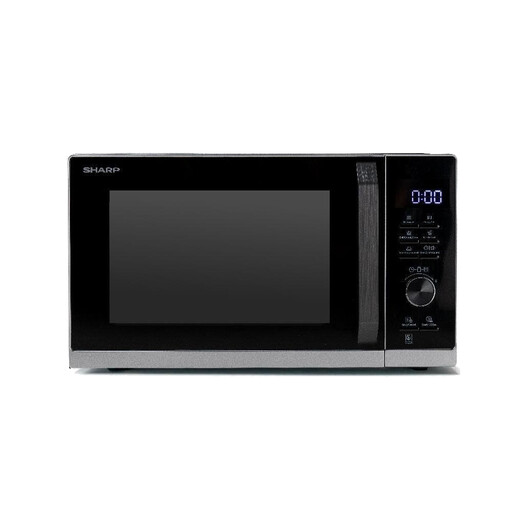 No image available
A combination option if you need grill or convection functions as well as microwave cooking during the renovation.
27 l; 900 W microwave; 1,000 W grill; 2,100 W convection; six microwave power levels.
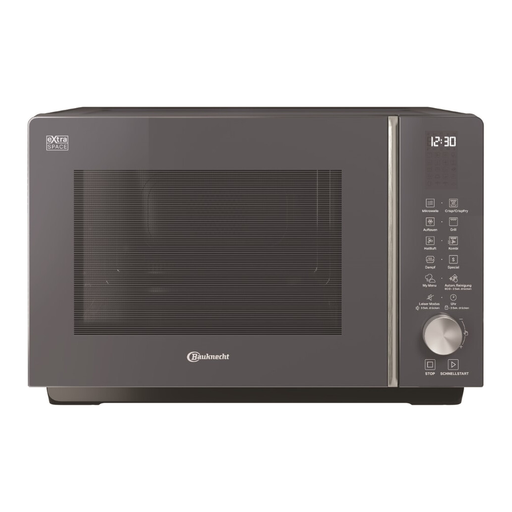 No image available
A combination option if you want to fit larger or square dishes without a turntable and use other cooking functions during the renovation.
25 l; flat cooking cavity without turntable; six microwave power levels; grill, convection and steam functions.
No. The microwave function is enough if you just want to reheat them. A grill is only worth considering if you also want to brown or grill other dishes.
Check the external dimensions, door opening and clearance requirements in the installation instructions for your specific appliance. Bosch specifically highlights ventilation clearances for the FFL023M model ranges covered; these requirements don’t automatically apply to other models.
For hot food that needs to be stored for longer, the German Federal Institute for Risk Assessment recommends cooling it quickly to below 7 °C; perishable food should be kept chilled. When reheating, the BfR recommends heating food to at least 70 °C throughout for two minutes. Stir the portion and check any cooler spots.
Only if the container’s label and instructions say it’s suitable for microwave use. Follow the stated temperature and wattage limits, and don’t continue using damaged containers. If cookware marked as microwave-safe doesn’t state a wattage limit, the consumer advice centre recommends avoiding the highest power setting.
For a fault with the product, the retailer is generally responsible for the statutory warranty, not the manufacturer. The consumer advice centre says this lasts two years. For sales contracts from 31 July 2026, it says choosing a repair extends the warranty period once by 12 months. A voluntary guarantee is subject to its own terms.
For electrical appliances covered by the relevant rules, CE is the manufacturer’s declaration that the product meets the applicable EU requirements; it isn’t an independent quality mark. The requirements that apply, and whether the marking is mandatory, depend on the product.