
Lieferung heute & morgen

Qualitätsgarantie

Willkommens-Angebote freischalten: KOSTENLOSE Lieferung | Bis zu 80 % RABATT | Kostenlose 30-Tage-JoyPlus-Testphase
App herunterladen
A microwave shelf can create extra worktop space and keep kitchen appliances, crockery and utensils neatly organised. However, models vary considerably in their dimensions, load capacity and features. If you focus only on the price or an appealing product photo, you may find at home that the microwave does not fit, doors are obstructed or the shelf wobbles under the weight of the appliance.
This guide explains what to check before buying a microwave stand, a kitchen worktop shelf or a larger kitchen shelving unit.
When choosing a kitchen shelf for a microwave, people often consider only the shelf’s width, depth and height. However, the following points are also crucial:
An expandable microwave shelf can offer greater flexibility in terms of width. However, its maximum extension must fit the available kitchen worktop.
Load-capacity specifications are only meaningful when it is clear which tier they apply to. A microwave distributes its weight differently from several small storage jars. You should therefore check whether the intended appliance shelf is suitably sturdy and whether the construction has been reinforced to prevent sideways wobbling.
For a tall, freestanding kitchen shelf, adjustable feet and an anti-tip device are also important. If the manufacturer specifies that the anti-tip device is required for safe use, fitting it should not be treated as optional.
A shelf with hooks, a kitchen-roll holder, wine rack or pull-out basket offers extra storage options. However, these elements also require room. Before buying, you should be clear about which utensils you actually intend to store. A multi-tier kitchen shelf only remains tidy when every shelf can be used sensibly.
Measure the microwave including its handle, feet and protruding controls. Then compare these measurements with the usable shelf area, not just the frame’s overall width.
Compact worktop models are suitable for small kitchens. A freestanding multi-tier shelf, on the other hand, provides more storage space but requires considerably more height. For example, the WOLTU model measures 80 × 40 × 168 cm, making it more suitable for vertical storage than for a small niche beneath a wall cupboard.
Powder-coated carbon steel, rust-resistant metal, stainless steel and coated engineered-wood panels have different properties:
Also look for information about edge finishing, frame reinforcement and care requirements. Several of the models mentioned are designed to be cleaned with a damp cloth and mild detergent.
The maximum load capacity should be suitable for the microwave and any additional weight you plan to store. The SRD Countertop Microwave Stand 3 Tier is stated to support up to 36 kg. This figure should not automatically be applied to every individual shelf or assembly configuration.
Before use:

Why this product suits this profile: The width can be adjusted from 39 to 62 cm. This is useful when your available worktop or microwave does not exactly match the dimensions of a fixed microwave stand.
The adjustable width reduces the risk of a rigid shelf being too wide or too narrow for the intended space. However, depth and the required ventilation clearances must still be checked before buying.
Two tiers, an expandable carbon-steel frame and five side hooks.
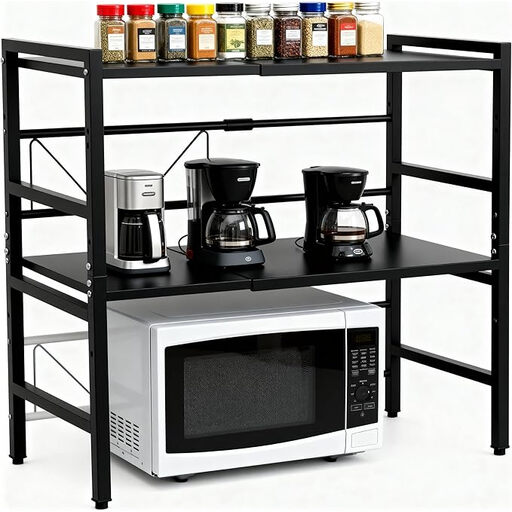
Why this product suits this profile: This model combines three tiers with an adjustable width of 40 to 60 cm. It allows you to organise a microwave, crockery and spices on a compact footprint.
The stated load capacity of up to 36 kg provides a specific benchmark to check against. The shelves and hooks are adjustable or removable, meaning less unused equipment gets in the way.
Three tiers, adjustable width and a rust-resistant stainless-steel construction according to the product description.

Why this product suits this profile: If you want to store other appliances, kitchen rolls, bottles and utensils alongside your microwave, this tall, freestanding kitchen shelf provides multiple tiers and additional organisational features.
X-shaped reinforcements, diagonal supports, adjustable feet and an anti-tip device address common stability issues. The shelf should be placed level and not overloaded.
Four tiers, ten S-hooks, pull-out basket, kitchen-roll holder and wine rack; dimensions: 80 × 40 × 168 cm.
We have put together a complete, regularly updated list of products that fully meet these strict selection criteria and the safety regulations applicable in the EU.
A microwave shelf should not be placed directly next to a heat source or in an area that regularly comes into contact with water. Before assembly, it is worth doing a quick trial placement. This will help you check that cables, the socket and the ventilation clearance remain accessible.
Only use hooks for lightweight kitchen utensils unless a higher load capacity is specified. Heavy supplies should be placed on a suitable shelf. Surfaces can generally be cleaned with a damp cloth; abrasive cleaning products can damage coatings and melamine surfaces.
This depends on the microwave manufacturer’s specifications. In addition to the appliance’s dimensions, the recommended clearances for air circulation must be maintained. The shelf should also provide a little extra room for the cable, handle and controls.
An expandable model can be stable if the frame, connections and shelves are suitably designed and correctly assembled. The maximum width should not be exceeded. Once extended, all specified fixings should be secure and the shelf should stand level.
It is not possible to give a reliable fixed lifespan. This depends on factors including the material, assembly, moisture, load and care. Keeping within the stated load capacity, avoiding leaving the shelf permanently wet and checking the connections regularly will reduce the risk of typical wear and tear.