Fans of chunky salsa
If you prefer to chop tomatoes, onions and herbs rather than purée them, look for easy-to-control operation and a bowl that lets you see the ingredients as you chop.


For a small batch of chunky salsa, a compact mini chopper is usually the better choice. If you also want to slice or grate vegetables, a food processor may be more suitable. Compare the usable working capacity and how easy the appliance is to clean, rather than looking only at the bowl size. No appliance replaces refrigeration: the German Federal Institute for Risk Assessment recommends keeping perishable foods chilled until they are eaten and using up cut raw ingredients promptly.
If you prefer to chop tomatoes, onions and herbs rather than purée them, look for easy-to-control operation and a bowl that lets you see the ingredients as you chop.
If you’re not eating the salsa straight away, hygienic decanting, refrigeration and using it promptly are essential. The appliance bowl isn’t a storage solution.
If you sometimes make a small batch and sometimes a larger one, compare the stated working capacity and accessories with the quantities in your usual recipes.
A compact mini chopper is usually the better fit if salsa is its main job. A food processor is worth considering if you’ll also use its extra slicing and grating functions.
A good fit if: You mainly chop ingredients for salsa and want a dedicated bowl rather than extra slicing and grating discs.
Things to consider: The stated bowl capacity isn’t necessarily the usable amount of salsa you can make; check the specified working capacity.
A good fit if: You regularly prepare larger quantities as well as salsa, or want to slice and grate vegetables too.
Things to consider: Extra attachments need storage space and must be cleaned after use.
| What matters | What to check when buying | Who it matters to |
|---|---|---|
| Chunkiness and control | Check the controls and whether there’s a pulse or momentary setting; neither guarantees a particular texture. | If you prefer chunky rather than finely puréed salsa, control while chopping matters. Around 29% of consumers put their preferred texture first. |
| Refrigeration and hygiene | Check that all food-contact parts can be cleaned thoroughly, and plan for a separate container and space in the fridge. | If you prepare salsa ahead of time, you’ll want to keep it chilled safely until the meal. Around 29% of consumers prioritise hygienic food preparation. |
| Portion and working capacity | Compare bowl size and stated working capacity separately, using the quantities in your usual recipes as a guide. | If your batches vary in size, don’t choose based solely on the largest capacity figure. Around 24% of consumers first look for a capacity that suits their needs. |
| Cleaning and accessories | Check the manual to see whether each individual part is dishwasher-safe, and consider whether you’ll use extra attachments regularly. | If you use the appliance often, the number of parts you need to clean and put away after each use matters. Around 18% of consumers prioritise keeping cleaning to a minimum. |
The Kenwood FDP23.140GR has a 1.3 l bowl, but its stated working capacity for liquids is 0.75 l.
Check the model-specific working capacity and the manual against your recipe quantity, rather than relying on the largest capacity figure.
You’ll need a suitable container and space in the fridge.
Slicing and grating discs give you more ways to use the appliance, but they also add more parts to clean and store.
Give extra functions more weight only if you’re actually planning to use them as well as making salsa.
The MZ 500 is a standalone multi-chopper for anyone mainly looking to chop and mix.
The MultiPro Go FDP23.140GR combines a chopping blade and pulse control with slicing and grating discs.
The MultiTalent 3 MCM3501M is aimed at anyone who wants to slice and grate as well as prepare salsa.
The MultiQuick-7 MQ7035X set is an option if you’d like to use a hand blender as well as a mini chopper.
The Joybuy products below are compact electric choppers for salsa ingredients, including options with several bowls and models with pulse control.
 No image available
For batches of different sizes: the product description lists three nesting bowls.
The stated capacities are 2.5 l, 2.2 l and 1.8 l, with two speeds and a pulse function. According to the description, pulse operation is designed for up to 30 seconds per cycle.
 No image available
For batches of different sizes: the set includes two glass bowls.
The bowls are listed as 2 l and 0.6 l; the product name also specifies 300 W. Two speed settings are described for different ingredients.
 No image available
For a batch in the stated 2 l glass bowl; two speed settings are described for different ingredients.
The product name specifies 300 W and four stainless steel blades. The description advises running it for no more than 40 seconds at a time, then pausing for two minutes, with a 15-minute cool-down after three cycles.
 No image available
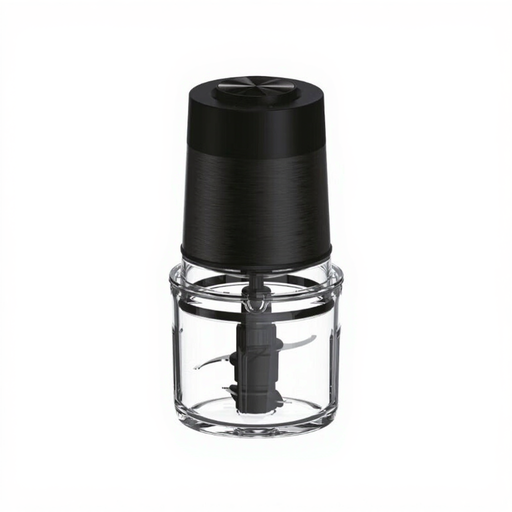
For smaller batches of salsa: the glass bowl holds 0.5 l.
It has four stainless steel blades, two speeds and a pulse function. The bowl and blades are described as dishwasher-safe.
No. The appliance bowl shouldn’t be used as a substitute for chilled storage. The German Federal Institute for Risk Assessment recommends keeping perishable foods chilled until they are eaten and using up cut raw ingredients promptly. This doesn’t establish a generally safe storage time for every salsa recipe.
No. It is only the same if the working capacity specified for that particular model confirms it. Kenwood lists a 1.3 l bowl for the FDP23.140GR, with a separate working capacity of 0.75 l for liquids. For other appliances, check the permitted quantity in the manual.
Clean the parts that come into contact with food in accordance with the manual for your model. The term ‘dishwasher-safe’ applies only to the parts specified by the manufacturer; for example, Kenwood lists the bowl, lid and blade for the FDP23.140GR.