
Lieferung heute & morgen

Qualitätsgarantie

Willkommens-Angebote freischalten: KOSTENLOSE Lieferung | Bis zu 80 % RABATT | Kostenlose 30-Tage-JoyPlus-Testphase
App herunterladen
A mini cordless chainsaw promises quick and easy help with garden work. Whether for pruning trees, limbing branches, or cutting up green waste, these lightweight, cordless tools are temptingly convenient. However, not every model lives up to its advertising. Many buyers quickly discover that their new tool is unsuitable for the intended tasks.
Before you make a decision, it's important to understand the most common pitfalls that often lead to disappointment and unnecessary expense:
An informed purchase, based on technical facts rather than marketing hype, protects you from these problems.
To make an informed choice, you should carefully examine three core technical parameters. These are the primary factors that determine the performance, durability, and versatility of your future mini chainsaw.
The motor is the heart of any cordless chainsaw. The recommendation here is clear: choose a model with a brushless motor. Unlike traditional brushed motors, where carbon brushes wear down through friction, brushless motors operate without physical contact.
The advantages are significant:
The freedom of a cordless saw depends directly on its power source. Pay attention to two values: voltage (in volts, V) and capacity (in amp-hours, Ah). Higher voltage generally provides more power, while higher capacity means longer runtime.
A key advantage is compatibility with existing battery platforms. If you already own tools from a specific brand, a cordless chainsaw for Makita batteries or other systems can be an economically smart choice, as you can reuse your existing batteries and chargers. Always check for battery compatibility before purchasing.
The bar length determines the maximum cutting diameter. For most garden tasks, like pruning branches, a cordless pruning saw with a bar length of 10 cm to 15 cm (4 to 6 inches) is ideal. These models are lightweight and easy to handle as a one-hand chainsaw. For thicker logs or firewood, lengths of 20 cm (8 inches) and up are better suited.
An often-overlooked but critical feature is chain lubrication. An automatic oiler is the most convenient and reliable solution. A system that continuously supplies oil to the bar and chain during operation reduces friction, prevents overheating, and significantly maximises the life of the cutting attachment. Models with a manual oiler require more user attention.
Based on these objective criteria, we have compiled a selection of tools suitable for different requirements and user profiles.
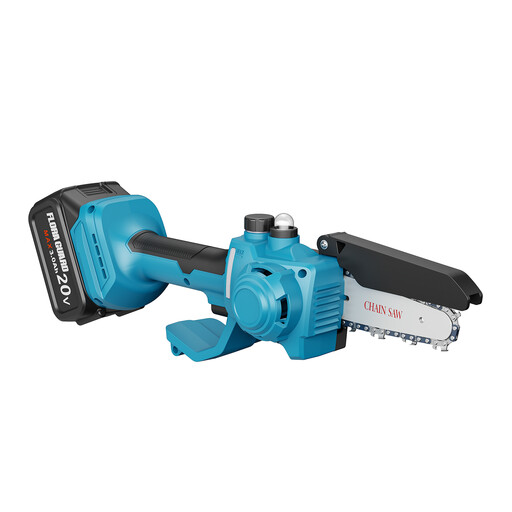
Why This Fits Their Persona: Ideal for homeowners who need a reliable tool for annual fruit tree pruning or cutting up green waste. The all-in-one package with two batteries and a charger lets you get started right away without any additional purchases.
This model is equipped with a brushless motor, which offers a longer lifespan and more power than basic brushed motors. The two included 3000mAh batteries provide realistic runtime, avoiding the frustration of short work sessions.
Compatibility with Makita 18V/20V batteries offers great flexibility for users already invested in that battery ecosystem. The manual lubrication system gives the user full control over chain maintenance.
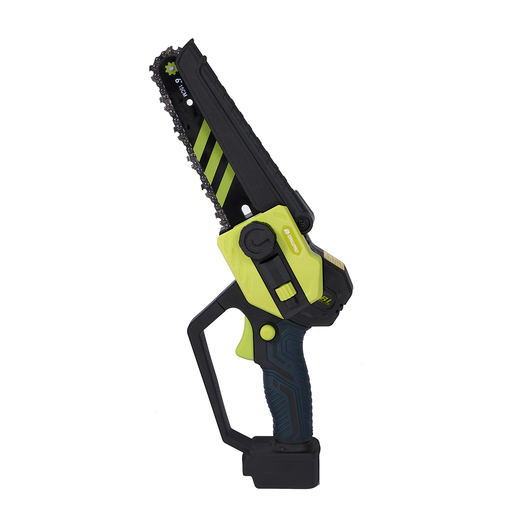
Why This Fits Their Persona: Perfect for garden owners with taller trees and shrubs. Its function as a cordless pole saw eliminates the need for precarious work on a ladder, significantly increasing safety and comfort.
This specialised tool solves a specific problem (reach) that standard mini saws can't handle. It prevents the mistake of buying an unsuitable tool for overhead work. The 400W brushless motor ensures enough power is delivered, even at the end of the pole.
The 2-in-1 functionality as both a handheld and pole saw offers maximum versatility. The telescopic pole extends up to 2 metres, allowing for safe tree maintenance from the ground.
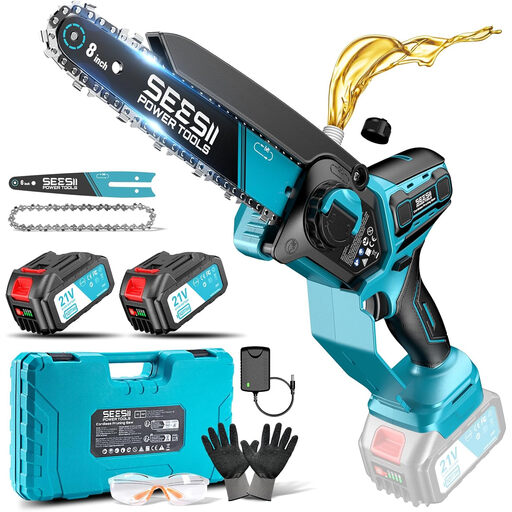
Why This Fits Their Persona: For users who regularly cut thicker branches, prepare firewood, or simply want more power reserves and flexibility. The combination of a powerful motor, large batteries, and two bar lengths covers a wide range of applications.
This model directly addresses the common weaknesses of power and runtime: the 1000W brushless motor provides high torque, while two 4000mAh batteries enable long work sessions. The automatic oiling and tool-free chain tensioning are convenience features that minimise wear.
The 2-in-1 functionality with interchangeable 6-inch and 8-inch bars offers outstanding flexibility. The high chain speed of up to 10 m/s ensures fast, clean cuts. Compatibility with Makita 18V batteries is also included.
We have compiled a complete, up-to-date list of products that fully meet these strict selection criteria and all relevant safety standards.
1. How do you properly tension the chain on a mini cordless chainsaw? The chain tension is correct when you can lift the chain about 2-3 mm away from the middle of the guide bar and it snaps back on its own. It should not sag. On models with tool-free tensioning, this is done using an adjustment dial. On other models, you loosen the side cover and adjust the tension with a screwdriver. Always perform this procedure with the battery removed.
2. What is the lifespan of a small chainsaw battery, and how do you maintain it? The lifespan of a lithium-ion battery is measured in charge cycles and typically lasts for several hundred cycles. To maximise its life, you should avoid fully depleting the battery and remove it from the tool after use. Store it in a cool, dry place with a charge level of around 40-60%. Avoid extreme temperatures (both heat and frost).
3. Is a mini cordless chainsaw suitable for felling small trees? Mini chainsaws are primarily designed for limbing, pruning, and cutting branches up to about 10-15 cm in diameter. For felling trees, even small ones, they are generally not suitable due to safety concerns (lack of bucking spikes, risk of kickback) and their limited power. For such tasks, you should use a larger, dedicated chainsaw.