Joybuy Insights

Mini Cordless Polisher Buying Guide: Avoid Costly Mistakes

For a flawless finish in car care, it's the details that make all the difference. While large surfaces are relatively easy to work on, complex components like door handles, spoilers, rims, or the A and B pillars present a unique challenge. A mini cordless polisher is the specialised tool of choice here. However, the market is flooded with offers that promise more than they deliver. Before you make a decision, it's crucial to understand the common pitfalls that can lead to frustration and unnecessary expense.

This guide will help you separate the best from the rest by highlighting the critical features and showing you how to find the right device for your paint care needs.

The 3 Most Common Traps When Buying a Cordless Polisher

Choosing the right device can be overwhelming. Many products entice with attractive prices but reveal critical flaws in practice. Pay special attention to these three points:

  1. The Battery Illusion: One of the biggest weaknesses of many budget models is their power management. Manufacturers often advertise long runtimes that are only achievable at idle without any downward pressure. Under a real-world load, performance drops off quickly, and long charging times severely interrupt your workflow. A device with only a single, non-removable battery is unsuitable for serious applications.
  2. The Single-Function Trap: Polishers work in either a rotary (RO) or dual-action (DA) mode. Rotary machines offer a high rate of material removal and are effective on deep scratches, but they carry the risk of creating holograms and paint burn. Dual-action machines are safer and ideal for achieving a high-gloss finish. A device that offers only one of these functions severely limits your paint correction capabilities.
  3. The Incomplete Kit Cost Trap: A low initial price is often only half the story. Basic packages frequently lack essential accessories like backing plates in various sizes, extension shafts for hard-to-reach areas, or a selection of polishing pads with different grades. These must then be purchased separately, often at high prices, driving up the total cost.

Critical Technical Features: What to Look For

To make an informed purchasing decision, you should focus on objective, technical parameters. These three aspects are decisive for the performance and versatility of a mini cordless polisher.

Drive Type: Rotary (RO) vs. Cordless Dual-Action (DA)

The heart of any polisher is its drive mechanism. The choice between rotary and dual-action depends on your intended application.

  • Rotary Drive (RO): The polishing plate rotates exclusively on its own axis. This generates high friction and heat, resulting in fast and aggressive cutting action. This mode is ideal for removing deep scratches and severe paint defects. However, it requires experience and a steady hand to avoid holograms or paint damage.
  • Dual-Action Drive (DA): The polishing plate not only rotates but also oscillates in an eccentric pattern. This movement simulates hand polishing, distributes pressure more evenly, and generates significantly less heat. A cordless dual-action polisher is therefore much safer to use and the preferred choice for finishing, applying waxes and sealants, and for beginners.

Some models offer a switchable dual-system that combines both operating modes, providing maximum flexibility for all stages of paint care.

Battery Performance and Management

Cordless freedom is the main advantage of a battery-powered polisher. To ensure this doesn't become a liability, a well-designed battery system is essential.

  • Voltage and Capacity: A 12-volt system with a capacity of 2.0 Ah per battery has established itself as a practical industry standard.
  • Swappable Batteries: A kit should include at least two swappable batteries. While one battery is in use, the other can be charging. This allows for an uninterrupted workflow, which is crucial for larger projects or professional use.
  • Realistic Runtime: Look for specifications on runtime under load. A figure of around 30 minutes per battery with normal downward pressure is a realistic benchmark.

Accessories and Ergonomics: The Professional Polishing Kit

The utility of a mini polisher lives or dies by its accessories. A good cordless polisher kit should cover a wide range of applications right out of the box.

  • Backing Plate Sizes: To truly reach every spot, multiple backing plate sizes are necessary. Common sizes are 25 mm, 50 mm, and 75 mm. Smaller plates are ideal for delicate areas like emblems, air intakes, or for polishing a motorcycle, while larger plates increase efficiency on small to medium-sized surfaces.
  • Orbital Throw: The throw (or stroke) describes the radius of the oscillating movement in DA mode. A small throw (e.g., 3 mm) is suitable for fine-finishing and sanding, while a larger throw (e.g., 12 mm) provides more efficient cutting action and a better finish on larger small areas.
  • Polishing Pads and Extensions: A professional polishing kit includes a selection of foam pads (coarse, medium, fine) and ideally also conical pads for recessed areas. One or more extension shafts are indispensable for working in extremely tight spaces like behind door handles or in grilles.

Pick for Detail-Oriented Users

Based on the criteria above, we have identified a product that stands out for its thoughtful design and comprehensive included accessories.
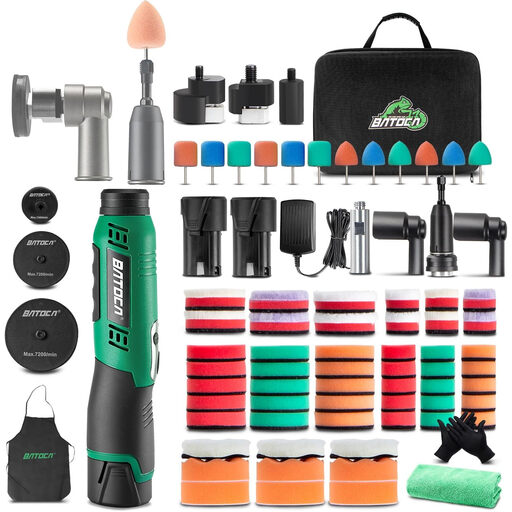
IDEAL FOR: THE DETAIL-ORIENTED USER
BATOCA S6 Mini Battery Polishing Machine, Professional Set for Detailing and Paint Care, 12 V Car Polishing, DA&RO Polishing Machine, Polisher Buffer for Motorcycles, 1000-5000 RPM & 4200-21000 RPM

BATOCA S6 Mini Cordless Polisher, Professional Kit

Why it's a great fit: Ideal for users seeking a versatile tool for complex tasks on cars and motorcycles. The ability to switch between aggressive cutting (RO) and fine finishing (DA) makes it a complete system for demanding auto detailing.

How It Avoids the Traps

The kit bypasses the battery trap with two included 12V batteries. With its switchable RO/DA system and a comprehensive accessory package, including various backing plates and polishing pads, it eliminates the need for expensive additional purchases.

Objective Advantages

Dual-System (RO/DA): Switchable between rotary and dual-action for maximum flexibility. Comprehensive Accessories: Includes backing plates (25mm, 50mm, 75mm), dual-action adapters, and various polishing foam pads.

Looking for More Options?

We have compiled a complete, up-to-date list of products that fully meet these rigorous selection criteria and safety standards.

Frequently Asked Questions (FAQ)

How long does a mini polisher's battery really last?

The actual runtime heavily depends on the downward pressure, selected speed, and the type of polishing pad used. While manufacturers often quote idle runtimes of up to 60 minutes, a more realistic value under working conditions is 25 to 35 minutes per 2.0 Ah battery. For this reason, a kit with at least two batteries is the most practical solution to ensure longer sessions without interruption.

Can I also remove scratches with a dual-action polisher?

Yes, a cordless dual-action polisher can remove light to medium scratches (e.g., car wash swirls). Success depends on the combination of orbital throw, pad hardness, and the abrasiveness of the polish. For deeper scratches that reach the primer, a rotary polisher or spot wet sanding is often the more effective method, which highlights the advantage of a dual-system tool.

What accessories are essential for polishing motorcycle parts?

When polishing a motorcycle, the surfaces are often even smaller and more intricate than on a car. Essential accessories here include a 25 mm diameter backing plate, one or more extension shafts to increase reach, and cone-shaped foam polishing pads. With these accessories, you can precisely work on tight areas like the gaps between wheel spokes, engine components, or triple clamps.