
Lieferung heute & morgen

Qualitätsgarantie

Willkommens-Angebote freischalten: KOSTENLOSE Lieferung | Bis zu 80 % RABATT | Kostenlose 30-Tage-JoyPlus-Testphase
App herunterladen
For a flawless finish on hard-to-reach areas like door handles, spoilers, or rims, a mini cordless polisher kit is an indispensable tool. However, the market is flooded with devices whose performance claims often don't match reality. Many users, whether professional detailers or ambitious enthusiasts, invest in a kit only to find it's unsuitable for precise paint correction.
As your Joybuy Product Recommendation Officer, I'll help you identify the common pitfalls and make an informed decision. We'll focus on the technical specs that truly matter, leaving the marketing hype behind.
Choosing the wrong tool not only leads to frustration but can also damage your vehicle's paint. Pay close attention to these three points to avoid a bad purchase:
To find the right paint care kit for your needs, you should examine three core technical features. These determine performance, flexibility, and the quality of the result.
The heart of any polisher is its drive system. Choosing the right one is crucial for its application in car detailing.
With a cordless polisher, the battery system is the limiting factor. Look for these values:
A detailing polisher is only as good as its accessories. The size of the backing plates determines which areas you can work on. A good kit should include at least 25 mm, 50 mm, and 75 mm plates. Smaller plates are essential for intricate work on emblems, trim pieces, or in tight air intakes. An included extension shaft also allows for polishing in extremely inaccessible spots, like behind door handles.
Based on these objective criteria, we have identified a few products from our range that represent a smart choice for specific user profiles.
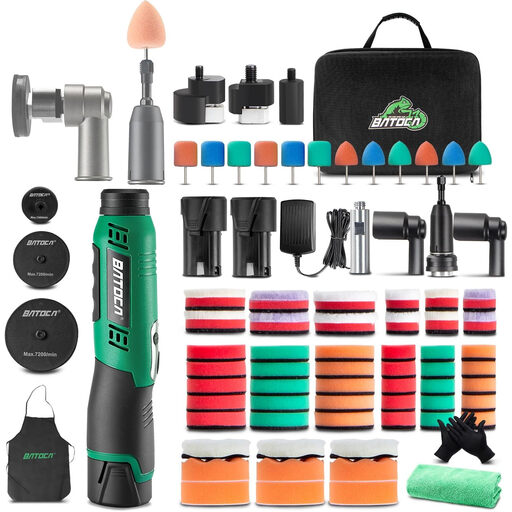
Why This Fits Their Persona: For professional detailers who require maximum flexibility. The switchable system allows for changing between aggressive cutting and fine finishing, while the various small backing plates and extensions enable precise work on any contour.
Solves the trap of lacking versatility with its switchable RO/DA system. Two 2.0Ah batteries prevent work interruptions, and the comprehensive accessory kit makes additional purchases unnecessary.
Switchable Dual System (Rotary & Dual-Action) for maximum control. Includes 25mm, 50mm, and 75mm backing plates, as well as dual-action drives with 3mm and 12mm orbits.
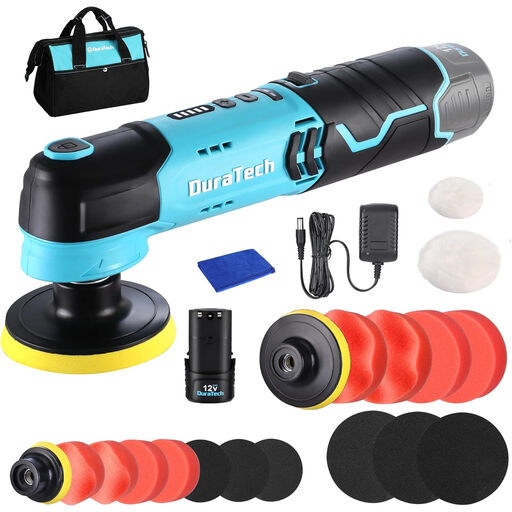
Why This Fits Their Persona: Ideal for DIY enthusiasts looking for a straightforward yet effective tool. The 5 speed settings offer enough control for most applications without overwhelming the user with too many options.
Avoids the hidden cost trap by coming as a complete kit with two backing plates (50mm, 80mm), various pads, sandpaper, and a storage bag. Everything you need to get started is included.
Complete Starter Kit with simple operation. The low weight of just 810g and the spindle lock for quick pad changes make it very comfortable to handle.
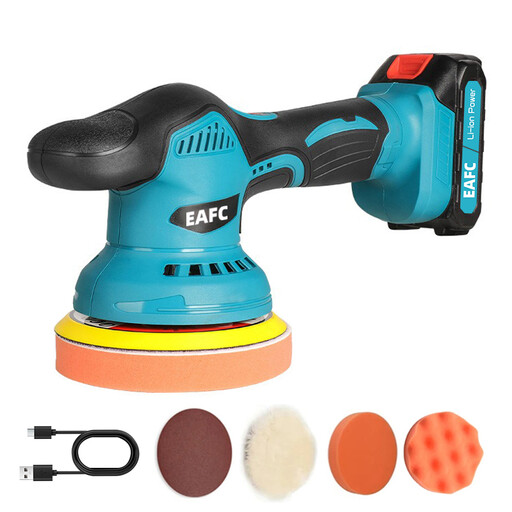
Why This Fits Their Persona: For users seeking a powerful all-rounder not just for cars, but also for furniture, boats, or woodworking. The large 125 mm plate is well-suited for larger surface areas, and the 8 speed settings provide adaptability for different materials.
With its 5mm random orbit, it offers safe application even for beginners on various surfaces, thus avoiding the risk of paint damage common with pure rotary machines.
Large 125 mm Backing Plate and 8 speed settings (2800-5500 RPM) for a wide range of polishing and sanding tasks on cars and around the home.
We have compiled a complete, up-to-date list of products that fully meet these strict selection criteria and safety regulations.
1. How long does the battery of a mini polisher last in practice? The actual runtime heavily depends on the selected speed and the amount of pressure applied. With most quality models featuring a 2.0 Ah battery, you can expect a continuous working time of about 25 to 40 minutes. For this reason, a kit with a second, swappable battery is highly recommended for uninterrupted work.
2. Can I remove deep scratches with a mini polisher? A mini cordless polisher is primarily designed for light to medium scratches (like car wash swirls) and for polishing in tight spots. For very deep scratches that go down to the primer, wet sanding and the use of a larger, often corded, rotary machine are typically required. However, the mini polisher is ideal for polishing the sanded area back to a high gloss afterwards.
3. What is the difference between a rotary and a dual-action polisher? In short: A rotary polisher only spins the polishing pad on a central axis, which leads to high material removal and significant heat generation—effective, but risky for beginners. A dual-action (DA) polisher adds an oscillating motion. This distributes heat more evenly, prevents holograms, and is much safer to handle, making it the ideal choice for most users and for finishing work.