Breakfast dishes, with hardly any worktop space
If you want to machine-wash a few bowls and cups you use every day without giving up a large part of your worktop, start by comparing the external dimensions and door clearance of the specific models.


If you mainly wash a few breakfast bowls and have very little worktop space, start by looking at a narrow mini countertop dishwasher. Measure the space it will occupy, its height and the clearance needed to open the door. A water tank can replace a fixed water supply, but you’ll still need a suitable way to drain the wastewater. A wider model offers more nominal place settings, but takes up more room. Whether your bowls fit in the rack and how much the Eco programme uses are more important when choosing than the place-setting count alone.
If you want to machine-wash a few bowls and cups you use every day without giving up a large part of your worktop, start by comparing the external dimensions and door clearance of the specific models.
A model with a tank could be a good alternative if you don’t have a suitable fixed water supply. You’ll still need to plan a safe route for draining the wastewater.
If you regularly have other dishes to wash as well as breakfast items, a model with more nominal place settings may be worth considering – as long as you have enough space and the water supply and drainage are suitable.
First, work out what will most limit your choice: the space available, the water supply and drainage, room for your bowls or the cost of running the appliance.
| What to consider | What to check before buying | Who it matters most to |
|---|---|---|
| Space | Check the external dimensions and height, and allow for the open door at the intended location. | If I have very little free space on my worktop, I want to know in advance how much room the appliance and its open door will take up. Space is the top priority for around 33% of consumers. |
| Water supply and drainage | Check whether the specific model uses a tank or a fixed water supply, and how the wastewater can be drained safely. | If there’s no suitable water supply, I want to be able to fill the appliance flexibly while still draining the wastewater safely. Water supply is the top priority for around 27% of consumers. |
| Whether your bowls fit | Compare the diameter and height of your bowls with the rack, supports and clearance for the spray arm. | I want to be able to load my own breakfast bowls alongside cups, rather than relying on the place-setting count alone. Actual bowl capacity is the deciding factor for around 27% of consumers. |
| Energy use and running costs | Compare electricity use per 100 Eco cycles and water use per Eco cycle, using the same programme basis. | If I use the appliance regularly, I want to compare like-for-like consumption figures and take my usual load into account. Running costs are the top priority for around 13% of consumers. |
The Verbraucherzentrale recommends comparing electricity use per 100 Eco cycles and water use per Eco cycle. The German Environment Agency advises against pre-rinsing dishes and recommends running the machine on the Eco programme with a full load wherever possible.
This figure describes the nominal capacity. Deep or wide bowls may sit differently in the rack from a standard place setting.
Measure your bowls and check the rack layout and spray-arm clearance for the specific model. If the load doesn’t fit well, you may need to wash some items by hand or run another cycle.
A tank can replace the fixed water supply. The used water still needs to be drained safely.
Before buying, check the appliance instructions and how the hoses can be routed at the intended location.
The stated consumption figures are for the Eco programme and can’t be applied across the board to quick programmes.
Compare figures on the same programme basis, and consider other programmes in light of how you’ll use the appliance.
The models listed offer a comparison between a narrower mini appliance and a wider countertop dishwasher.
The TSG 7405 is a countertop model for households with enough room for a wider appliance with six place settings.
The LIFE DWT30 (MD370022) is a mini appliance for smaller loads, with different water supply options.
This selection includes countertop and mini dishwashers with tank options for kitchens with limited worktop space. Before choosing, compare the external dimensions, water supply and drainage, and the space available for your own bowls.
 No image available
An option for tight spaces if you’re looking for a countertop dishwasher with a tank.
The product name lists an integrated 5-l tank, 9 wash programmes and dimensions of 37 × 50 cm. A separately available adapter may be required to connect it to a tap.
 No image available
For smaller loads, if a nominal capacity of three place settings suits your breakfast dishes.
The product name lists 7 programmes, a 5-l tank or water connection, 56.3 dB and energy class C. Check the external dimensions against your available space.
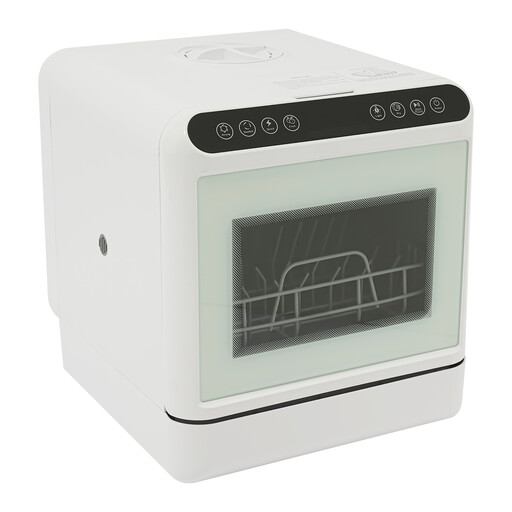 No image available
A tank option for anyone who needs to factor in the available space when planning for a countertop appliance.
The product name lists an integrated 1.32-gallon tank, hot-air drying and a 72-hour storage function. Check that the dimensions and features suit how you plan to use it.
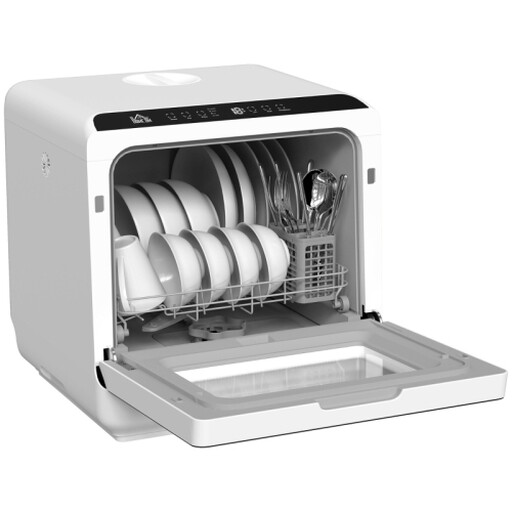 No image available
For a countertop space where the model’s external dimensions will fit.
The product name lists a 6-l tank, 5 programmes, an LED display and a drying function. Measure the intended location and check the drainage requirements.
 No image available
A countertop option for limited spaces if an integrated tank suits your water supply.
The product name lists a 5-l tank and 6+3 programmes. The safety notice states that an earthed 220–240-V socket is required; do not use an extension lead.
On models designed for it, a tank can replace a fixed water supply. You’ll still need a safe way to drain the wastewater, so check the instructions for the specific appliance and the intended location.
Compare the diameter and height of your bowls with the rack, supports and spray-arm clearance on the specific model. The nominal place-setting count alone won’t tell you how your bowls will fit.
The German Environment Agency advises against pre-rinsing dishes, especially with warm water, and recommends running the machine on the Eco programme with a full load wherever possible. Also follow the appliance’s loading and care instructions.
The Verbraucherzentrale recommends comparing electricity use per 100 Eco cycles and water use per Eco cycle. Cycle time and noise levels can also help you choose. Your annual costs will also depend on how you use the appliance and the energy and water rates that apply to you.
Under the conditions set out in § 17 of the German Electrical and Electronic Equipment Act (ElektroG), retailers with a legal obligation to do so must accept an old appliance of the same type, with essentially the same functions, free of charge when selling a new electrical or electronic appliance. Whether this applies to a particular sale and handover must be checked separately.